




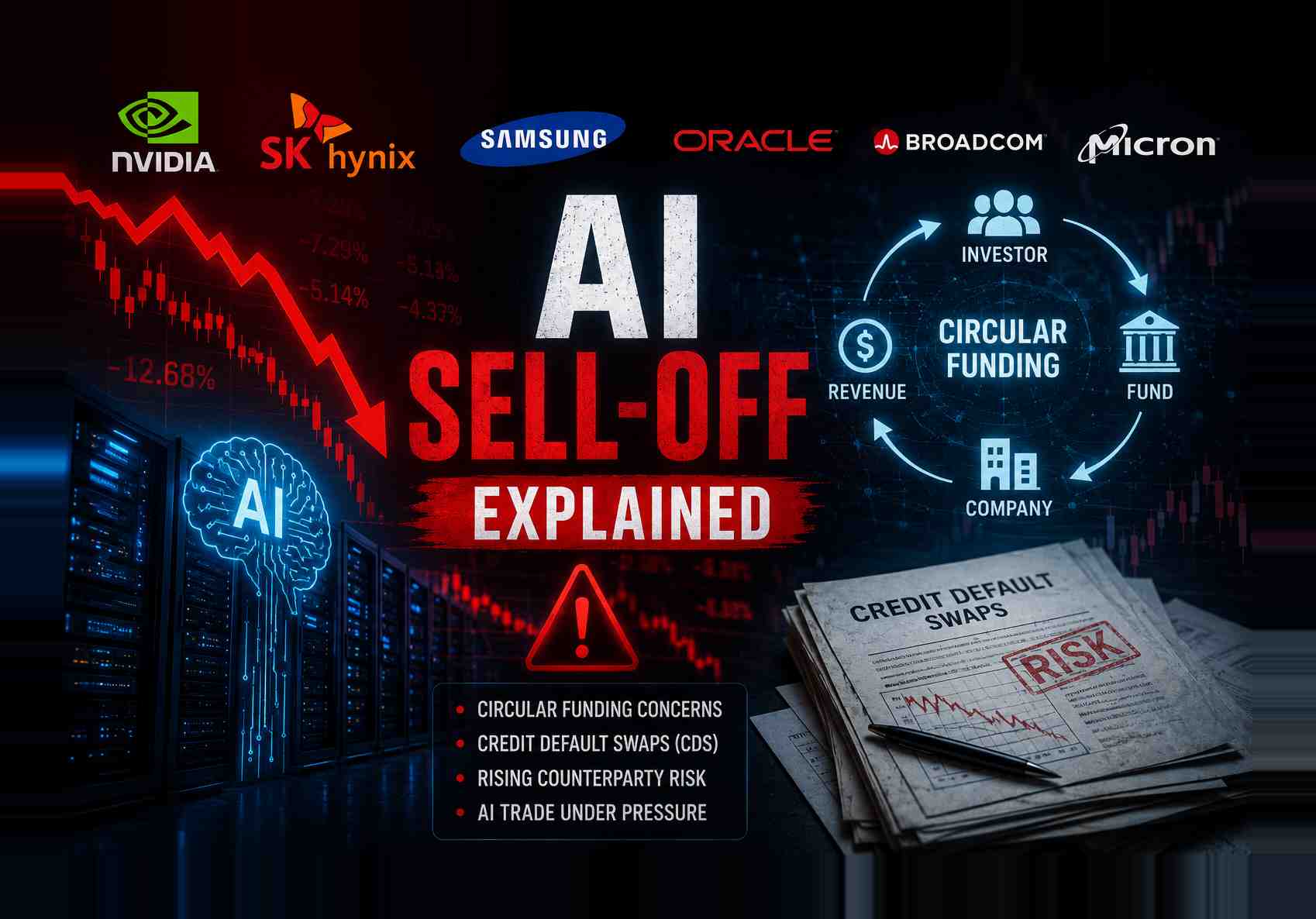
The AI investment theme has gone from market darling to market concern in just a few weeks. Semiconductor shares have led the decline as investors question whether the enormous spending on AI infrastructure can continue indefinitely.
South Korea’s KOSPI index, dominated by chip giants Samsung (LON:SMSN) and SK Hynix (NASDAQ:SKHY), has slumped nearly 40% in barely a month, while Nvidia (NASDAQ:NVDA), Micron (NASDAQ:MU), Advanced Micro Devices (NASDAQ:AMD) and many others have struggled for weeks.
The latest trigger has been growing concern over ‘circular funding’ alongside rising credit default swap (CDS) prices for several AI-linked companies. Neither necessarily signals a financial crisis, but together they suggest that debt markets are becoming less comfortable with the pace of AI investment.
What is circular funding?
The concern centres on the way money is increasingly flowing around the AI ecosystem.
A simplified example looks like this:
Nvidia sells GPUs → AI company raises debt/equity → builds data centres → buys more Nvidia chips → Nvidia invests in AI companies or infrastructure supporting those customers → further demand for Nvidia chips.
None of these transactions are inherently improper. However, investors worry that it becomes a variant of ‘robbing Peter to pay Paul’, where money moves but not to the greater good. So, if financing becomes more difficult, several parts of the ecosystem could weaken simultaneously, reducing AI spending much faster than markets currently expect.
Why are credit default swaps suddenly important?
A credit default swap (CDS) acts like insurance against a company’s debt default, important as large-cap tech issues increasing amounts of corporate bond debt.
Credit Default Swaps detailed explanation – CFA Institute
When CDS prices rise it usually means:
| Falling concern | Rising concern |
| Credit easily available | Credit becoming more expensive |
| Investors comfortable | Investors demanding more protection |
| Funding relatively cheap | Funding costs increasing |
Higher CDS spreads do not mean a company will default. Instead, they indicate investors believe credit risk has increased.
Recent reports show CDS spreads widening across several AI leaders including Oracle, Nvidia, Broadcom, Alphabet, Amazon and Meta.
Why chip stocks have been hit hardest
Chipmakers are effectively the ‘picks and shovels’ suppliers to the AI boom.
If investors begin questioning:
- hyperscaler capital expenditure
- AI project financing
- datacentre construction
- return on AI investment
then semiconductor companies are usually the first shares sold.
The recent correction has therefore been much larger for semiconductor shares than for the broader market.
10 key AI stocks UK investors should watch
| Company | Why it matters |
| Nvidia | Centre of AI GPU ecosystem |
| Broadcom | AI networking chips |
| AMD | Nvidia’s largest GPU competitor |
| Micron | High-bandwidth memory (HBM) supplier |
| SK Hynix | World’s leading HBM producer |
| Samsung Electronics | Memory and AI semiconductor exposure |
| TSMC | Manufactures most advanced AI chips |
| ASML | Essential EUV lithography equipment |
| Oracle | Massive AI data-centre expansion funded partly through debt |
| Microsoft | Largest AI infrastructure customer |
What analysts are saying
The bullish camp
Bernstein’s Stacy Rasgon
Rasgon argues recent weakness reflects sentiment rather than collapsing demand. AI chip demand remains extremely strong and supply constraints continue across advanced GPUs.
Many semiconductor analysts
Several believe hyperscalers remain committed to AI investment because falling behind competitors would be strategically more damaging than temporarily lower returns. Capital spending may moderate but is unlikely to collapse.
The cautious camp
Fitch Ratings
Fitch warns an extended AI market correction could become a wider credit event if highly leveraged AI investment produces weaker-than-expected returns.
Bank of America fund manager survey
Nearly half of surveyed fund managers reportedly view excessive AI spending as the biggest potential trigger for a broader credit event.
Market strategists
Several analysts argue investors are increasingly asking not whether AI demand exists—but whether current valuations already assume years of perfect execution.
Data points that matter most
UK investors should monitor:
| Indicator | Why it matters |
| Hyperscaler capex guidance | Is AI spending accelerating or slowing? |
| Nvidia data-centre revenue | Demand health |
| HBM memory pricing | Measures AI infrastructure demand |
| CDS spreads | Funding stress indicator |
| Corporate bond issuance | Ease of raising capital |
| Datacentre financing announcements | Pipeline health |
| Free cash flow | Can companies self-fund AI? |
| AI utilisation rates | Are customers generating returns? |
How different investors could respond
Long-term growth investors
- Focus on structural AI winners.
- Accept higher volatility.
- Consider adding gradually during large corrections.
- Prioritise companies with dominant technology and strong balance sheets.
Balanced investors
- Diversify beyond semiconductors.
- Add software, cloud and AI applications.
- Maintain exposure but avoid excessive concentration in one stock.
More cautious investors
- Reduce exposure to highly leveraged AI beneficiaries.
- Prefer profitable, cash-generative technology companies.
- Hold some defensive sectors alongside AI investments until credit conditions improve.
Risks
- Higher interest rates increase financing costs.
- Slower hyperscaler spending.
- Faster Chinese competition.
- Weak returns from AI investment.
- Credit markets tightening further.
Opportunities
The long-term AI investment case has not disappeared.
Global cloud providers are still investing hundreds of billions in AI infrastructure, and demand for advanced GPUs, networking and memory remains historically strong. If current fears prove overdone, today’s correction could present attractive long-term entry points into high-quality semiconductor companies.
Bull case vs bear case
| 🐂 Bull Case: AI Investment Boom Continues | 🐻 Bear Case: Credit Stress Slows the AI Trade |
| Hyperscalers such as Microsoft, Amazon, Alphabet and Meta reaffirm record AI capital expenditure. | Major cloud providers begin trimming AI capital expenditure after questioning returns on investment. |
| AI demand continues to outstrip supply, supporting pricing for GPUs, high-bandwidth memory (HBM) and networking chips. | Widening credit default swap (CDS) spreads and higher borrowing costs make financing large AI infrastructure projects more expensive. |
| Nvidia, Broadcom, TSMC, Micron and SK Hynix continue reporting revenue growth well ahead of market expectations. | Concerns over ‘circular funding’ intensify, with investors fearing AI spending is increasingly dependent on continual access to debt and equity markets. |
| Falling chip prices encourage wider AI adoption across enterprises, creating a second wave of demand beyond hyperscalers. | AI spending becomes concentrated among a handful of large customers, exposing suppliers to customer concentration risk. |
| Corporate AI applications accelerate, driving a multi-year upgrade cycle in software and enterprise IT. | Valuations continue to compress as investors rotate from expensive growth stocks into more defensive sectors. |
| Strong cash generation allows leading technology companies to self-fund AI investment, reducing dependence on external financing. | A weaker global economy or recession prompts businesses to delay AI projects, reducing demand for data centres and advanced semiconductors. |
| Potential winners: Nvidia, Broadcom, TSMC, ASML, Micron, SK Hynix, AMD, Vertiv, Arista Networks. | Potential relative winners: Microsoft, Alphabet and Amazon (strong balance sheets), while more leveraged AI infrastructure companies could remain under pressure. |
Investor verdict
For UK retail investors, the AI investment theme has gone from market darling to market concern in just a few weeks but the recent sell-off is less about an immediate collapse in AI demand and more about how the AI boom is being financed. Equity investors are beginning to pay closer attention to signals from credit markets, particularly widening CDS spreads and rising borrowing costs.
History suggests that semiconductor shares can be exceptionally volatile during periods of changing sentiment. Investors with a long investment horizon may view sharp pullbacks as opportunities to build positions gradually. More risk-averse investors may prefer to wait for reassurance from upcoming earnings, capital expenditure plans and credit-market indicators before increasing exposure.
The best global AI stocks beyond expensive US mega-cap market
The next few weeks of results from major hyperscalers and AI infrastructure companies are therefore likely to determine whether this is simply a healthy correction—or the start of a more prolonged reassessment of AI valuations.
Bottom line: The debate has shifted from whether AI demand exists to whether the pace of investment can be sustained without increasing financial risk. The long-term AI opportunity remains compelling, but in the near-term investors should watch the credit markets as closely as quarterly earnings.
You might also like:
