




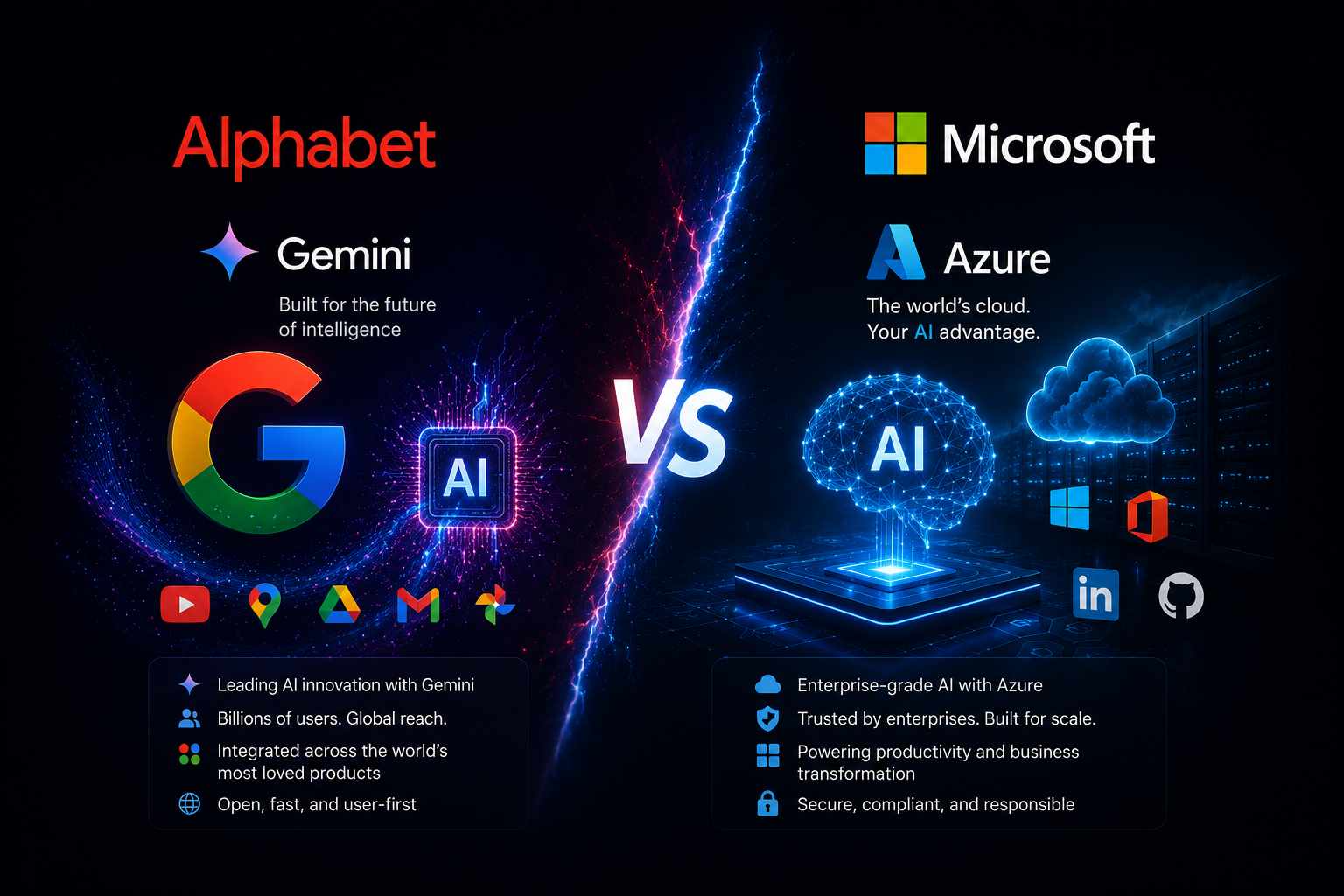
For UK retail investors sitting on sizeable gains, the obvious question is whether to bank Alphabet (NASDAQ:GOOG) profits and switch into Microsoft (NASDAQ:MSFT), which has underperformed despite remaining one of the world’s strongest AI franchises.
There is no simple answer. Alphabet arguably has the stronger earnings momentum today, while Microsoft may offer the better risk/reward profile if its AI investments begin translating into faster revenue growth during the second half of 2026.
| Alphabet (NASDAQ:GOOG) | Price: $371.10 | Market cap: $4.53tn |
| Microsoft (NASDAQ:MSFT) | Price: $393.83 | Market cap: $2.93tn |
Share price performance
| Metric | Alphabet | Microsoft |
| 2026 YTD share performance | +18% | -17% |
| Market sentiment | Strong | Cautious |
| Main concern | Can Search remain dominant? | Can AI spending generate sufficient returns? |
Gap has largely reflected:
- stronger-than-expected Google Cloud growth
- improving confidence around Gemini AI
- Microsoft suffering multiple valuation downgrades after several years of market leadership
- investor concerns that Microsoft’s AI spending is arriving ahead of meaningful monetisation.
AI opportunity
Alphabet
Google increasingly looks like an AI company rather than simply a search engine.
Major opportunities include:
- Gemini becoming the default assistant across Android
- AI Overviews increasing search engagement
- Google Cloud becoming one of the fastest-growing enterprise AI platforms
- Waymo robotaxis
- custom Tensor Processing Units reducing AI infrastructure costs
The biggest surprise has been that AI has strengthened, rather than weakened, Google’s search business so far.
Many analysts now believe Alphabet owns perhaps the broadest collection of AI assets outside Nvidia.
Risks
The obvious risk remains:
if users increasingly bypass Google Search altogether in favour of AI assistants.
While evidence has yet to show this happening at scale, investors continue watching carefully.
Microsoft
Microsoft’s opportunity is arguably easier to monetise.
Its AI products include:
- Microsoft 365 Copilot
- Azure AI
- GitHub Copilot
- Dynamics AI
- Windows AI
- enterprise AI agents
Unlike consumer AI companies, Microsoft already bills hundreds of millions of business users every month.
If Copilot adoption accelerates, AI revenues could compound for years.
Azure also remains one of the world’s largest AI infrastructure providers.
Many analysts still view Microsoft as the ‘enterprise AI winner.’
Capex comparison
One reason Microsoft’s shares have struggled is enormous AI spending.
| 2026 expected AI investment | Alphabet | Microsoft |
| Expected capital expenditure | $180bn-$190bn | ~$175bn-£185bn |
| Primary focus | Data centres, TPUs, Cloud | Azure AI infrastructure |
| Investment pace | Very aggressive | Very aggressive |
Alphabet shocked investors by lifting planned capital spending towards $180 billion, almost double 2025 levels.
Microsoft is also expected to spend significantly more than $100 billion, primarily expanding Azure AI capacity, although exact 2026 forecasts are less clear.
Analysts see both splurging even larger amounts of cash in 2027, with estimates pitched around $190 billion for Microsoft. There are no firm forecasts for Alphabet 2027 but CFO Anat Ashkenazi confirmed that 2027 spending will ‘significantly increase’ compared to 2026.
Cash flow comparison
Despite enormous spending, both companies remain exceptional cash generators.
| Metric | Alphabet | Microsoft |
| Operating cash flow | Extremely strong | Extremely strong |
| Balance sheet | Net cash | Net cash |
| Dividend | Small | Growing |
| Share buybacks | Significant | Significant |
Microsoft arguably has the more diversified recurring revenues.
Alphabet still generates extraordinary cash from Search advertising, although capex is consuming a much larger proportion of free cash flow than previously. Some analysts even expect periods of negative free cash flow as investment peaks before new AI capacity generates returns.
Relative valuation
Following this year’s performance divergence, valuation has narrowed considerably.
| Metric | Alphabet | Microsoft |
| Forward valuation (next 12m) | ~26 earnings multiple | ~20 earnings multiple |
| Growth outlook | High | High |
| Margin outlook | Some pressure from capex | Some pressure from AI investment |
Earlier in the AI cycle Microsoft traded at a substantial premium.
After falling around 17% this year, that premium has compressed considerably.
For value-conscious investors, Microsoft now arguably offers the more attractive entry point.
What analysts are saying
Alphabet
Most Wall Street analysts remain positive.
Bullish arguments include:
- AI is improving Search rather than replacing it
- Google Cloud continues to accelerate
- Gemini is closing the capability gap with rivals
- Waymo provides additional optionality
Concerns remain around the scale of capital expenditure and the long-term impact on margins.
Microsoft
Analysts remain constructive despite recent weakness.
Key positives include:
- Azure demand remains exceptionally strong
- enterprise AI adoption is still in the early innings
- Copilot revenue should accelerate
- Microsoft’s installed business customer base remains unmatched
However, many believe investors now want evidence that AI spending is translating into meaningful earnings growth, rather than simply larger infrastructure budgets.
Reasons to take profits in Alphabet
✅ Shares have significantly outperformed Microsoft this year.
✅ Valuation has become less compelling.
✅ AI optimism is now widely reflected in the share price.
✅ Rotating into Microsoft could capture any recovery if investor sentiment improves.
Reasons to stay invested in Alphabet
✅ Search continues proving remarkably resilient.
✅ Google Cloud is growing rapidly.
✅ Gemini is improving quickly.
✅ Waymo could become a major long-term value driver.
Selling a compounding business too early can be expensive.
Reasons to buy Microsoft now
✅ Share price weakness has reduced valuation.
✅ Enterprise AI adoption remains in its early stages.
✅ Azure remains one of the largest AI infrastructure businesses globally.
✅ Microsoft enjoys exceptionally sticky recurring revenues.
If AI spending begins producing stronger earnings growth over the next 12–24 months, today’s valuation could look attractive.
Investor verdict
This does not look like a case of swapping a winner for a loser and whether to bank Alphabet (NASDAQ:GOOG) profits and switch into Microsoft. Instead, it is a question of rebalancing between two exceptional AI franchises.
For investors with a large gain in Alphabet, taking partial profits and reallocating some capital into Microsoft could be a sensible portfolio management decision. It locks in gains while maintaining exposure to two of the strongest AI ecosystems in the market.
For those with a long investment horizon, a 50:50 allocation between Alphabet and Microsoft arguably offers a better balance than attempting to predict which company will emerge as the ultimate AI winner. Both were featured in Sharesify’s recent research of the best AI stocks for maximum returns over the next 5 years, which you can read below.
Best AI stocks for maximum returns over the next 5 years
Alphabet currently appears to have the stronger operating momentum, while Microsoft may offer the more attractive valuation after its 2026 underperformance. If Microsoft demonstrates that Copilot, Azure AI and enterprise agents can convert heavy capital spending into accelerating cash flow, its recent share price weakness could prove a compelling entry opportunity.
You might also like: