




Amazon (AMZN) ignited a sharp market backlash after the close Thursday after projecting $200 billion in capital expenditures for 2026. It’s a gobsmacking figure that dwarfs Wall Street’s consensus expectation of around $146 billion.
Investors reacted as expected given the recent push back against lavish AI investment, the stock plunging more than 11% in savage after‑hours trading. However, that S&P 500 and Nasdaq Composite futures are pointing to a relatively calm reaction when Wall Street reopens later today, offers comfort after both indexes fell sharply yesterday, -1.23% and -1.59% respectively.
Earnings strong but overshadowed
The company’s quarterly performance was solid. Revenue reached $213.4 billion, up strongly year-on-year, with its crucial Amazon Web Services cloud unit topline growth jumping 24% to $35.6 billion. AWS also posted record operating income.
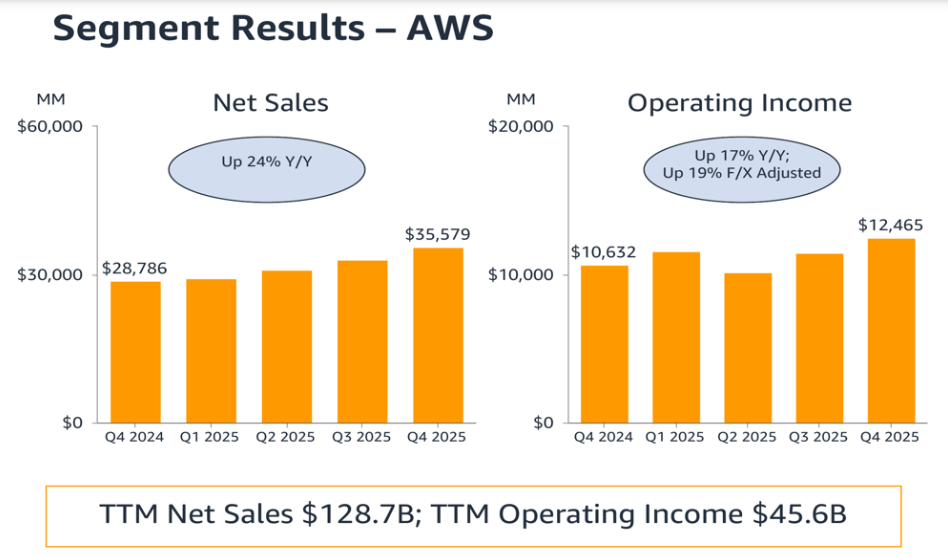
However, markets largely ignored these beats. The overriding concern was the massive acceleration in spending. Reportedly the largest corporate capex forecast in history, Amazon says this massive commitment is needed to keep pace with demand for AI compute, cloud infrastructure, robotics, chips, and satellite connectivity.
It’s hard to argue with the logic as Amazon’s Alexa and other AI tools lose ground to ChapGPT and Google Gemini. CEO Andy Jassy reiterated that the company expects ‘strong long-term return on invested capital’, but provided no precise timeline for when those returns could materialise, doing little ease investor’s chief concern.
Sector-wide spending explosion
Amazon’s announcement followed Alphabet’s (GOOG) own stunning disclosure the day before, when the Google-owner unveiled that it will more than double its 2025 spend to between $175 billion-$185 billion in 2026.
Collectively, tech hyperscalers are now embarking on what analysts describe as a multi‑year infrastructure arms race, with Alphabet, Amazon, Meta Platforms (META), Microsoft (MSFT), Oracle (ORCL), and Tesla (TSLA) together expected to deploy more than $740 billion in AI‑related capex, if we annualise Microsoft’s $37.5 billion quarterly estimate.
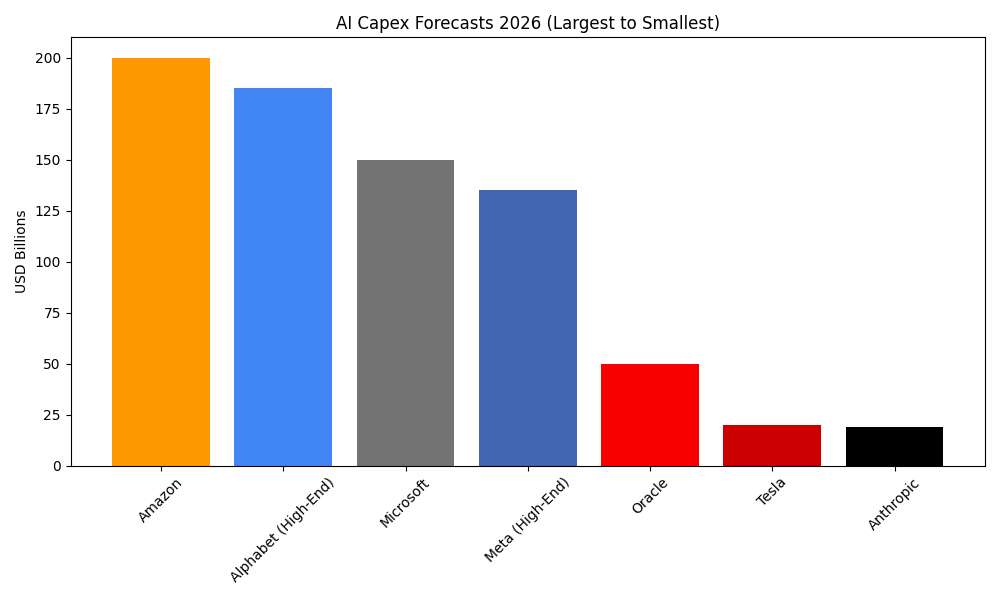
Privately-owned Anthropic will add another $19 billion to that jaw-dropping figure.
The strategic rationale is consistent across companies:
- Explosive customer demand for AI services.
- Severe constraints around data‑centre capacity, power availability, and GPU supply.
- A race to build proprietary compute stacks (custom chips, networking, and massive GPU clusters) to secure long‑term AI leadership.
Alphabet executives, for example, noted that compute capacity — not model quality — is the company’s greatest bottleneck heading into 2026.

The dominance of big tech firms cannot be taken for granted, and capex of this magnitude may be necessary to remain competitive in the face of new entrants. But companies must justify the spend with clearer return profiles, not just growth narratives.
The capex bomb has detonated, and markets are demanding proof that these historic investments will pay off. That evidence will take time, which explains the stark reaction to Amazon’s announcement, and recent share price moves across the big tech space.
In the meantime, this should probably be seen as a (healthy?) realignment of valuations with new growth and capex expectations.
You might Also like: