




Author: Ian Conway

Ian Conway
Ian Conway has worked in financial markets for over 30 years as a bond and equity trader, Extel-rated analyst and strategist, and partner of a stockbroking firm. He also founded a financial research company servicing institutional clients prior to writing for and editing Shares magazine. Ian is primarily an income investor although he also buys selected growth stocks. Find him at LinkedIn: Click Here
Shares in Lloyds (LON:LLOY) slipped despite the bank posting a strong increase in Q3 earnings. As with Barclays (LON:BARC) and HSBC (LON:HSBA), which also dropped on results, it seems investors had let expectations get ahead of themselves. Strong Q3 earnings For the three months to September, the UK’s biggest mortgage lender posted a pre-tax profit of £2.33 billion. That was almost double the £1.17 billion it reported in Q3 2025 and well ahead of the £2.28 billion consensus. However, the beat was mainly down to a sharp drop in ‘remediation’ charges to just £22 million against £875 million last year.…

In contrast to HSBC (LON:HSBA) earlier this week, Asia- and Africa-focused lender Standard Chartered (LON:STAN) beat Q3 forecasts and rasied its FY guidance. Shares in the bank gained almost 8% in Hong Kong, although the response in London was a more muted 3% gain. Q3 profit beats forecasts For the three months to September, Standard Chartered posted a 46% increase in net profit to $1.5 billion, comfortably above the $1.23 billion consensus. Growth was driven by higher interest and non-interest income, strong wealth management results and a solid performance in investment banking. Net interest income rose 9% to $3 billion…

On a day when large-cap stocks disappointed investors, sending the market lower, a handful of small- and mid-cap UK IT services firms stood out. Reports from NCC (LON:NCC), Redcentric (LON:RCN), RWS (LON:RWS) and Shearwater Group (LON:SWG) were a reminder of the UK’s prowess in specialist IT applications. Mid-cap firms thriving Maidenhead-based RWS, the largest of the four firms by market cap, provides language platforms and services and AI data services. More than 80 of the world’s top 100 brands trust it to generate and protect their IP in new and existing markets. For the year to September, the AIM-listed firm…
Asia-focused lender HSBC (LON:HSBA) extended its share buyback as its Q3 earnings missed market forecasts. On balance, investors took a negative view of the update sending the bank’s London-listed shares down nearly 7%. Q3 earnings miss estimates For the three months to September, HSBC reported a 4.5% or $0.8 billion increase in revenue to $18.6 billion. Within that, however, net interest income only increased 6% or $0.5 billion to $9.3 billion, missing market estimates. Operating costs were 12% or $1.3 billion lower at $8.8 billion, due mainly to fewer charges for Hong Kong commercial real estate. That meant profit before…
The independent provider of NHS-funded surgical procedures One Health Group (LON:OHGR) said H1 trading was ‘significantly ahead’ of last year. The AIM-listed firm provides outsourced procedures for patients referred from the NHS through the ‘Patient Choice’ scheme. H1 trading ‘significantly ahead’ Revenue for the six months to September rose 17% to £18.3 million, in line with management expectations. Underlying EBITDA, while not disclosed, is expected to be ahead of 1H26 and 2H26 due to ‘continued operational progress’. Activity in terms of consultations and surgical procedures was comfortably ahead of the same period last year. This reflected continued growth in patient…

Multi-asset trading platform Plus500 (LON:PLUS) raised its FY26 revenue and profit guidance after posting ‘excellent’ Q3 results. New customer numbers grew significantly, while customer acquisition costs fell, which is very impressive. Raising FY guidance For the three months to September, Plus500 increased revenue by 11% to $203.2 million, topping market estimates. EBITDA increased by 7% to $88.4 million, also topping estimates and raising the margin to 44%. Remarkably, the firm added 27% more new customers than a year earlier yet the acquisition cost fell 14%. The firm also said these new customers quickly converted into high-quality revenue drivers, contributing to…
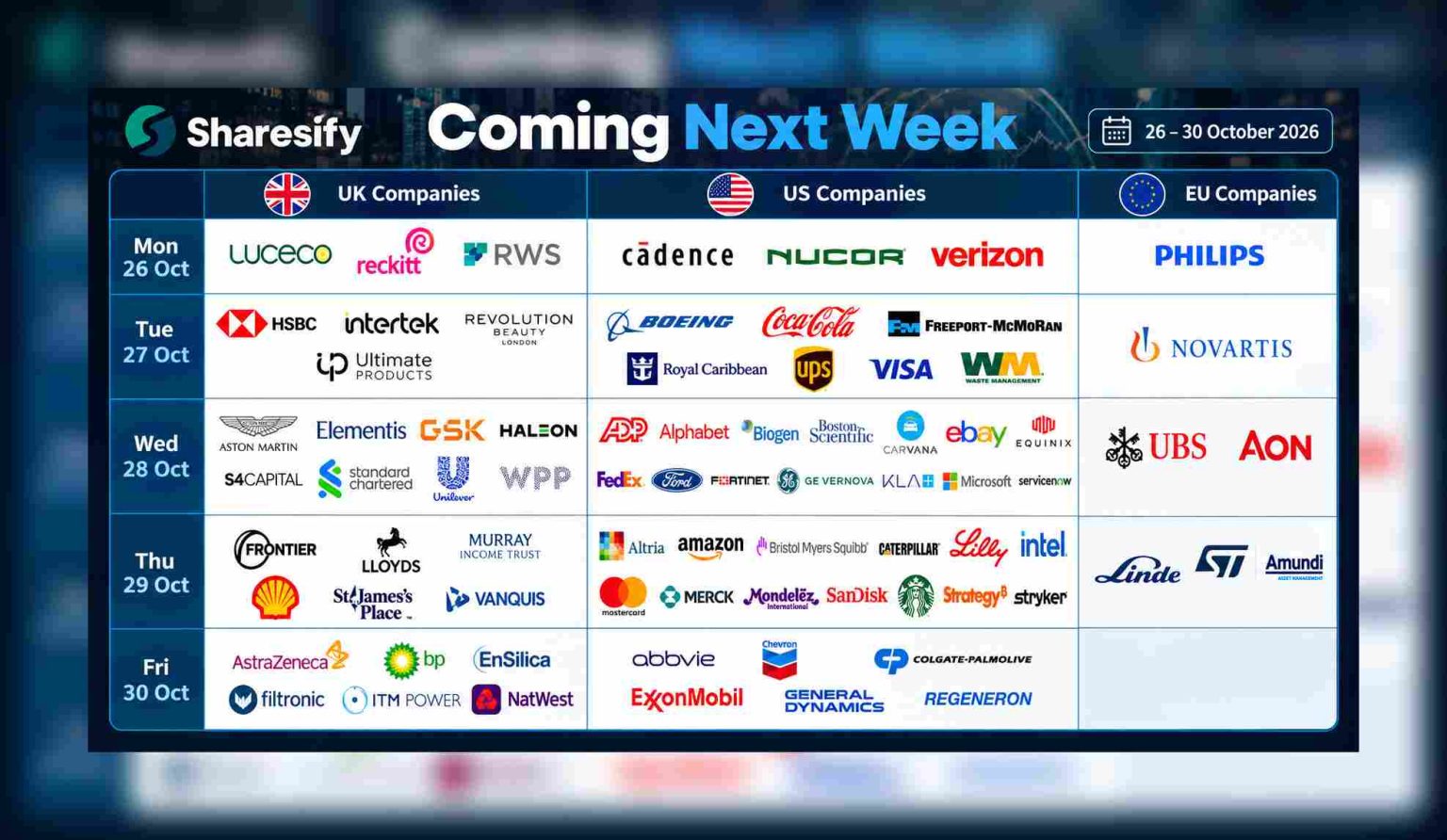
The week of 26–30 October 2026 is set to be one of the busiest earnings periods of the quarter, giving UK retail investors plenty to digest across banks, healthcare, energy, consumer stocks and technology. In the UK, HSBC, GSK, Unilever, Shell, Lloyds, AstraZeneca and NatWest are among the biggest reports, while Aston Martin and Haleon offer more focused reads on consumer demand and company-specific execution. The real global market focus, however, is likely to be in the US. Alphabet and Microsoft report on Wednesday, followed by Amazon, Eli Lilly, Intel, Mastercard and SanDisk on Thursday. Visa, Boeing, Caterpillar and others…

It’s tempting to give a one-word answer, but that would make this a very short article. In essence, valuation is the main attraction, but other factors also make the UK a rewarding hunting ground for activists. On the whole, UK companies are seen as well run, with good corporate governance, and are open to dialogue with major shareholders. UK the most popular with activists According to a study by investment bankers at Barclays (LON:BARC), the UK represents over half of the activist campaigns in Europe this year. Of the 28 campaigns aimed at companies with a market cap over $500…
A week ahead of the budget, high street lender Barclays (LON:BARC) published Q3 earnings which fell short of forecasts. With talk of the chancellor increasing taxes on windfall bank profits, the timing was fortuitous, even if the results weren’t. Profit falls short of expectations For the three months to September, Barclays posted a pre-tax profit of £2.32 billion. That represented an 11.5% increase on last year’s figure, but fell short of the company-compiled consensus of £2.42 billion. Part of the miss was due to revenue missing estimates, with a 3.6% rise to £7.37 billion coming in short of the £7.62…

As the last few weeks have shown, having too much of a good thing – like a portfolio full of US tech stocks – carries risks. Even global index products like ETFs are 72% weighted to the US and 30% to technology. For years, cheap capital has enabled businesses without any earnings, including tech firms, to raise billions of dollars. Investors believed the ‘story’ was more important than profits and growth was more important than return on invested capital. However, as interest rates have increased, companies which burn through cash are discovering capital comes at a price. Investors don’t have…