




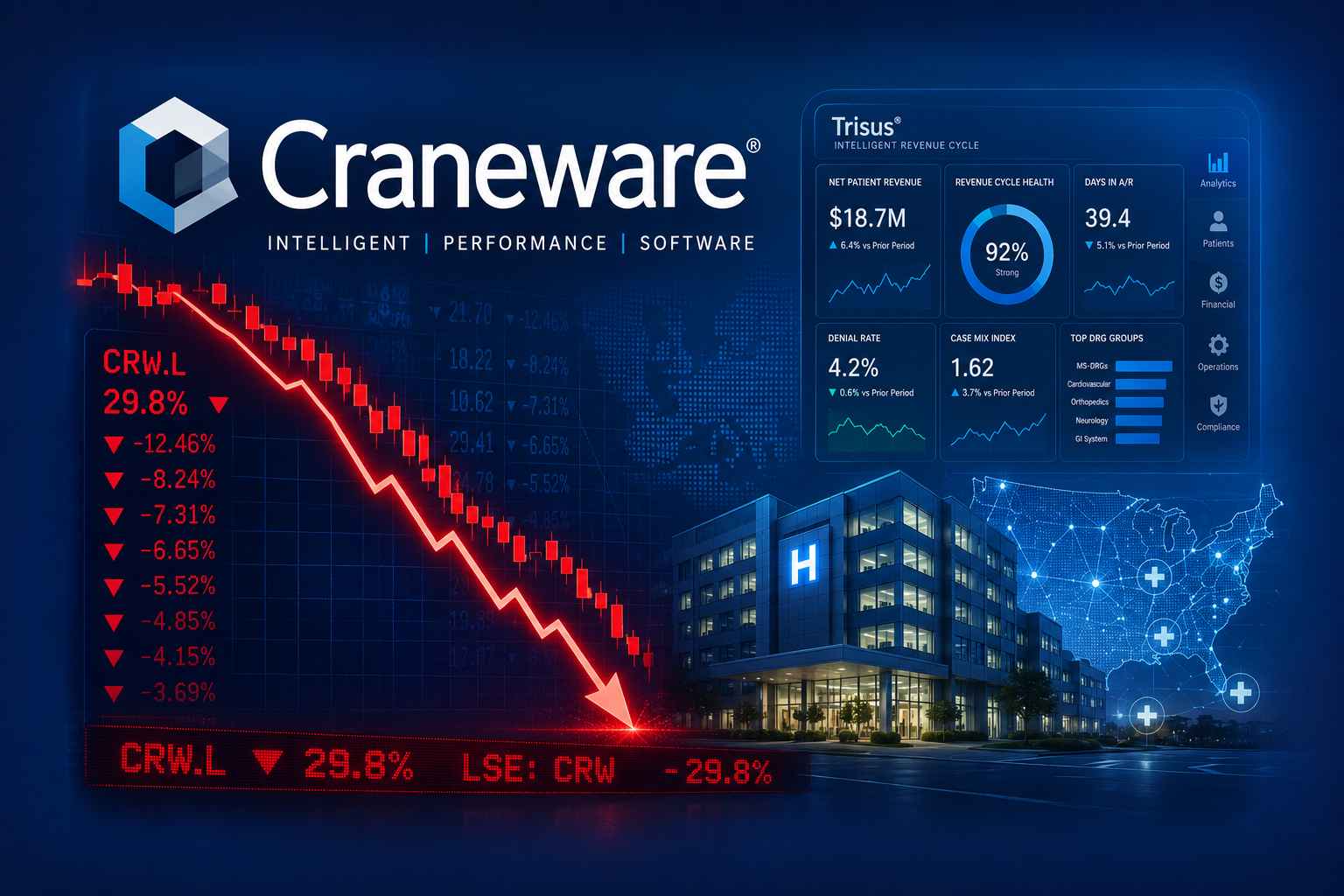
The Craneware (LON:CRW) investment case has now suffered its biggest setback in years. A trading update issued on 3 July warned that full-year revenue and earnings will come in below market expectations after delays in recognising revenue from eligible activity within the US 340B drug pricing programme and the deferral of several significant enterprise software contracts into FY2027.
For years, the healthcare software company looked like one of the highest-quality software businesses on the London market. It combined recurring revenues, high margins, strong cash generation and exposure to the structurally attractive US healthcare software market. Investors were prepared to pay a premium valuation because management consistently delivered double-digit growth while expanding its product platform.
| Craneware (LON:CRW) | Price: £11.54 (-21%) | Market cap: ~£395m |
The shares reacted sharply, reflecting not only lower profits but also concern that Craneware’s long-standing reputation for predictable execution has been dented.
Cerillion shares: Is this AIM software stock a buy after H1 and record order growth?
What does Craneware do?
Craneware is an Edinburgh-based healthcare software company whose products help US hospitals maximise revenues, manage reimbursement, comply with increasingly complex healthcare regulations and improve operational performance.
Its Trisus cloud platform analyses vast amounts of financial and clinical data, enabling hospitals to optimise billing, pharmacy management and revenue integrity.
The company generates most of its income through recurring software subscriptions, historically giving investors unusually good earnings visibility.
Why has earnings disappointed?
Management says the problems are largely about timing rather than demand.
Two factors combined:
- slower recognition of revenue linked to activity under the US 340B drug discount programme;
- several large enterprise contracts that customers decided to implement later than originally expected.
As a result, FY2026 revenue is now expected at $205-208 million, with adjusted EBITDA of $65-67 million, broadly flat on last year rather than delivering the double-digit growth investors had expected. Management believes much of the deferred revenue should instead benefit FY2027.
Why is US healthcare market proving difficult?
The US hospital sector has become considerably more cautious over the past two years.
Challenges include:
- continuing labour shortages
- pressure on hospital operating margins
- slower technology procurement decisions
- changing reimbursement rules
- uncertainty surrounding the 340B programme.
Earlier this year, Craneware highlighted disruption caused by regulatory changes around the HRSA Rebate Model Pilot, although a court ruling temporarily halted implementation, providing short-term clarity.
These issues have lengthened software sales cycles across much of the healthcare technology sector.
Key numbers
| Metric | Latest outlook |
| FY2026 revenue | $205m-$208m |
| Adjusted EBITDA | $65m-$67m |
| Revenue growth | Approximately flat year-on-year |
| Main issue | Deferred enterprise contracts and slower 340B revenue recognition |
| Expected benefit | Revenue deferred into FY2027 rather than cancelled |
Source: Company trading update.
Management’s view
Chief executive Keith Neilson has attempted to reassure investors that customer demand remains healthy.
The company says:
- customer retention remains strong;
- cash generation continues to be robust;
- deferred contracts have not been lost;
- long-term demand for healthcare financial management software continues to grow.
Management argues the issue is one of timing rather than structural deterioration. Investors, however, have heard similar explanations from many software companies over the past three years, making proof more important than promises.
What are analysts likely to do?
Most analysts are expected to cut:
- FY2026 revenue forecasts
- earnings forecasts
- price targets
However, much depends on whether they simply shift earnings into FY2027 or begin assuming permanently slower growth.
That distinction matters enormously.
If analysts merely defer earnings by one year, long-term valuations may remain largely intact.
If they conclude sales cycles have permanently lengthened, Craneware’s premium multiple becomes much harder to justify.
Prior to the warning, analyst sentiment remained overwhelmingly positive, with most published recommendations in the Buy or Outperform categories and consensus price targets substantially above the pre-warning share price. Those targets are now likely to come under review.
Is Craneware still a quality company?
This is now the key question.
Historically Craneware ticked many boxes investors associate with quality investing.
| Traditional strengths | Current concerns |
| High recurring revenues | Growth has stalled |
| Sticky customer base | Sales cycles lengthening |
| Strong cash conversion | Forecast reliability weakened |
| High operating margins | Premium valuation challenged |
| Attractive healthcare niche | Regulatory uncertainty persists |
Importantly, none of those historic strengths has disappeared overnight.
The business still possesses:
- long-term customer relationships;
- attractive recurring revenues;
- healthy balance sheet;
- significant free cash generation.
What has changed is investor confidence in management’s ability to deliver consistent growth every year.
Does the valuation now look attractive?
The answer depends entirely on whether investors believe this is a one-off setback.
Before the warning, Craneware traded on a relatively high earnings multiples compared to other UK software providers because investors believed double-digit growth was dependable.
Following the share price collapse:
Bull case
- much of the revenue is delayed rather than lost;
- recurring revenues remain resilient;
- FY2027 could rebound strongly;
- the valuation multiple has compressed significantly.
Bear case
- repeated delays suggest hospitals are becoming permanently more cautious;
- premium software multiples rarely survive slowing growth;
- earnings downgrades may continue over coming quarters;
- investors may now demand evidence before re-rating the shares.
What should investors watch next?
Three indicators will determine whether confidence returns:
- whether deferred contracts actually convert into FY2027 revenue;
- recurring revenue growth and customer retention;
- evidence that US hospital technology spending is improving.
If all three recover, this could ultimately prove a classic quality-company setback.
If not, investors may conclude Craneware has transitioned from a dependable compounder into a slower-growing software business deserving of a much lower valuation.
Investor verdict
Quality investing relies heavily on consistency. Craneware has spent more than a decade building a reputation for reliable execution, making this earnings disappointment particularly damaging. The investment case has now suffered its biggest setback in years.
The company’s competitive position has not fundamentally changed, nor has the structural need for hospitals to improve revenue management. Its balance sheet remains sound, cash generation appears resilient and management insists deferred revenues should emerge next year rather than disappear altogether.
However, premium valuations are built on trust. Until investors see evidence that delayed contracts are converting and double-digit growth can resume, Craneware is unlikely to regain the quality premium it once enjoyed. For long-term investors willing to accept execution risk, the share price weakness could create an attractive entry point. More cautious investors may prefer to wait until management demonstrates that this earnings shock was an isolated stumble rather than the start of a more prolonged slowdown.
You might also like: