




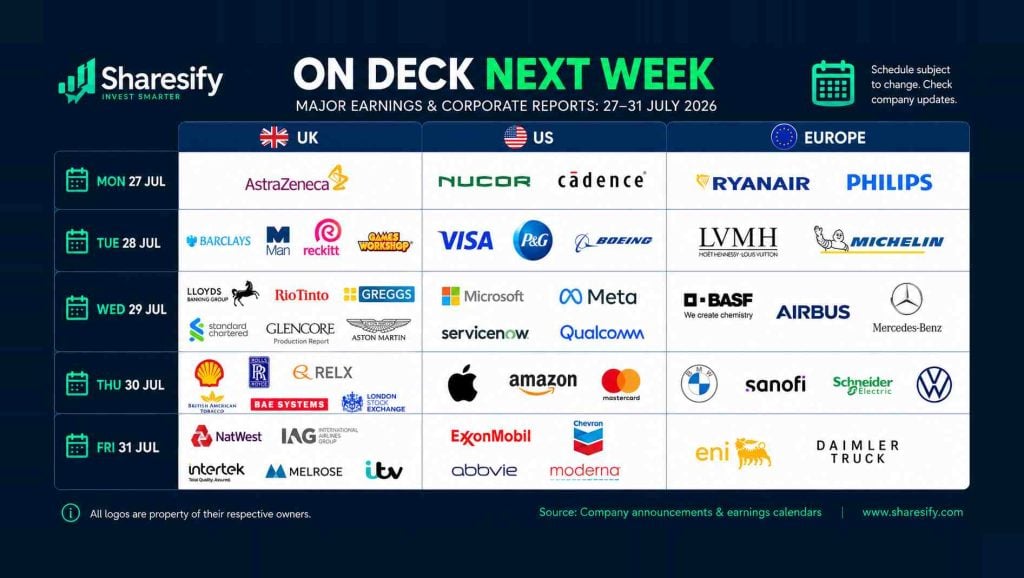
Next week brings one of the busiest stretches of the earnings season, with results from some of the world’s biggest companies likely to set the tone for UK and global equity markets.
Wall Street’s technology giants will command much of the attention. Microsoft (NASDAQ:MSFT), Meta Platforms (NASDAQ:META), Amazon (NASDAQ:AMZN) and Apple (NASDAQ:AAPL) are among the key names reporting, putting AI investment, cloud growth and consumer demand firmly under the microscope.
Alphabet Q2 2026: AI spending explodes as Google Cloud growth accelerates
With mega-cap technology stocks carrying enormous weight in global indices, surprises on earnings, guidance or AI spending could trigger significant moves well beyond the US market. Apple will be particularly closely watched following a strong share-price run and high expectations heading into its fiscal third-quarter results.
For UK investors, Barclays (LON:BARC) will provide an important read on banking profitability, investment-banking activity and shareholder returns, while consumer-goods heavyweight Unilever (LON:ULVR) reports half-year results on Tuesday, with investors watching volume growth, margins and the outlook for its portfolio.
Together, these results could make next week a major test of market valuations and investor confidence.
Barclays (LON:BARC)
After blow-out Q2 results from the US banks, particularly those with big trading operations, we assumed hopes for Barclays’ (LON:BARC) results on 28 July would be high. As the only UK bank with a credible Wall Street presence, investors would be hoping some of the magic might have rubbed off.
Instead, expectations seem remarkably tame with total income seen rising just 13% to £8.1 billion against £7.2 billion last year. More surprising still, income at the investment bank is seen rising just 10% to £3.6 billion against £3.3 billion last year. This would suggest analysts aren’t expecting anything like the trading gains seen at Goldman Sachs (NYSE:GS) and JPMorgan Chase (NYSE:JPM).
The UK consumer business is expected to generate net interest income of £2 billion, up 8% on last year’s £1.85 billion. Meanwhile, fee and commission income is actually forecast to drop slightly to £256 million, so no fireworks here either.
The big bonanza is expected to come from the US consumer banking business, where Q2 income is seen jumping 45% to £1.2 billion. Net interest income is expected to rise 20%, similar to Q1, but fees and commissions are expected to more than double. This would be a big step up from Q1, when fee and commission income dropped 14% driven by partner reward updates in Q4 2025.
Consensus forecasts for Barclays
| Q2 2026 | FY 2026 | FY 2027 | |
| Net interest income (£m) | 3,414 | 13,904 | 14,906 |
| Fee income (£m) | 4,291 | 15,736 | 16,056 |
| Total income (£m) | 8,117 | 31,244 | 32,715 |
| Operating expenses (£m) | 4,391 | 18,005 | 18,194 |
| Pre-tax profit (£m) | 3,116 | 10,630 | 12,118 |
Source: Barclays
Apple (NASDAQ:AAPL)
Apple (NASDAQ:AAPL) reports fiscal Q3 results after the US market closes on 30 July, with Wall Street expecting another strong quarter. Consensus points to revenue of roughly $109bn and EPS of about $1.89, implying double-digit growth from a year earlier. Bank of America is slightly more bullish, forecasting $109bn revenue and $1.89 EPS, above its cited Street revenue estimate.
For UK investors, the headline numbers may matter less than the outlook. The biggest potential share price catalysts are stronger-than-expected iPhone demand, resilient growth in high-margin Services, improving China sales and evidence that Apple Intelligence can stimulate a new device-upgrade cycle.
Consensus forecasts for Apple
| Q3 2025 | Q3 2026F | YoY Growth | Q4 2026F | |
| Revenue ($bn) | 94.04 | 108.89 | 15.8% | 114.80 |
| EPS ($) | 1.57 | 1.89 | 20.4% | 2.02 |
Source: Koyfin
The downside risk is expectations. Apple shares have rallied strongly, meaning a modest earnings beat may already be priced in. Investors will closely watch rising memory/component costs and gross margins.
A convincing beat plus upbeat guidance could extend the rally; margin pressure, weak guidance or disappointing AI commentary could trigger profit-taking.
Unilever (LON:ULVR)
Since Fernando Fernandez’s arrival as CEO, Unilever (LON:ULVR) has sharpened its focus on faster-growing beauty and personal care brands while implementing a major cost-cutting drive. Unfortunately, the consumer goods giant has been out of favour since March, when Unilever announced a controversial deal to combine its foods business with spices-to-sauces maker McCormick (NYSE:MKC).
Fernandez says the food separation will unlock value by shaping Unilever into a pure-play home and personal care company, while also creating a ‘global flavour powerhouse’. But investors seem unconvinced at the wisdom of this deal.
One vocal critic is Terry Smith, who has completely sold Unilever from his Fundsmith Equity Fund, having previously held the stock since the fund’s inception in 2010. Smith didn’t like the decision to merge the food division with McCormick. The pugnacious portfolio manager also criticised the Dove-to-Domestos maker’s management of shifting towards activist-led restructuring rather than focusing on operational improvement.
Given poor sentiment towards the Anglo-Dutch conglomerate, Unilever will need to deliver positive news with its Q2 and H1 results on 28 July. A quarterly sales ‘beat’, a fresh share buyback and cost savings progress could help foster a more upbeat narrative.
Back in April, Unilever reported better-than-expected Q1 sales as strong emerging markets demand offset sluggish developed markets growth. Underlying sales grew by a forecast-beating 3.8% including volume growth of 2.9% and price growth of 0.9%. Unilever’s Power Brands spearheaded the performance.
For Q2, the company-compiled consensus calls for underlying sales growth of 4.3%, balanced between volume growth of 2.5% and price increases of 1.8%. For H1, consensus calls for revenue of €25.46 billion, underlying operating profit of €5.16 billion and earnings per share of €1.59.
Consensus forecasts for Unilever
| Q2 2026 | H1 2026 | |
| Turnover (€bn) | 12.9 | 25.5 |
| Underlying sales growth | 4.3% | 4.1% |
| Earnings per share (€) | n/a | 1.59 |
Source: Company-compiled consensus
Next week brings one of the busiest stretches of the earnings season…
On deck next week, Investing.com
You might also like:
