




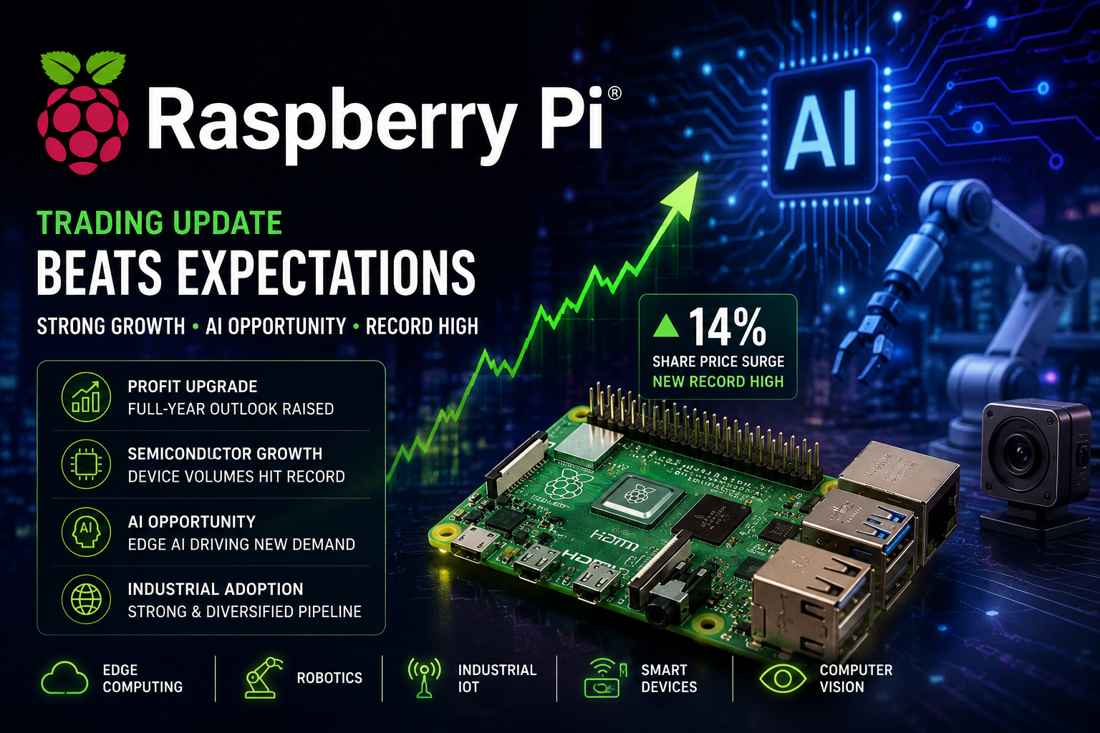
Raspberry Pi (LON:RPI) delivered one of the strongest trading updates on the London market so far in 2026, with upgraded profit expectations that sent the shares to new all-time highs. The update confirms that the Cambridge-based computing platform is increasingly becoming an industrial technology and semiconductor company rather than simply a hobbyist computer brand.
| Raspberry Pi (LON:RPI) | Price: £10.32 (+25%) | Market cap: £2.23bn |
For UK retail investors, the key question is whether today’s surge reflects the start of a longer growth story or whether much of the good news is now reflected in the valuation.
What Did Raspberry Pi Announce?
The company reported a strong first half of 2026 and upgraded full-year expectations.
Key highlights included:
| Metric | Update |
| H1 2026 Adjusted EBITDA | Expected to be at least $38m |
| Profitability | Materially ahead of H1 2025 |
| Unit volumes | Continued growth |
| Product mix | More favourable, supporting margins |
| Inventory management | Benefited from lower-cost DRAM inventory accumulated in 2025 |
| Full-year outlook | Upgraded versus previous expectations |
Management highlighted stronger demand, improving product mix and successful utilisation of memory inventory purchased before the recent DRAM price surge.
Share Price Reaction
The market’s response was emphatic.
- Shares jumped around 25%.
- The stock hit a new record high.
- Raspberry Pi has become one of the UK’s best-performing technology shares since listing in 2024.
The reaction reflects two important factors:
- Earnings upgrades are relatively rare in today’s uncertain market.
- Investors had been worried about rising memory-chip costs earlier this year.
Back in January, Raspberry Pi warned that DRAM inflation caused by AI data-centre demand could hurt profits and analysts cut forecasts. Today’s update suggests management has navigated that challenge far better than expected.
Why Growth Could Continue
1. Industrial Adoption Remains Strong
Many investors still associate Raspberry Pi with education and hobbyist computing.
In reality, industrial and embedded computing customers are becoming increasingly important.
Applications include:
- Factory automation
- Industrial IoT
- Smart devices
- Robotics
- Edge computing
- Digital signage
These customers tend to buy repeatedly and at larger scale than hobbyists, creating a more predictable revenue stream.
2. Semiconductor Expansion
One of the most interesting developments is Raspberry Pi’s growing semiconductor business.
The company reported that semiconductor device volumes exceeded board and module volumes for the first time in 2025. This suggests Raspberry Pi is increasingly monetising its intellectual property rather than simply selling physical computers.
This transition could be important because semiconductor businesses typically command higher valuations than hardware assemblers.
3. Global Distribution Network
Raspberry Pi has built one of the strongest distribution ecosystems in embedded computing.
The combination of:
- Hardware
- Software
- Operating system support
- Distribution channels
- Developer community
creates a competitive moat that is difficult for rivals to replicate.
The AI Opportunity
The AI angle is still underappreciated.
Raspberry Pi is not trying to compete with Nvidia (NASDAQ:NVDA) in AI training.
Instead, it is targeting edge AI — running AI models directly on devices.
Potential applications include:
| AI Application | Raspberry Pi Opportunity |
| Smart cameras | Local image recognition |
| Robotics | Autonomous decision making |
| Industrial sensors | Predictive maintenance |
| Retail systems | Computer vision |
| Education | AI development kits |
| Consumer devices | On-device AI assistants |
The company already launched AI-focused products such as the AI HAT+ accelerator platform.
Industry experts increasingly believe much AI processing will move from the cloud to edge devices over time because of:
- Lower latency
- Lower bandwidth requirements
- Better privacy
- Reduced operating costs
If that trend develops, Raspberry Pi could become one of the UK’s most interesting edge-AI beneficiaries.
What Are Analysts Saying?
Recent analyst commentary has become increasingly positive.
Jefferies
Following strong 2025 results, Jefferies raised its 2026 revenue forecast by 42% to approximately $511 million, citing sustained demand momentum and improving commercial traction.
Peel Hunt
Earlier in 2026 Peel Hunt had cut forecasts due to DRAM inflation concerns. Today’s trading update effectively demonstrates that those concerns have been less damaging than feared, explaining the strong market reaction.
Financial Times Stockpickers
The FT recently highlighted Raspberry Pi’s potential role in low-cost AI deployment and maintained a positive stance despite margin pressures from memory costs.
Valuation Assessment
This is where investors need caution.
The Bull Case
If Raspberry Pi can achieve:
- Sustained double-digit revenue growth
- Expansion of semiconductor sales
- Increasing industrial adoption
- Growing AI-related demand
then today’s valuation may still be reasonable.
Investors would effectively be paying for a niche semiconductor and edge-computing platform rather than a simple hardware manufacturer.
The Bear Case
Several risks remain:
| Risk | Impact |
| DRAM inflation | Margin pressure |
| Semiconductor cyclicality | Earnings volatility |
| Large customer concentration | Revenue risk |
| China demand slowdown | Growth risk |
| High expectations | Share price sensitivity |
The biggest issue is that the stock now trades on growth expectations. Any slowdown could lead to significant volatility.
What Retail Investors Should Watch
Over the next 12 months, the key indicators are:
- Semiconductor revenue growth.
- AI product adoption.
- Industrial customer wins.
- Gross margin progression.
- DRAM pricing trends.
- Further earnings upgrades.
If management continues delivering ahead of expectations, today’s valuation could still be justified.
Retail Investor Conclusion
Raspberry Pi increasingly resembles a specialist semiconductor and edge-computing platform rather than the educational computer company many investors remember.
Today’s trading update confirms:
- Strong demand.
- Better-than-expected profitability.
- Successful management of memory-cost challenges.
- Continued earnings momentum.
The AI opportunity is real, although indirect. Raspberry Pi is unlikely to become the next Nvidia, but it could become a major beneficiary of edge AI adoption across industrial and embedded computing markets.
For long-term retail investors, Raspberry Pi remains one of the most compelling growth stories on the London market.
Cerillion shares: Is this AIM software stock a buy after H1 and record order growth?
However, after today’s rally and record highs, the shares are no longer cheap. Future returns will depend on whether management can convert its strong ecosystem, semiconductor expansion and AI ambitions into sustained earnings growth.
Verdict: Positive long-term outlook, but investors should expect higher volatility now that the market is pricing in substantial future growth. Existing holders may wish to continue holding, while new investors may prefer to build positions gradually rather than chase today’s spike.
Disclaimer: The author Steven Frazer has a personal interest in Nvidia.
You might also like:
