


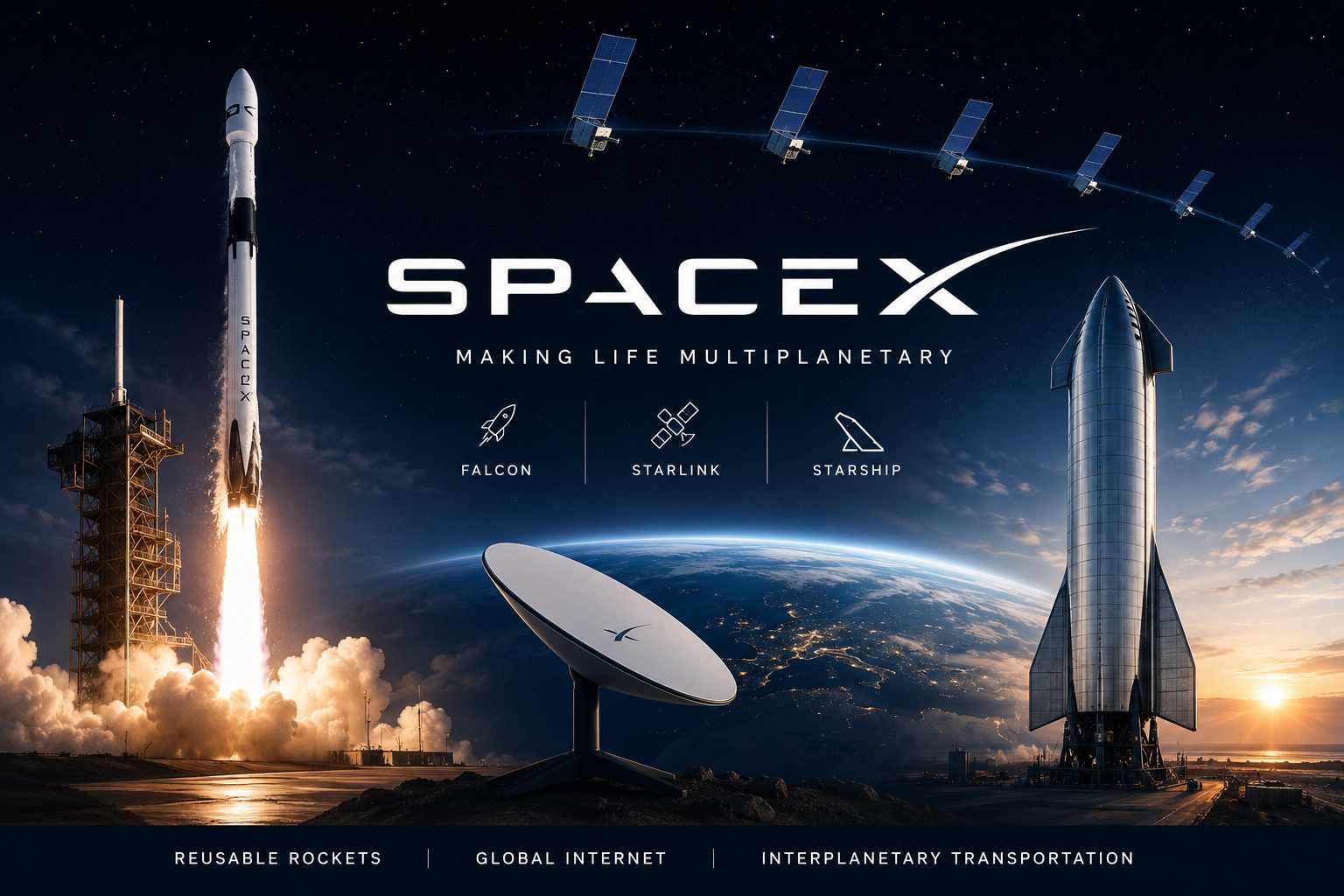
SpaceX’s (NASDAQ:SPCX) spectacular stock market debut exceeded even bullish expectations. After pricing its IPO at $135, the shares surged almost 19% to close at $160.95, giving the company a market capitalisation of approximately $2.1 trillion—instantly making it one of the world’s largest listed companies.
For UK retail investors, the key question is whether this valuation reflects genuine long-term opportunity or excessive first-day enthusiasm.
SpaceX IPO frenzy: should UK investors join the rush?
| SpaceX (NASDAQ:SPCX) | Price: $160.95 (+19%) | Market cap: $2.1tn |
First-day highlights
| Metric | Value |
| IPO price | $135.00 |
| First-day close | $160.95 |
| First-day gain | +19.2% |
| Market capitalisation | $2.1 trillion |
| Capital raised | $75 billion |
Source: Nasdaq trading data and Reuters reporting.
Valuation: priced for decades of growth
At roughly $18.7 billion of 2025 revenue, SpaceX now trades at around 110x sales, far above the largest AI and technology companies.
| Company | Approx. Price/Sales |
| SpaceX | ~110x |
| Nvidia | ~30-35x |
| Palantir | ~70-90x |
| Microsoft | ~14x |
| Alphabet | ~8x |
This immediately tells investors one thing:
Today’s valuation is based far more on future earnings than current financial performance.
Investors are effectively pricing in enormous future cash flows from businesses that either remain in rapid expansion or have yet to mature.
Why investors are willing to pay the premium
1. Starlink
Many analysts now believe Starlink could become the world’s dominant satellite communications network.
Potential revenue streams include:
- consumer broadband
- enterprise connectivity
- airlines
- maritime
- defence contracts
- government communications
- AI infrastructure connectivity
Several analysts estimate Starlink alone could eventually justify a trillion-dollar valuation if subscriber growth continues.
2. Launch monopoly
SpaceX has become the dominant global commercial launch provider.
Its reusable Falcon rockets continue reducing launch costs while competitors struggle to match reliability and pricing.
This provides recurring cash generation alongside satellite deployment.
3. Starship
The biggest unknown—and arguably the largest source of valuation upside—is Starship.
The Starship project is an ongoing development program for a fully reusable, super heavy-lift launch vehicle designed to be the most powerful rocket ever built. Its ultimate goal is to drastically lower the cost of spaceflight and enable humanity to become a multiplanetary species by transporting both crew and cargo to Earth orbit, the Moon, and Mars.
If fully successful it could unlock:
- lunar logistics
- Mars missions
- point-to-point cargo
- orbital manufacturing
- next-generation defence applications
- vastly cheaper satellite deployment
Most of these markets barely exist today.
Investors are paying today for industries that could emerge over the next 20 years.
4. Elon Musk premium
History shows investors consistently assign Musk-led companies higher valuations than peers.
His track record of creating category-defining businesses continues to command a significant premium.
Reasons to be cautious
Despite the excitement, risks are substantial.
Extraordinary valuation
Reuters Breakingviews estimates SpaceX now trades at over 100 times revenue, making it one of the richest valuations ever achieved by a company of this scale.
Execution risk
Much of today’s valuation assumes:
- Starship succeeds technically
- Starlink continues rapid expansion
- AI and defence spending remain robust
- international regulation remains supportive
Failure in any of these areas could compress the valuation significantly.
Capital intensity
Unlike software businesses, SpaceX requires enormous ongoing investment.
Building rockets, satellites, launch facilities and global infrastructure consumes billions annually.
Future shareholder dilution cannot be ruled out.
Limited profitability
Unlike most companies valued above $2 trillion, SpaceX is still investing heavily for growth rather than maximising profits.
What analysts are saying
Bullish investors argue SpaceX resembles buying the railroads during the Industrial Revolution—a unique infrastructure asset with decades of expansion ahead. Reuters also quoted Sequoia Capital partner Shaun Maguire as saying Elon Musk deserves “an extreme premium” because of his long-term vision and execution record.
Others urge caution. Keith Snyder of CFRA on Friday initiated coverage of SpaceX with an unusual Sell rating and a $115 price target, below the company’s IPO price of $135. He argues the $2 trillion-plus valuation already assumes successful execution across Starship, Starlink and future AI ambitions while leaving little room for disappointment.
Portfolio managers also expect heightened volatility because only a relatively small proportion of shares are freely traded, which can amplify price swings.
What could justify $2.1 trillion?
To support today’s valuation over time, investors would likely need to see:
| Growth driver | What investors need |
| Starlink | Tens of billions of annual free cash flow |
| Launch services | Continued market leadership |
| Starship | Commercial success beyond government missions |
| Defence | Expansion of military contracts |
| AI infrastructure | New high-margin revenue streams |
| Profitability | Sustained earnings growth rather than revenue alone |
Investor verdict
SpaceX has become one of the most exciting listed companies in the world—and one of the most expensive.
The spectacular stock market debut exceeded even bullish expectations. The first-day valuation reflects extraordinary confidence in Elon Musk, Starlink, reusable rockets and the long-term commercialisation of space. If SpaceX delivers on even part of its ambitious roadmap, today’s valuation may eventually look justified.
However, at more than 100 times annual revenue, investors are paying for decades of future success today. Any slowdown in Starlink growth, delays to Starship, regulatory setbacks or weaker-than-expected profitability could trigger sharp corrections.
For long-term investors who can tolerate significant volatility, SpaceX could become a defining growth company of the next two decades. For value-focused investors, patience may prove rewarding, as the shares are likely to experience large swings while the market tests whether operational progress can catch up with an exceptionally ambitious valuation.
You might also like:


