According to a recent study published by Bowmore Asset Management, 52% of the FTSE 100’s total return over the last decade came from dividends. Let that sink in for a minute. Not capital appreciation, re-rating, economic expansion, earnings growth or buybacks, but dividends.
FTSE 100 total return with dividends vs without dividends
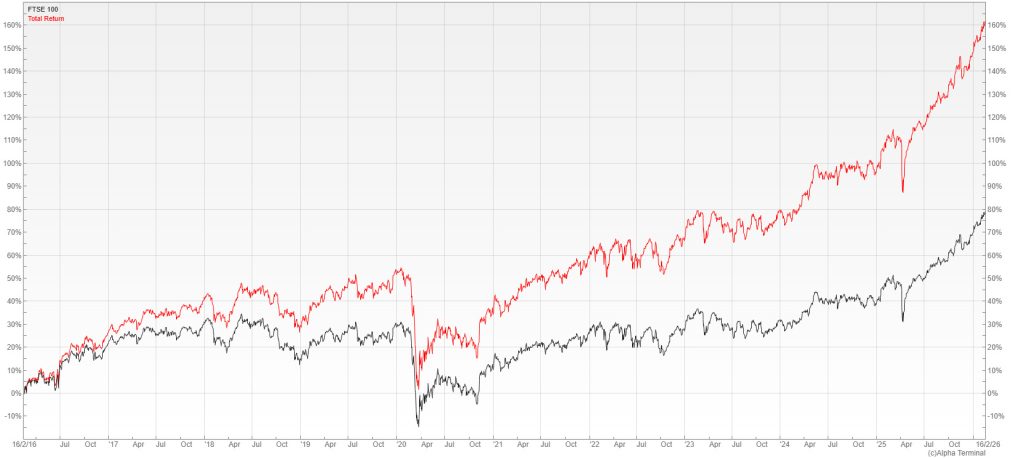
Source: Bowmore Asset Management
There are plenty of experts who will argue dividends are a drag on growth and should be the last resort when a company is allocating capital. So how is it possible they account for most of the return from big-cap UK stocks since 2016?
The clue is in the first paragraph – dividends are the biggest component of total returns. If you reinvest your dividends in more shares, you are compounding your returns and growing your wealth.
We have already written on the power of compounding, but we used a made-up example to illustrate the point. Here we have actual, real-life proof that compounding dividends does the heavy lifting in portfolios.
A sign of financial strength
James Woodman, investment director at Bowmore, argues dividends reflect disciplined capital allocation and strong cash generation.
‘Dividends are not a sign that a company has run out of ideas. They are a sign of financial strength and rational capital allocation,’ says Woodman.
‘Returning excess cash allows investors to redeploy it into new opportunities rather than leaving it tied up in projects that may not generate attractive returns.’
For some time, income investing was out of favour as growth investing and tech companies dramatically outperformed. However, investors are now leaning towards income investing, says Woodman, partly because valuations on growth shares have become too stretched.
Steady underlying growth
According to financial services firm Computershare, total UK dividends rose 1.3% £14.3 billion in Q4 2025. Regular underlying dividends, which exclude one-off payments, rose 2.1% to £13.9 billion.
The final quarter surprised to the upside thanks to higher-than-expected payouts by energy, consumer staples and property stocks. Financial stocks raised their payouts, as did healthcare and utilities, according to Comptershare.
There was also a small positive contribution from companies promoted from AIM to the main market. However, the total level of dividends hasn’t yet recovered its 2019 pre-pandemic high.
Part of the reason for that is companies are diverting ever more cash to share buybacks instead of dividends. Buybacks reached £63.6 billion last year, compared with £30.8 billion in 2019.
For 2026, regular dividends are expected to rise by 2% to a total of £85.9 billion. ‘There are no clear indications dividends will grow much faster in 2026, but a median dividend growth of 3.7% suggests a healthier market trend than the outlying figures suggest’, commented Computershare’s Mark Clelland.