




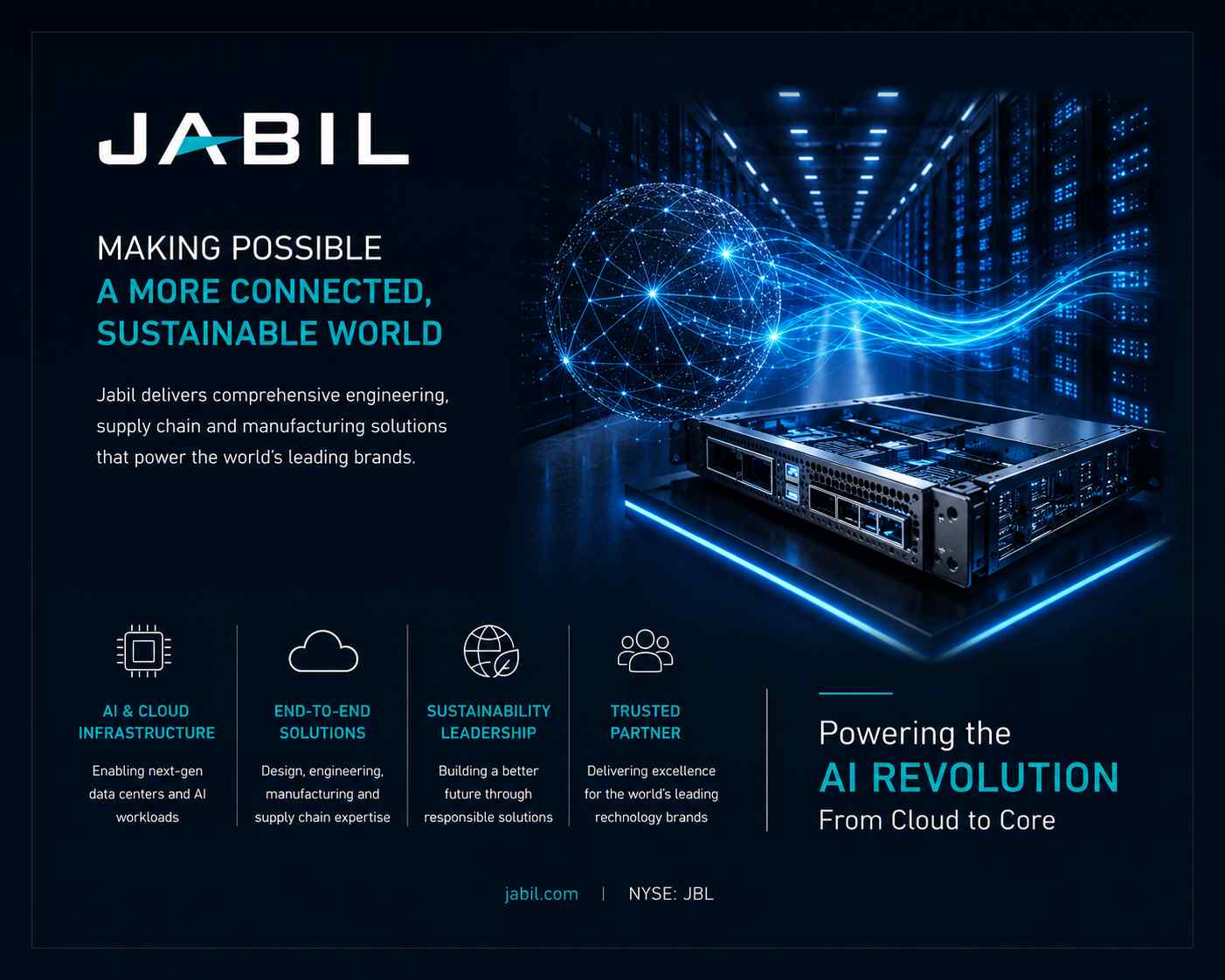
Contract electronics manufacturer Jabil (NYSE:JBL) delivered another impressive quarter on 17 June, comfortably beating Wall Street expectations and, more importantly, raising full-year guidance again. Jabil offers a differentiated way to gain exposure to the AI build-out without relying solely on chip designers. The results reinforce one of the strongest themes in global technology investing: the enormous build-out of AI infrastructure extends well beyond chip designers like Nvidia (NASDAQ:NVDA) and into the companies that physically manufacture servers, networking equipment, power systems and cooling infrastructure.
While the share price initially responded strongly, jumping by as much as 14% in early trading, much of those gains faded during the session as investors took profits and the broader US market sold off after the Federal Reserve meeting.
| Jabil (NYSE:JBL) | Price: $374.98 (+56% YTD) | Market cap: $39.56bn |
Why the gains faded
Despite the excellent results, several factors caused the rally to unwind:
1. Profit-taking after a huge run
Before earnings, Jabil shares had already risen roughly 65-70% year to date, making it one of the best-performing large-cap technology stocks of 2026. Many investors used the earnings spike to lock in profits.
2. High expectations
The stock had already been re-rated as an AI infrastructure beneficiary. Options markets were implying an earnings move of around 9%, reflecting elevated expectations going into the release.
3. Broader market weakness
The Federal Reserve’s decision and a more hawkish tone on inflation pushed Treasury yields higher and triggered a broad sell-off across US equities during the afternoon, dragging many technology stocks lower regardless of company-specific news.
For UK investors, Jabil increasingly looks less like a traditional low-margin contract manufacturer and more like a key enabler of hyperscale AI infrastructure.
Q3 FY2026 highlights
| Metric | Q3 FY26 | Q3 FY25 | YoY |
| Revenue | $8.8bn | $7.8bn | +12% |
| GAAP EPS | $2.59 | $2.03 | +28% |
| Core (non-GAAP) EPS | $3.16 | $2.55 | +24% |
| Core operating margin | ~5.8% | ~5.4% | Higher |
| Nine-month adjusted free cash flow | $991m | $813m | +22% |
Results exceeded analyst expectations for both revenue and earnings, prompting management to lift full-year guidance.
Guidance raised again
Management now expects:
| FY2026 guidance | Previous | New |
| Revenue | $34bn | $35bn |
| Core EPS | $12.25 | $12.70 |
| Core operating margin | 5.7% | 5.8% |
| Adjusted free cash flow | >$1.2bn | >$1.4bn |
Q4 guidance was also comfortably ahead of previous expectations.
| Q4 FY26 guidance | New targets |
| Revenue | $9.2–10.0bn |
| Core EPS | $3.80–4.20 |
What is driving demand?
1. AI infrastructure remains the biggest growth engine
Management again highlighted ‘extremely strong’ AI infrastructure demand.
Unlike semiconductor companies that design chips, Jabil manufactures much of the hardware surrounding AI deployments:
- AI servers
- rack-scale systems
- networking hardware
- optical interconnects
- liquid cooling systems
- power distribution equipment
- storage systems
As hyperscalers continue building AI clusters, virtually every server requires sophisticated manufacturing, testing and assembly.
Jabil is increasingly supplying complete AI platforms rather than simply assembling individual components.
How crazy could the memory chip shortage become – and what does it mean for UK investors?
2. Hyperscaler capex is still booming
Its biggest customers continue spending aggressively.
Among them:
- Microsoft
- Alphabet
- Amazon
- Meta Platforms
Combined capital expenditure from the hyperscalers is expected to exceed $350 billion annually during 2026, much of which ultimately creates manufacturing work for suppliers such as Jabil.
3. Automotive recovery
Management also cited improving trends in:
- electric vehicles
- advanced driver assistance
- vehicle electronics
- traditional automotive electronics
After two difficult years, automotive manufacturing appears to be recovering.
4. Healthcare continues growing
Healthcare remains one of Jabil’s most attractive long-term businesses.
Growth drivers include:
- GLP-1 drug delivery systems
- continuous glucose monitors
- minimally invasive surgery
- diagnostics
- medical devices
Healthcare also carries higher margins than many traditional electronics manufacturing activities.
Portfolio mix is improving
One notable trend is that Jabil continues moving away from low-margin consumer electronics.
Instead, the company is increasing exposure to:
| Higher-growth markets | Mature markets |
| AI infrastructure | Consumer electronics |
| Cloud computing | Legacy mobility |
| Healthcare | Lower-end industrial |
| Automotive electronics | Commodity manufacturing |
That mix shift helps explain why operating margins continue expanding despite only moderate revenue growth.
Growth opportunities into 2027
AI factories
The biggest opportunity is the construction of AI data centres worldwide.
Industry forecasts suggest AI data-centre spending could grow at around 24% annually through the early 2030s, providing a long runway for companies supplying infrastructure.
Optical networking
Jabil is investing heavily in:
- 800G networking
- 1.6T optical modules
- silicon photonics
- high-speed interconnects
These technologies become increasingly important as AI clusters scale to hundreds of thousands of GPUs.
Liquid cooling
Traditional air cooling is becoming inadequate for next-generation AI racks.
Jabil has become a major supplier of:
- liquid cooling
- rack integration
- thermal management
Many analysts believe cooling will become one of the fastest-growing segments within AI infrastructure over the next five years.
Geographic diversification
Customers increasingly want manufacturing outside China.
Jabil continues expanding production across:
- Mexico
- Southeast Asia
- Europe
- North America
That provides resilience against tariffs and geopolitical disruption.
Risks investors should watch
AI spending slows
The biggest risk is that hyperscalers eventually moderate AI capital expenditure.
At present there is little evidence of this, but AI investment cycles are unlikely to grow at today’s exceptional pace indefinitely.
Customer concentration
Large technology customers account for a significant proportion of revenue.
Any delay in cloud spending could quickly affect earnings.
Margins remain relatively thin
Although improving, manufacturing remains a lower-margin business than semiconductor design. Operating margins have trended in the low-to-mid single digits for years.
Execution is therefore critical.
Tariffs and geopolitics
Global manufacturing always carries exposure to:
- trade restrictions
- tariffs
- supply-chain disruptions
- currency movements
Analyst reaction
The initial analyst response has been broadly positive.
Common themes include:
- stronger-than-expected AI demand
- another guidance increase
- improving operating leverage
- accelerating free cash flow
Several analysts raised FY2026 and FY2027 EPS forecasts following the results, reflecting confidence that AI infrastructure demand is proving more durable than previously expected.
Valuation versus peers
| Company | Forward PE (approx.) | AI exposure | Margin profile |
| Jabil | 26–28x | Very high | Improving |
| Flex | High-20s | High | Similar |
| Celestica | Low-30s | Very high | Strong |
| Sanmina | High teens | Moderate | Stable |
Jabil trades broadly in line with Flex (NASDAQ:FLEX), at a discount to the faster-growing Celestica (NYSE:CLS), and at a premium to Sanmina (NASDAQ:SANM). Investors appear willing to pay more because Jabil has successfully repositioned its business toward AI infrastructure and healthcare rather than traditional electronics manufacturing.
Investment positives
✔ AI infrastructure spending remains exceptionally strong.
✔ Management has now raised guidance multiple times.
✔ Improving operating margins suggest a more profitable business mix.
✔ Free cash flow continues strengthening, supporting investment and shareholder returns.
✔ Healthcare and automotive provide additional diversification beyond AI.
Investment risks
✖ The share price has already rerated sharply, leaving less room for disappointment.
✖ AI infrastructure demand remains the dominant earnings driver, so any slowdown in hyperscaler spending would likely have an outsized impact.
✖ Manufacturing businesses generally have lower structural margins than semiconductor designers, requiring consistently strong execution.
Investor verdict
Jabil is becoming one of the clearest ‘picks and shovels’ investments in the AI ecosystem. Rather than competing in the crowded semiconductor design market, it profits from building the physical infrastructure—servers, racks, networking systems, power and cooling—that enables hyperscalers to deploy AI at scale. The latest results indicate this demand remains robust, with higher revenue, expanding margins, stronger cash generation and another uplift to full-year guidance.
The valuation is no longer inexpensive after a strong share price run, but it remains broadly reasonable relative to peers given the company’s improving quality and earnings trajectory. If hyperscale AI investment continues into 2027 as most analysts expect, Jabil appears well positioned to deliver another year of double-digit earnings growth.
For UK retail investors, Jabil offers a differentiated way to gain exposure to the AI build-out without relying solely on chip designers. While near-term volatility is possible after its substantial share price appreciation, the combination of raised guidance, expanding margins and structural AI demand supports a constructive long-term investment case.
You might also like: