




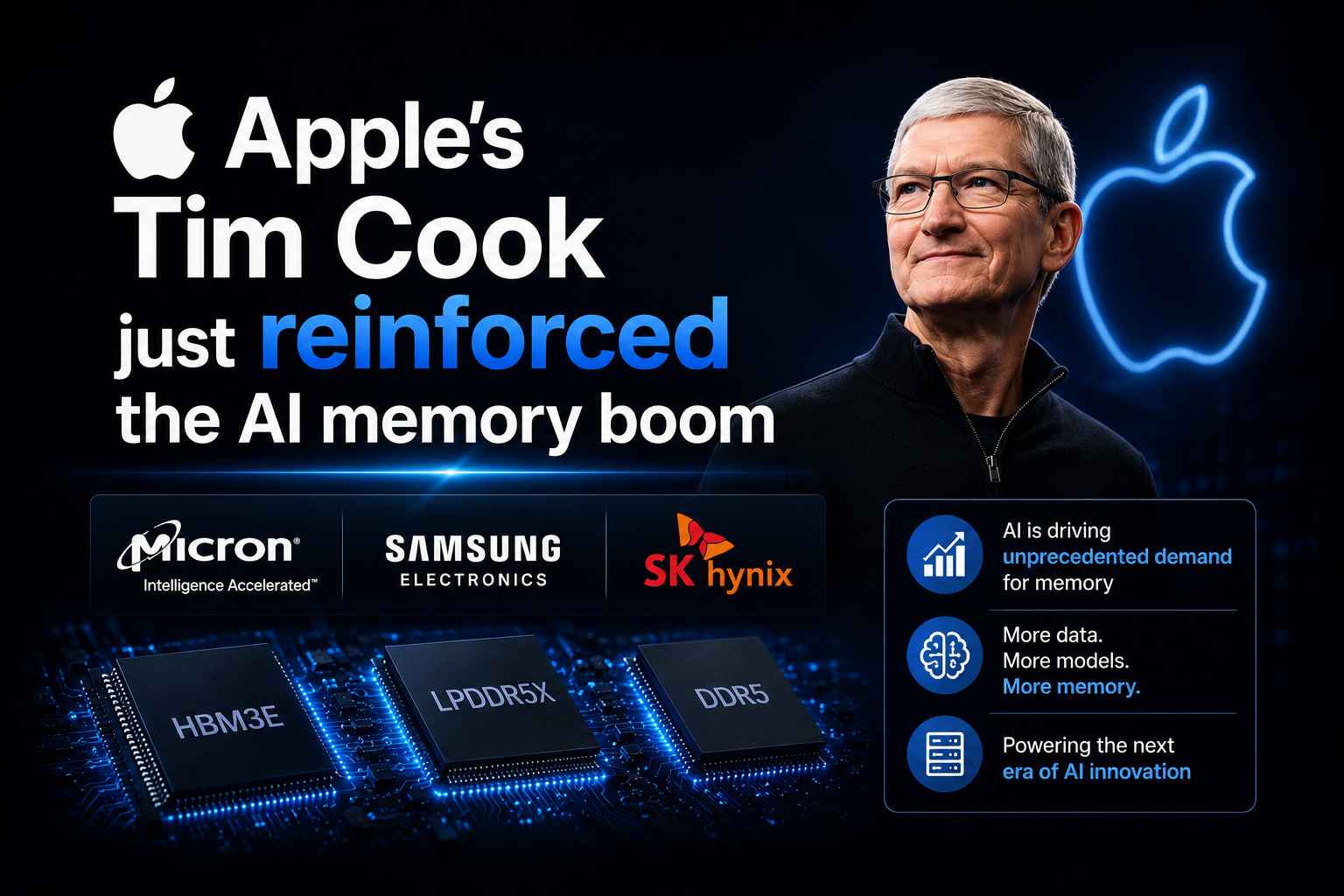
Memory stocks rallied after Tim Cook acknowledged that Apple (NASDAQ:AAPL) will have to raise product prices because soaring memory chip costs have become ‘unavoidable’. Investors interpreted the comments as confirmation that the current AI-driven memory shortage is proving more persistent than many had expected.
The key point was not simply that Apple faces higher costs. It was that one of the world’s largest semiconductor buyers effectively confirmed that demand for DRAM and NAND remains far stronger than supply, a point Sharesify investigated recently (click link below).
How crazy could the memory chip shortage become – and what does it mean for UK investors?
Apple has historically enjoyed enormous purchasing power, so if it can no longer absorb higher prices, investors believe memory manufacturers retain significant pricing power.
That sparked gains running in the 6%-10% range across companies including Micron Technology (NASDAQ:MU), SanDisk (NASDAQ:SNDK), Western Digital (NASDAQ:WDC), Samsung Electronics (KRX:005930), and SK Hynix (KRX:000660).Micron reports Q3 2026 earnings next week.
Coming next week: Berkeley, Micron and Halfords
What Cook said
Cook told the Wall Street Journal that:
- Apple can no longer absorb rising memory and storage chip costs.
- Product price increases are now ‘unavoidable’.
- AI datacentre investment is diverting DRAM and NAND supply away from consumer electronics.
- Apple will continue supporting suppliers but has no plans to manufacture memory chips itself.
Apple CEO tells WSJ that soaring costs make price increases ‘unavoidable’
Why this matters for investors
The AI boom has fundamentally changed the memory market. Large cloud providers are buying enormous quantities of high-bandwidth memory (HBM) for AI accelerators. Although HBM is a specialist DRAM product, it consumes manufacturing capacity that would otherwise produce conventional DRAM, tightening supply across the industry.
At the same time, smartphones and PCs increasingly require more memory to run on-device AI features, lifting demand for both DRAM and NAND.
Memory pricing snapshot
| Segment | Current trend | Main driver |
| DRAM | Strong double-digit annual price increases | AI server demand, HBM shortages |
| HBM | Near full allocation through 2026 | Nvidia and hyperscale AI deployments |
| NAND flash | Recovering after prolonged downturn | Enterprise SSD demand and supply discipline |
| Consumer memory | Costs rising | AI-enabled smartphones and PCs competing for supply |
Why Apple is important
Apple buys billions of dollars’ worth of memory every year.
When management publicly admits it cannot offset rising input costs, investors take it as evidence that:
- suppliers retain pricing power;
- shortages are lasting longer than expected;
- memory producers may continue enjoying unusually high margins.
That is particularly positive ahead of Micron Technology’s quarterly results next week.
Analyst commentary
Several analysts said Cook’s remarks validate the industry’s bullish outlook.
- Dan Ives of Wedbush believes consumers are likely to face higher prices for next-generation Apple devices as memory costs continue climbing.
- Deepwater’s Gene Munster argued Apple’s comments reinforce that the memory shortage remains intact rather than easing.
- Melissa Weathers of Deutsche Bank expects DRAM and NAND demand to outpace supply for several more years, supporting favourable pricing conditions for memory manufacturers.
Investor verdict
AI-driven memory shortage is proving more persistent than many had expected. For UK retail investors, Cook’s comments matter because they provide independent confirmation that the AI infrastructure build-out is affecting the entire semiconductor supply chain—not just specialist AI chipmakers.
If memory pricing remains firm through the second half of 2026, companies such as Micron Technology, Samsung Electronics and SK Hynix could continue delivering earnings upgrades and strong free cash flow. The principal risk is that smartphone and PC demand weakens if higher component costs translate into significantly higher retail prices, eventually reducing unit shipments.
You might also like: