




One of the most talked about stocks this year, Rocket Lab (NASDAQ:RKLB), delivered another very strong growth quarter, but the market’s reaction shows the problem for investors: the business is improving rapidly, while the share price already discounts a very ambitious future. Investors are paying a very large premium for a company that still loses money.
Investing.com has its sat atop its list of the most overvalued large-cap US stocks.
| Rocket Lab (NASDAQ:RKLB) | Price: $72.18 (~-10% after-hours) | Market cap: ~$43.0bn |
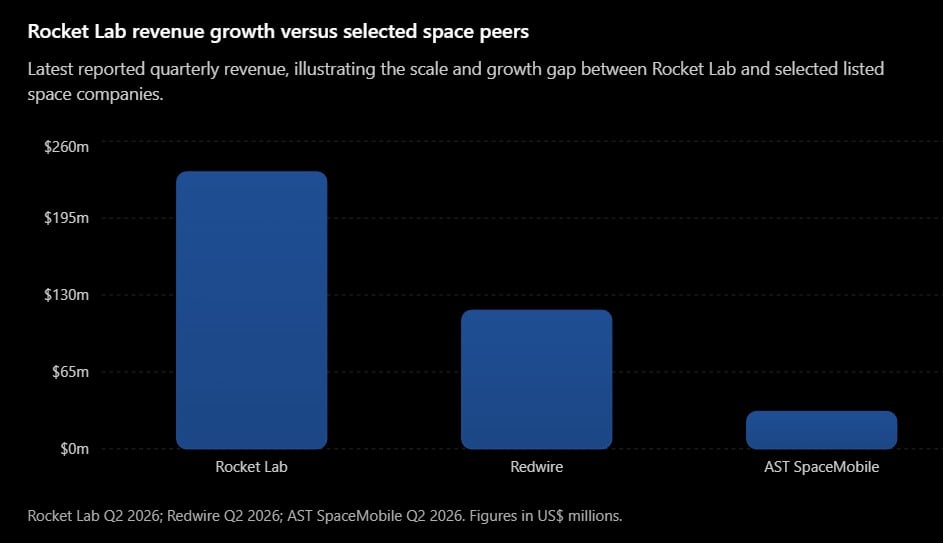
The company reported record Q2 revenue of $234.1m, up 62% year-on-year, beating consensus of about $232m. Backlog rose 137% to $2.36bn, while management guided Q3 revenue to another record $250m-$265m. Yet the shares fell sharply after hours because the $0.08 adjusted loss per share was worse than the roughly $0.06 expected, and management expects another quarter of negative EBITDA and cash flow.
After-hours reaction: why did investors sell?
Rocket Lab closed Monday at $80.04, down 3.4%, before falling nearly 10% after hours to ~$72.18.
That reaction looks harsh given the headline numbers, but there are several reasons:
| Q2 2026 | Actual | Market view | Verdict |
| Revenue | $234.1m | ~$232m | ✔️ Beat |
| YoY growth | 62% | — | ✔️ Excellent |
| GAAP gross margin | 36.1% | — | ✔️ Above guidance |
| Non-GAAP gross margin | 41.5% | ~38% | ✔️ Beat |
| Adjusted EBITDA | -$8.8m | ~$20m loss guide | ✔️ Better |
| EPS | -$0.08 | ~-$0.06 | ❌ Miss |
| Q3 revenue guidance | $250-$265m | ~$238.5m | ✔️ Strong |
| Q3 adjusted EBITDA | -$17m to -$23m | ~-$10m | ❌ Worse |
The key issue is therefore not demand. It is the speed at which Rocket Lab can turn that demand into profits and cash. Q3 gross-margin guidance also falls to 29%-31% GAAP, partly because of business mix and the lower initial margins of newly acquired operations.
What does Rocket Lab actually do?
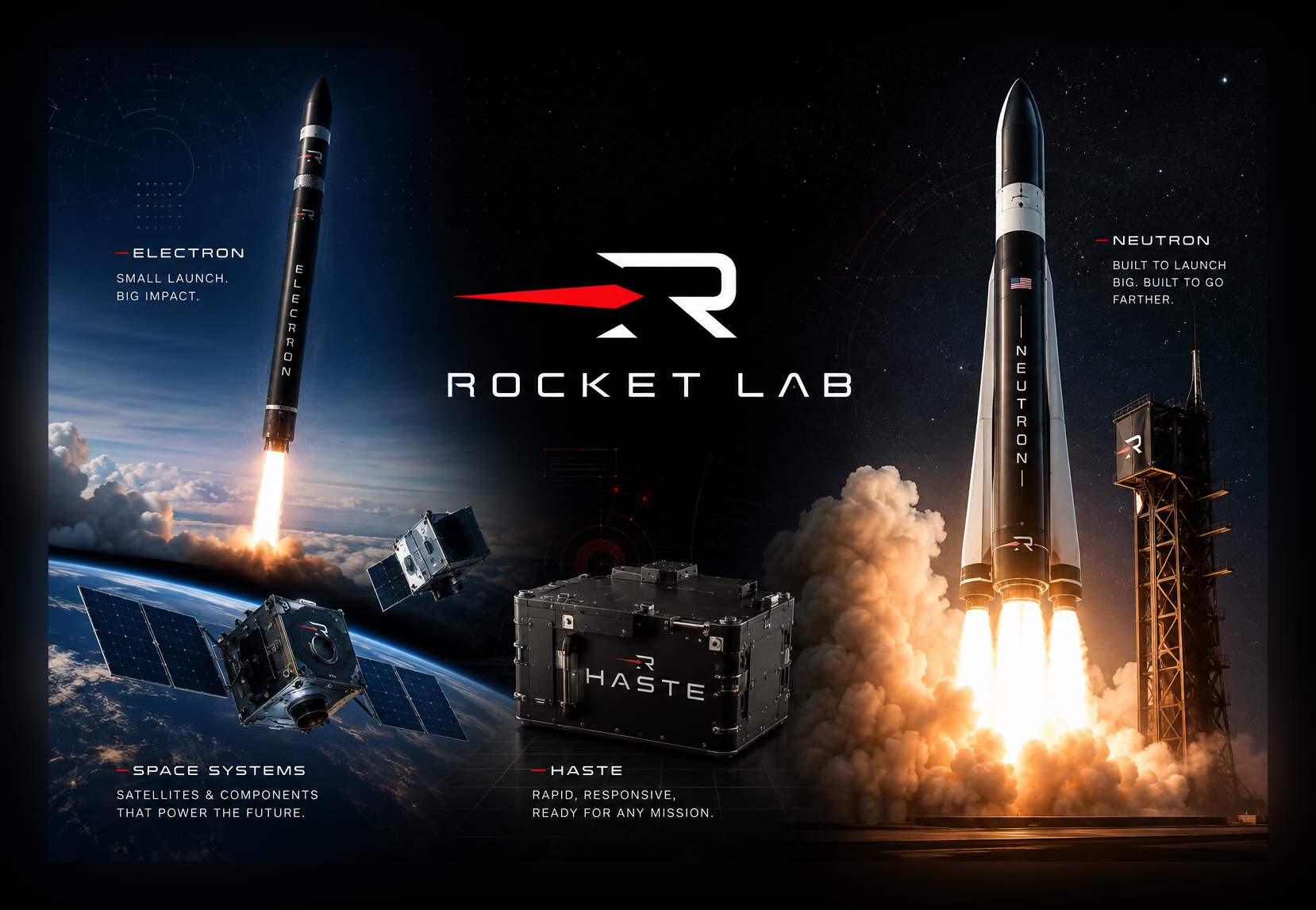
Rocket Lab is becoming much more than a small-rocket company.
Its business has three increasingly interconnected layers:
1. Launch services — Electron and HASTE
Electron is Rocket Lab’s small orbital rocket, while HASTE is used for hypersonic and defence testing. Launch revenue was $44.6m in Q2, with the sequential decline largely reflecting revenue-recognition timing rather than collapsing launch activity. Rocket Lab had completed 13 Electron launches year-to-date with a 100% mission-success rate.
2. Space Systems
This is currently the bigger business. Q2 Space Systems revenue reached $189.5m, driven by satellite manufacturing, components and payloads, including contributions from Mynaric.
This is strategically important because it gives Rocket Lab revenue even when it isn’t launching rockets.
3. Neutron
The big prize is Neutron, a reusable medium-lift rocket designed to compete for larger commercial and government missions.
Rocket Lab says Neutron remains on track to reach the launch pad in Q4 2026. The company is already selling launches at an intended $50m-$55m average selling price, and management says demand is sufficiently strong that it sees more potential for price increases than reductions.
That creates the potential for a much larger business.
The real bull case: Rocket Lab becomes vertically integrated
The most interesting aspect of Rocket Lab isn’t simply ‘another rocket company’.
It wants to control more of the space value chain:
Components → spacecraft → satellite payloads → launch → orbital infrastructure → communications
The acquisitions of Mynaric and Motiv, alongside the proposed $8bn acquisition of Iridium, push that strategy further.
Rocket Lab also won major government contracts, including a $397m Space Force contract for Flatellite spacecraft and launch services, plus more than $160m of contracts for three geostationary satellites.
The company says more than $1bn of additional contracts have already been signed in Q3, taking the momentum beyond the $2.36bn Q2 backlog figure.
That is a powerful signal: customers are committing before Neutron has even flown.
Profitability: improving, but still a long way away
There is genuine progress.
Q2 GAAP gross margin reached 36.1%, while non-GAAP gross margin reached 41.5%. Adjusted EBITDA was only an $8.8m loss, substantially better than the company’s $20m-$26m guidance.
But operating expenses remain enormous because Rocket Lab is effectively funding the next generation of the business while simultaneously scaling today’s operations.
Q2 operating expenses were approximately $142m, including substantial R&D and investment in Neutron. The result was a $49.3m net loss.
The important distinction
Rocket Lab isn’t yet trying to maximise current profits.
It is effectively saying:
Spend heavily now to establish the infrastructure, technology and production capacity required to capture a much larger future market.
That can work spectacularly if Neutron succeeds.
It can also destroy shareholder value if development costs rise, the first launch slips repeatedly, or competitors take the available market.
Free cash flow: the biggest weakness
This is where UK investors should be particularly careful.
Rocket Lab’s H1 2026 operating cash outflow was approximately $134m, compared with about $78m in H1 2025.
And this is before considering the broader capital requirements of scaling Neutron.
Management was unusually clear about the timetable for cash generation. CFO Adam Spice said the successful Neutron test flight should be the turning point for adjusted EBITDA, but Rocket Lab could still be 18-24 months after that event before reaching cash-flow positivity, because it needs to continue investing in additional Neutron vehicles.
That means investors shouldn’t expect free cash flow to suddenly turn positive when Neutron launches.
Cash flow bridge
| Metric | Q2/H1 2026 | Investor interpretation |
| H1 operating cash flow | ~-$134m | 🔴 Significant burn |
| Q2 capex/infrastructure | Elevated | 🔴 Investment phase |
| Cash + equivalents | ~$2.13bn | 🟢 Large liquidity cushion |
| Cash + securities | ~$2.4bn | 🟢 Strong funding position |
| EBITDA | -$8.8m Q2 | 🟡 Nearing breakeven |
| Management FCF outlook | Still negative | 🔴 No near-term FCF |
The balance sheet is therefore not the immediate problem. Rocket Lab has substantial liquidity. The problem is what that liquidity ultimately buys.
The company also raised roughly $1.53bn through ATM equity issuance, meaning part of the balance-sheet strength has come from issuing extra shares. That is important for existing shareholders because dilution reduces their percentage ownership of the future company.
Valuation: this is where the investment becomes tricky
At around $70-$80, Rocket Lab’s market capitalisation is approximately $43bn-$48bn.
Against Q2 revenue of $234m, that is already an extraordinary valuation.
Even simply annualising Q2 revenue gives roughly $936m. That puts the equity value at approximately 50x annualised Q2 sales.
That is considerably more demanding than many listed space companies.
| Company | Recent/2026 revenue scale | Profitability | Valuation characteristics |
| Rocket Lab | Q2 $234m; +62% YoY, backlog $2.36bn | Loss-making, negative FCF | ~50x annualised Q2 sales, premium reflects Neutron optionality |
| Planet Labs | FY26 revenue $308m | Adjusted EBITDA positive | Much lower sales multiple |
| Redwire | Q2 $117m; +90% YoY | EBITDA loss | High-growth, but substantially smaller valuation |
| AST SpaceMobile | Q2 $31.5m | Heavy losses | Extremely speculative |
Planet Labs (NYSE:PL), for example, generated $307.7m of FY2026 revenue, while its latest outlook calls for FY2027 revenue of roughly $425m-$441m and $80m-$95m of capex. It is already targeting adjusted EBITDA profitability.
AST SpaceMobile (NASDAQ:ASTS), by contrast, generated only $31.5m of Q2 revenue and expects 2026 revenue of $150m-$200m, illustrating how speculative valuations can become in the space sector.
The important caveat: these aren’t direct like-for-like businesses. Rocket Lab has launch capability, defence contracts, spacecraft manufacturing and the potential Neutron/Iridium combination. A simple P/S comparison therefore understates the optionality embedded in Rocket Lab.
But it also highlights the central risk: investors are paying today for substantial future success.
Opportunities for investors
- ✔️ 1. Neutron could transform the economics
If Neutron works and reaches a meaningful launch cadence, Rocket Lab moves from a small-launch provider into a much larger medium-lift market.
Management believes the launch market remains structurally capacity constrained, with customers already booking Neutron slots.
- ✔️2. Defence spending
Rocket Lab is increasingly positioned as a defence-space supplier rather than simply a commercial rocket company.
The Space Force, SDA and other government programmes could provide large, multi-year contracts.
- ✔️3. Vertical integration
Owning components, spacecraft and launch capability could allow Rocket Lab to capture more value per mission.
The Flatellite programme is a good example: Rocket Lab can design/build the satellite and provide the launch.
- ✔️4. Europe
The Mynaric acquisition gives Rocket Lab a European manufacturing and communications foothold at a time when European governments are increasingly focused on sovereign space and defence capabilities.
- ✔️5. Iridium optionality
The proposed Iridium acquisition could fundamentally alter Rocket Lab’s cash-flow profile because Iridium is already a mature, recurring-revenue and cash-generative satellite communications business. Management explicitly said the acquisition would materially change the company’s cash-flow outlook.
Risks UK retail investors should watch
- ❌ 1. Neutron execution
This is probably the single biggest risk.
A first launch is not the same thing as a reliable commercial rocket. Engine testing, stage testing, launch infrastructure, reusability and production scaling all have to work.
Management itself identified fully fuelled stage testing as a particularly important milestone.
- ❌ 2. Valuation
At roughly $48bn, Rocket Lab is no longer priced like an early-stage space company.
The market is effectively saying:
‘Neutron succeeds, Space Systems scales, defence contracts continue and margins eventually expand.’
If any two of those assumptions weaken simultaneously, the valuation could compress sharply.
- ❌ 3. Cash burn
Management’s own estimate of 18-24 months between EBITDA inflection and positive cash flow shows that investors need patience.
- ❌ 4. Dilution
Rocket Lab has used equity financing to build its balance sheet. Future acquisitions and investment could require more shares.
- ❌ 5. SpaceX
The elephant in the room remains SpaceX (NASDAQ:SPCX).
SpaceX has enormous scale, reusable rockets, a massive launch cadence and internal demand from its own satellite businesses. Rocket Lab does not need to beat SpaceX everywhere — but it needs to carve out a sufficiently valuable niche.
SpaceX Q2 2026 earnings: Strong results fail to justify lofty valuation as shares tumble
Bull vs bear case
| 🐂 Bull case | 🐻 Bear case |
| Neutron reaches the pad in Q4 2026 and subsequently flies successfully | Neutron suffers delays or technical problems |
| Launch capacity remains structurally constrained | SpaceX and other competitors add capacity faster than expected |
| Neutron achieves $50m-$55m+ pricing | Launch pricing becomes more competitive |
| Space Systems continues 30%+ growth | Large defence contracts create lumpy revenue |
| $2.36bn backlog converts rapidly into revenue | Backlog conversion takes longer than expected |
| Defence spending drives major satellite awards | Government procurement timing slips |
| Margins expand as manufacturing scales | Q3’s 29%-31% GAAP margin decline persists |
| Iridium adds recurring cash generation | Iridium acquisition increases complexity/leverage/dilution |
| FCF turns positive after Neutron scales | Cash burn persists for longer |
| Rocket Lab becomes a vertically integrated space prime | Valuation compresses before earnings catch up |
Investor verdict
Rocket Lab’s Q2 results reinforce the bullish long-term business story: 62% revenue growth, a $2.36bn backlog, more than $1bn of subsequent contracts, strong gross margins and increasingly important defence relationships.
But the after-hours sell-off also makes sense.
The market isn’t questioning whether Rocket Lab is growing. It is questioning how much future growth is already priced in.
At around $70-$80, investors are paying a very large premium for a company that still loses money, consumes substantial cash and has a critical rocket — Neutron — yet to fly.
For a UK retail investors, Rocket Lab should be thought of as a high-risk growth/speculative holding rather than a conventional aerospace investment. The potential upside is substantial if Neutron succeeds and Rocket Lab becomes a vertically integrated space-and-defence platform. But at the current valuation, execution must remain close to excellent.
The three numbers to watch most closely over the next 12 months are:
1. Neutron — does it reach the pad and fly?
2. Space Systems margins — can gross margin stay above 35%-40%?
3. Cash burn — does the company move towards EBITDA and FCF break-even without excessive dilution?
If those three move in the right direction, today’s valuation could eventually be justified. If not, the downside could be considerable.
You might also like: