




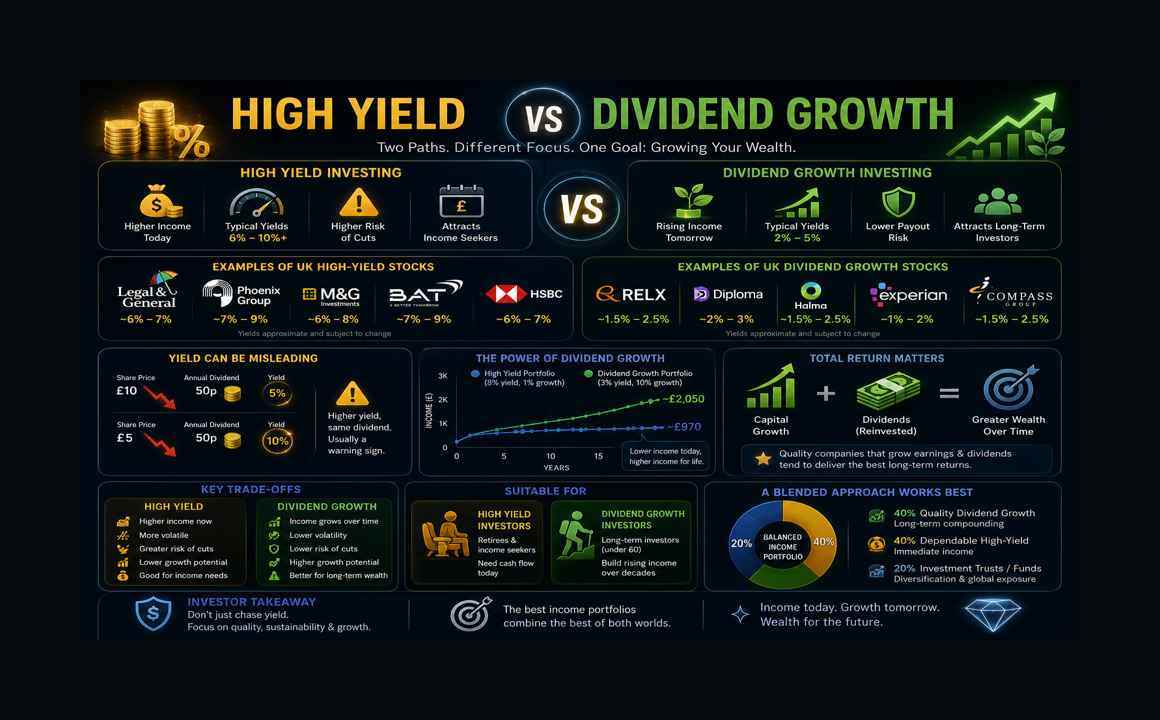
For income investors, one of the biggest decisions is whether to pursue the highest dividend yields available today or focus on companies that consistently grow their dividends year after year.
Both approaches can generate attractive long-term returns, but they suit different objectives and risk tolerances. The key is understanding that a high dividend yield is not necessarily a sign of quality, while a lower yield combined with strong dividend growth can produce significantly greater total returns over time.
The two approaches explained
| High Yield Investing | Dividend Growth Investing |
| Prioritises maximum income today | Prioritises rising income tomorrow |
| Typical yields 6%-10%+ | Typical yields 2%-5% |
| Usually mature companies | Often high-quality compounders |
| Greater risk of dividend cuts | Usually lower payout risk |
| Higher immediate cash flow | Higher long-term income growth |
| Often attracts retirees | Popular with long-term investors |
Why dividend yield can be misleading
Dividend yield equals:
Annual dividend ÷ Share price
That means a falling share price automatically pushes the yield higher.
For example:
| Share Price | Annual Dividend | Yield |
| £10 | 50p | 5% |
| £5 | 50p | 10% |
Nothing has improved.
In fact, the company may simply be in trouble.
This is known as a yield trap.
Many dividend cuts have occurred after investors were attracted by unusually high yields created by collapsing share prices rather than improving fundamentals.
Five metrics every dividend investor should monitor
Rather than simply buying the highest yield, experienced income investors typically assess:
| Metric | Healthy range |
| Dividend yield | Sustainable rather than simply high |
| Payout ratio | Generally below 70%–75% for most sectors |
| Free cash flow cover | Positive and comfortably covering dividends |
| Dividend growth history | Consistent increases over many years |
| Balance sheet strength | Moderate debt with strong interest cover |
Dividend sustainability is usually far more important than headline yield.
5 great and reliable income stocks for any retirement portfolio
Typical UK high-yield shares
These companies have traditionally appealed to income investors because of their relatively high yields.
| Company | Sector | Investment attraction | Principal risk |
| Legal & General | Insurance | Strong cash generation | Interest-rate sensitivity |
| Phoenix Group | Insurance | Attractive retirement cash flows | Limited earnings growth |
| M&G | Asset management | High capital returns | Market volatility |
| British American Tobacco | Tobacco | Exceptional cash generation | Regulatory pressure |
| HSBC | Banking | Strong capital returns | Global economic cycle |
These businesses often offer yields between roughly 6% and 9%, although yields change continually with share prices and dividend announcements.
Examples of UK dividend growth stocks
These businesses generally produce lower initial yields but have stronger prospects for steadily increasing shareholder payouts.
| Company | Why investors like it |
| RELX | Consistent earnings and long record of dividend growth |
| Diploma | High-quality acquisition-led growth |
| Halma | Excellent cash generation and dividend progression |
| Experian | Structural growth and strong returns on capital |
| Compass | Global market leadership and resilient cash flows |
Many of these companies yield just 1.5–3%, yet their dividends have compounded steadily over many years alongside earnings growth.
Why dividend growth can outperform
Imagine investing £10,000.
Portfolio A
- Initial yield: 8%
- Dividend growth: 1%
Year one income:
£800
Year 10 income:
approximately £880
Portfolio B
- Initial yield: 3%
- Dividend growth: 10%
Year one income:
£300
After ten years:
approximately £780
After twenty years, however, the faster-growing dividend often overtakes the higher initial yield, while investors have also benefited from potentially much stronger capital appreciation through earnings growth.
Total return matters
Many investors focus solely on dividend income.
Professional fund managers usually look at:
Total Return = Capital gains + Dividends
A company growing earnings by 12% annually while increasing dividends can create substantially more wealth than a stagnant business paying an 8% yield.
What professional investors say
Stuart Rhodes, manager of the M&G Global Dividend Fund
Rather than chasing the highest yield, Rhodes combines dependable income producers with companies capable of delivering sustained dividend growth. He notes that technology companies can play an important role in maintaining long-term dividend progression, even if their starting yields are relatively modest.
David King, Columbia Flexible Capital Income Fund
King argues investors should compare a company’s dividend yield with its corporate bond yield. If the dividend yield is unusually high relative to the company’s bonds, it may represent value—but only if the balance sheet remains strong. He also stresses that payout ratios well above earnings are an important warning sign.
What private investors are discussing
Across dividend investing communities, a recurring theme is that ‘yield chasing’ can become a trap. Experienced investors frequently favour a balanced approach, combining dependable current income with businesses that have demonstrated the ability to raise dividends consistently over many years.
Advantages and disadvantages
| High Yield | Dividend Growth |
| Immediate income | Income increases over time |
| Attractive for retirees | Better inflation protection |
| Usually lower valuations | Often stronger businesses |
| Greater risk of dividend cuts | Lower starting income |
| Limited earnings growth | Higher valuation multiples |
| Can become yield traps | Requires patience |
Which investors suit each strategy?
High yield investors
Best suited to:
- Retirees
- Investors needing income today
- ISA income portfolios
- Investors comfortable with slower capital growth
Dividend growth investors
Better suited to:
- Investors under 60
- Long investment horizons
- Dividend reinvestment strategies
- Investors seeking rising passive income over decades
A blended strategy may offer the best balance
Many professional income funds combine both approaches.
A diversified portfolio might include:
| Allocation | Objective |
| 40% quality dividend growth | Long-term compounding |
| 40% dependable high-yield companies | Immediate income |
| 20% investment trusts or global dividend funds | Diversification across sectors and regions |
This blend can help smooth income while still providing opportunities for dividend growth and capital appreciation.
Stockopedia income investing screens
Investor verdict
For most UK retail investors, dividend growth investing has historically offered the better long-term combination of income growth, capital appreciation and resilience. Companies that consistently raise their dividends tend to have stronger balance sheets, durable earnings and greater pricing power, making them better placed to compound shareholder wealth over decades.
High-yield shares still have an important role, particularly for investors seeking immediate income or funding retirement. However, yields above 7%–8% deserve careful scrutiny, as they can reflect market concerns about future earnings or dividend sustainability rather than exceptional value.
For many investors, one of the biggest decisions is whether to pursue the highest dividend yields available today or focus on companies that consistently grow their dividends year after year. Yet the most robust approach is not choosing one strategy over the other but combining selective high-yield holdings with high-quality dividend growers, creating a portfolio capable of delivering attractive income today while steadily increasing that income over time.
You might also like: