




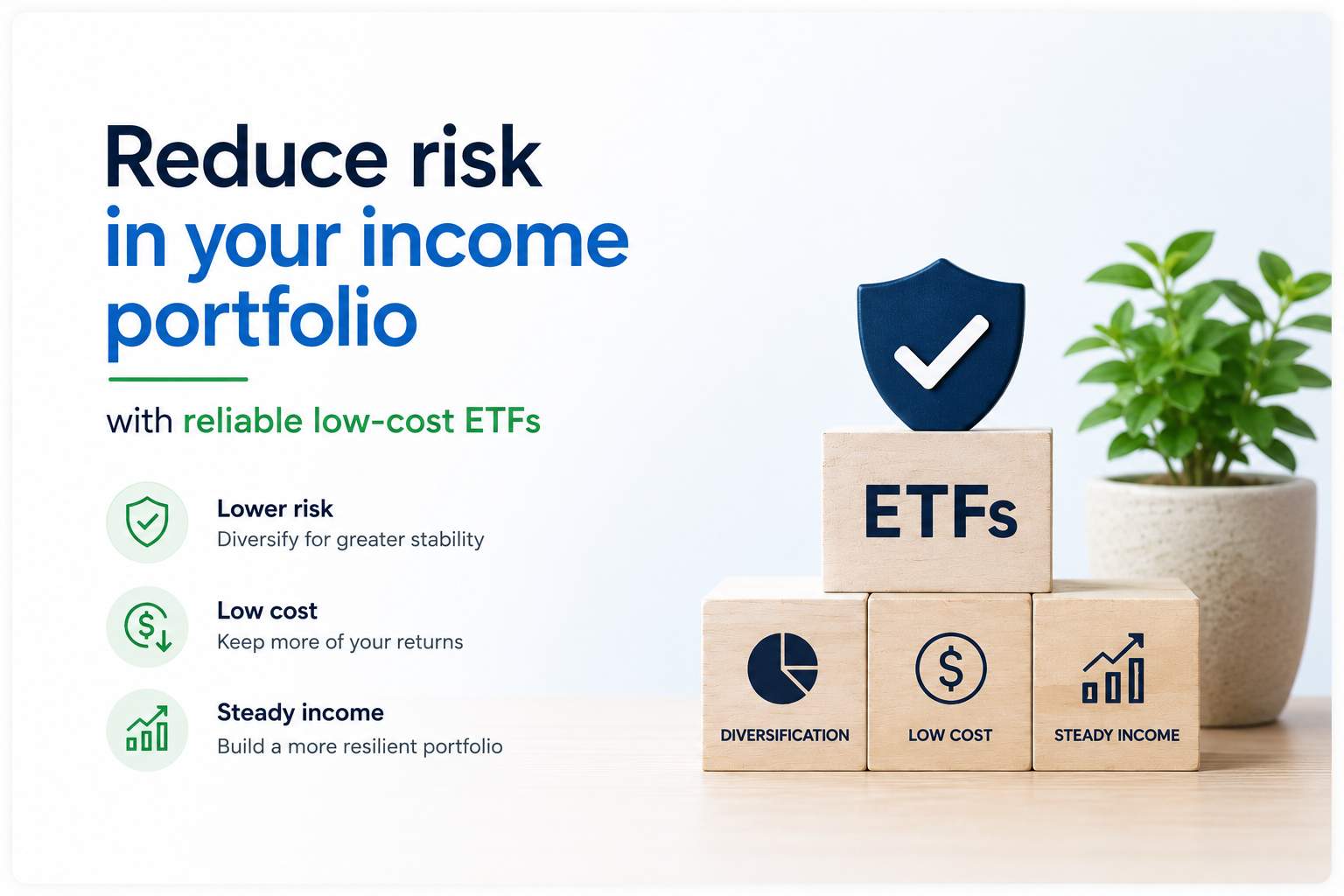
For many UK retail investors, fixed income ETFs have become attractive again after the sharp rise in global bond yields since 2022. With investment-grade bond ETFs now offering yields in the 3.5%–5% range, bonds are once again capable of generating meaningful income while also diversifying equity-heavy portfolios.
A fixed income ETF is simply an exchange-traded fund holding hundreds or thousands of bonds. Rather than buying individual gilts or corporate bonds, investors can access diversified exposure through a single low-cost fund.
⚖️ Why UK investors use bond ETFs
The main diversification benefit comes from bonds often behaving differently to equities during economic slowdowns or market stress. Government bond ETFs in particular can reduce overall portfolio volatility.
Everything you need to know about investing in bonds
Key benefits include:
→ Diversification across issuers, maturities and countries
→ Lower volatility than equities
→ Regular income distributions
→ Daily liquidity on the London Stock Exchange
→ Low costs compared with active bond funds
However, risks remain significant:
- Interest-rate risk: bond prices fall when rates rise
- Duration risk: long-dated bonds are more volatile
- Credit risk: weaker corporate issuers may default
- Currency risk: unhedged global bond funds can fluctuate with FX markets
- Inflation risk: fixed coupons lose purchasing power over time
Duration is particularly important. A bond ETF with a 7-year duration may fall roughly 7% if yields rise by 1%.
Popular fixed income ETF options for UK investors
| ETF | Focus | Ongoing Charge | Key Features | Main Risks |
| Vanguard Global Aggregate Bond UCITS ETF (LON:VAGS) | Global investment-grade bonds | 0.08% | Nearly 12,000 bonds, GBP-hedged, broad diversification | Medium duration risk |
| BlackRock iShares Core Global Aggregate Bond ETF (LON:AGGG or LON:AGUG)* | Global aggregate bonds | 0.10% | Government + corporate exposure | Interest-rate sensitivity |
| BlackRock iShares Global Corporate Bond ETF (LON:CRPU) | Global corporate bonds | 0.25% | Higher yield potential | Higher credit risk |
| Vanguard UK Gilt UCITS ETF (LON:VGOV) | UK government bonds | ~0.07% | Lower default risk | Sensitive to UK rate changes |
| BlackRock iShares £ Corporate Bond 0-5yr ETF (LON:IS15) | Short-duration sterling corporates | Low cost | Lower volatility | Lower yield upside |
*BlackRock iShares Core Global Aggregate Bond ETF (LON:AGGG or LON:AGUG) – different ticker, different function
AGGG and AGUG are both iShares global bond ETFs. The key difference is how they handle the interest they pay out and whether they protect your investment from currency swings.
BlackRock iShares Core Global Aggregate Bond ETF
1. Dividend / Income Handling (Distributing vs. Accumulating)
- AGGG is a Distributing fund. It pays the interest (coupons – the bond equivalent of a dividend) from the bonds directly to your investing account semi-annually.
- AGUG is the ticker for the Accumulating variant. Accumulating funds automatically reinvest the dividends back into the fund to grow its value, rather than paying them out as cash.
2. Currency Hedging
- AGGG is generally unhedged. Its value will fluctuate based on the exchange rate between the base currency (eg, USD or GBP) and the various currencies of the global bonds it holds..
- AGUG is currency-hedged. It uses financial contracts to shield the value of the fund from daily fluctuations against a specific currency, usually the US Dollar.
3. Which to choose?
- Go with AGGG if you want to generate a regular, spendable cash income and do not mind currency fluctuations.
- Go with AGUG if you want to minimize your exposure to foreign currency movements and prefer that your dividends are automatically rolled back into the fund to compound over time.
🌍 Global aggregate bond ETFs: the ‘one fund’ solution
Many UK DIY investors favour global aggregate bond ETFs because they combine:
- Government bonds
- Investment-grade corporate bonds
- Multiple maturities
- Global diversification
Funds such as Vanguard Global Aggregate Bond ETF (LON:VAGS) and iShares Core Global Aggregate Bond ETF (LON:AGGG) hold thousands of securities globally while hedging currency exposure back to sterling.
This hedging is important because currency swings can otherwise dominate bond returns.
Government bonds vs corporate bonds
| Type | Advantages | Disadvantages |
| Government bond ETFs | Defensive characteristics, lower default risk | Lower yields |
| Corporate bond ETFs | Higher income potential | More economically sensitive |
| Short-duration bond ETFs | Lower volatility | Lower total return potential |
| Long-duration bond ETFs | Greater capital upside if rates fall | Higher sensitivity to rising rates |
Many UK investors now blend short-duration gilts with global aggregate funds to balance stability and income. Discussions on UK investing forums increasingly focus on combining short-dated gilts with diversified global bond ETFs to manage volatility ahead of retirement.
💰 Costs matter in fixed income investing
Because bond returns are typically lower than equities over the long term, fees have a larger impact on real returns.
Typical ETF cost ranges:
| ETF Type | Typical OCF |
| Passive gilt ETF | 0.05%–0.10% |
| Global aggregate ETF | 0.08%–0.15% |
| Corporate bond ETF | 0.15%–0.30% |
| Active bond ETF | 0.20%–0.60% |
Low-cost passive ETFs from providers like Vanguard, iShares by BlackRock and JP Morgan Asset Management remain popular among UK retail investors.
👉 Key takeaway for UK retail investors
Fixed income ETFs can play several roles:
→ Portfolio stabiliser
→ Income generator
→ Retirement-risk reducer
→ Diversification tool during equity market weakness
For investors seeking simplicity, a low-cost global aggregate bond ETF may provide the broadest diversification. Investors prioritising capital preservation may prefer short-duration gilt ETFs, while those seeking higher income may lean toward investment-grade corporate bond funds.
The key decision is not simply ‘which bond ETF?’, but rather:
- How much duration risk to take
- Whether to prioritise income or stability
- Whether bonds are intended for defence, income, or both.
You might also like:
