





Inflation is often described as a ‘hidden’ form of income tax as it reduces your spending power. The same is also true if you use your investments to provide a regular income.
In this article, we’ll look at why inflation may be on the rise again. We’ll also highlight some funds, investment trusts and stocks that can help protect your purchasing power.
Why is inflation rising?
The main reason why inflation rises is because demand for goods or services exceeds the supply. That means companies can raise prices. However, if they raise them too far there is a risk demand will fall, so it’s a balancing act.
Demand-led inflation tends to be fairly short-lived, as it is caused by short-term situations. A good example would be computer chips, which are experiencing strong demand for AI processing.
On the other hand, supply-led inflation can last for a long time. Typically, it only falls when an alternative product or service is found. A good example is oil, which despite increases in renewable sources is still the primary source of energy.
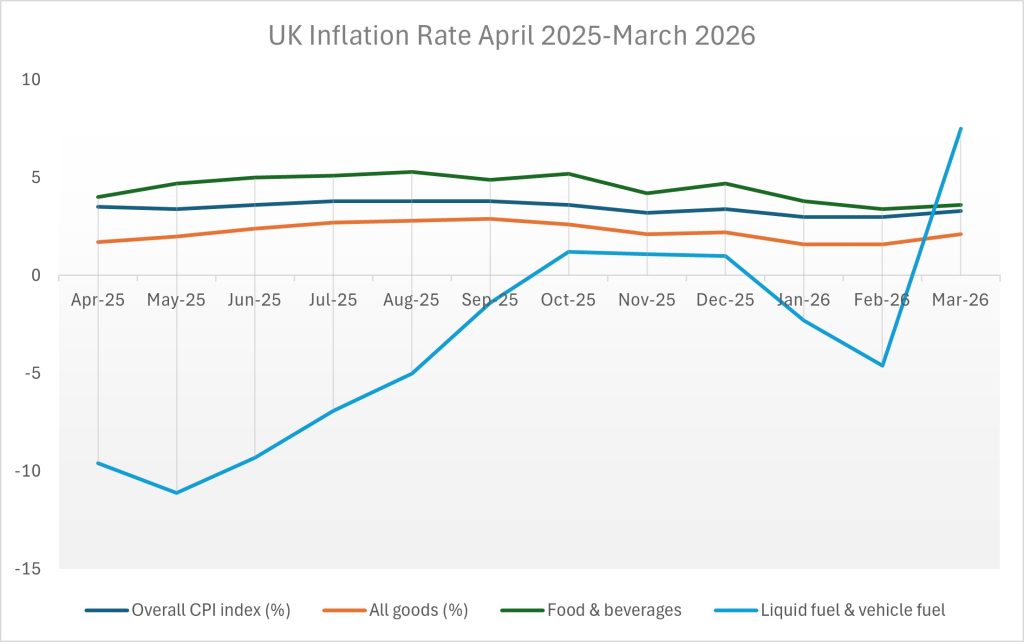
UK inflation increased to 3.3% in March from 3% in February after fuel prices rose the most in three years due to the Iran war (light blue line). Unfortunately, there is probably more pain to come as the secondary effect of higher fuel prices feeds through into food and travel costs.
How does inflation affect my investments?
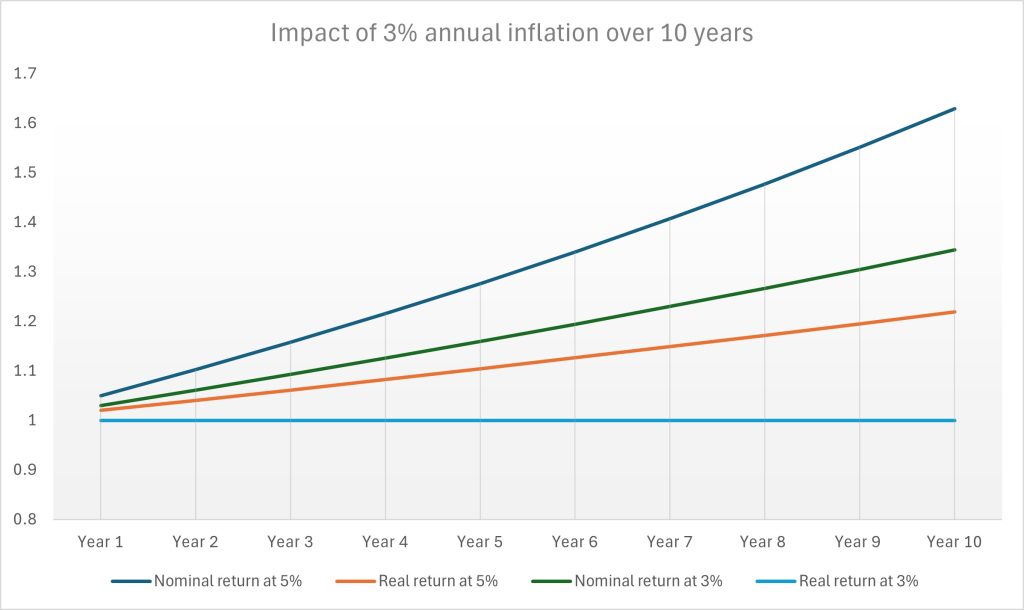
Inflation eats away at your returns, so £1,000 invested today will be worth less than £1,000 a year from now. If the annual rate of inflation is 3%, you need your investments to earn more than 3% to maintain their real value.
If you generated a 5% nominal return on your investments each year, a decade from now your total return would be roughly 63% (dark blue line). However, subtracting inflation at 3%, your real return over the decade would be more like 22% (orange line).
If you only generated a 3% nominal return over the decade, you total return would be around 34% (green line). Taking away inflation at 3%, however, your real return would actually be zero (light blue line).
Inflation-beating funds and trusts
Darius McDermott is managing director at FundCalibre. He tells Sharesify that a diversified blend of real assets can play a vital role in today’s higher inflation environment.
‘While oil has dominated headlines, price pressures are broadening,’ observes McDermott. ‘Industrial metals have risen sharply since mid-March, with copper and aluminium both up more than 11%. And supply chain disruption is beginning to feed into agricultural markets, where tighter fertiliser supply risks pushing food prices higher.’
McDermott stresses that unlike traditional equities and bonds, real assets tend to have a more direct link to inflation. Their revenues and asset values often rise alongside prices.
One fund that takes a balanced approach to real assets is Cohen & Steers Diversified Real Assets (BD5TQG0). ‘Around 40% is allocated to commodities and natural resources, with the remainder diversified across real estate and infrastructure,’ explains McDermott.
‘This allows investors to participate in rising commodity prices, while benefiting from the relative stability of other real assets. The result is a differentiated return profile with built-in inflation sensitivity. This makes it a compelling option in a higher inflation environment.’
An investment trust McDermott believes to be well-positioned for a more inflationary backdrop is BlackRock World Mining (BRWM).
Managed by one of the most experienced teams in the sector, this trust offers broad exposure to the global mining cycle. It invests in developers and major producers and across commodities such as copper, iron ore and gold.
‘While the sector has faced a challenging period, fundamentals are improving,’ McDermott tells Sharesify. ‘Rising M&A activity points to more attractive valuations, while structural demand – particularly for copper, driven by electrification and AI infrastructure – continues to strengthen.’
UK equities are well-equipped
McDermott also highlights the inflation-beating qualities of the UK equity market. ‘In an inflationary environment, it’s larger constituents are relatively well positioned,’ he explains.
‘The FTSE 100 has significant exposure to energy, materials and other real asset-linked sectors. And many of its largest companies have strong pricing power and global revenue streams, with around three quarters of earnings generated overseas.’
McDermott adds: ‘Inflationary shocks, particularly those driven by energy, tend to support the US dollar, which in turn benefits UK large caps with dollar-linked earnings. Combined with attractive valuations and strong dividend income, this creates a favourable backdrop for UK equities in a higher inflation environment. In this space, investors may want to consider large-cap focused UK funds such as Schroder Recovery (B3VVG60) and Rathbone Income (B3Q9WG1).’
Inflation-proof stocks
Jean Roche manages the Schroder Mid Cap Fund (SCP). She flags the inflation-busting credentials of pork and poultry processor Cranswick (CWK). Roche expects Cranswick to be ‘structurally resilient to inflation through disciplined cost pass-through, hedging, and favourable category dynamics’.
Roche points out that pork and poultry are affordable family expenditure items compared with beef for example. ‘What is most instructive is to look back at the experience of 2022/23, when revenue grew around 16% despite margin compression, with profitability recovering above 7% the following year, demonstrating Cranswick’s effective pricing mechanisms.
‘Pork input volatility is typically passed through, albeit with a lag, while poultry operates on near 100% pass-through contracts, materially insulating margins,’ observes Roche.
‘Looking further down the profit and loss account, utilities are well hedged, limiting energy exposure. And Cranswick is benefitting from investment in automation, helping to dampen the effect of any potential labour cost inflation.’
Many companies operating in the UK hospitality sector are experiencing a significant reduction in profitability due to soaring costs. Schroders’ fund manager Graham Ashby notes pub operator JD Wetherspoon (JDW) recently revealed rises in national insurance and labour rates will result in cost increases of approximately £60 million per annum.
However, Hollywood Bowl (BOWL) is faring much better than many leisure peers, according to Ashby. It has been keeping its prices flat in recent years, hence providing better value for money for its family-led customers.
Hollywood Bowl can do this because bowling inherently has high gross margins. And the company has relatively low labour costs at each of its bowling centres.
| Hollywood Bowl | Share price: 260.5p |
| PE ratio: 11.7x | Dividend yield: 5.1% |
‘In addition, Hollywood Bowl has hedged 76% of its electricity needs until the end of FY29, including 12% provided from on-site solar,’ notes Ashby.
‘Finally, Hollywood Bowl has recently expanded into Canada, helping to diversify its offering. Despite these positives, Hollywood Bowl continues to trade on a prospective price-to-earnings (P/E) ratio of less than 12 times, close to 3-year lows.’
Talking of Canada
Talking of Canada, Greg Eckel manages North America-focused investment trust Canadian General Investments (CGI). He tells Sharesify that areas of the market with direct exposure to real assets and/or pricing power tend to offer some kind of inflation protection.
‘Much like the UK, Canada is heavily overweight to energy and materials, which provide one of the purest inflation hedges,’ he explains.
Resources make up close to 40% of the Canadian stock market index. That gives investors direct leverage to rising commodity prices, where protection is typically strongest when inflation is driven by supply shocks.
‘The conventional inflation hedge is gold, which we access through Franco-Nevada (FNV),’ says Eckel. ‘This is a gold-focused royalty and streaming company that has remained a core position of ours since its 2007 IPO.
‘Instead of running mines, Franco-Nevada provides upfront funding to miners in exchange for the right to buy gold at a fixed low price. This means it benefits when gold prices rise without taking on the risks of operating a mine. Gold has historically acted as a store of value when inflation erodes the purchasing power of fiat currencies.’
Eckel also highlights uranium as a scarce commodity with constrained supply and growing structural demand. This means uranium can perform well when inflation is tied to energy shortages and resource constraints.
‘Companies like Cameco (CCO), one of the world’s largest and most cost-efficient uranium miners, are well-positioned in this environment,’ enthuses Eckel.
Beyond commodities, businesses with strong pricing power can also help protect portfolios.
‘Canadian Pacific Kansas City (CP), the only single-line freight rail network connecting Canada, the US and Mexico, can pass on higher costs as a critical transport network,’ says Eckel. The trust is also owns discount retailer Dollarama (DOL), which tends to benefit as consumers trade down.
‘There’s no single ‘inflation-proof’ stock,’ concedes Eckel. ’But focusing on real assets and resilient businesses with the ability to protect their margins can help investors navigate a rising cost environment.’
You might also like these stories:
