




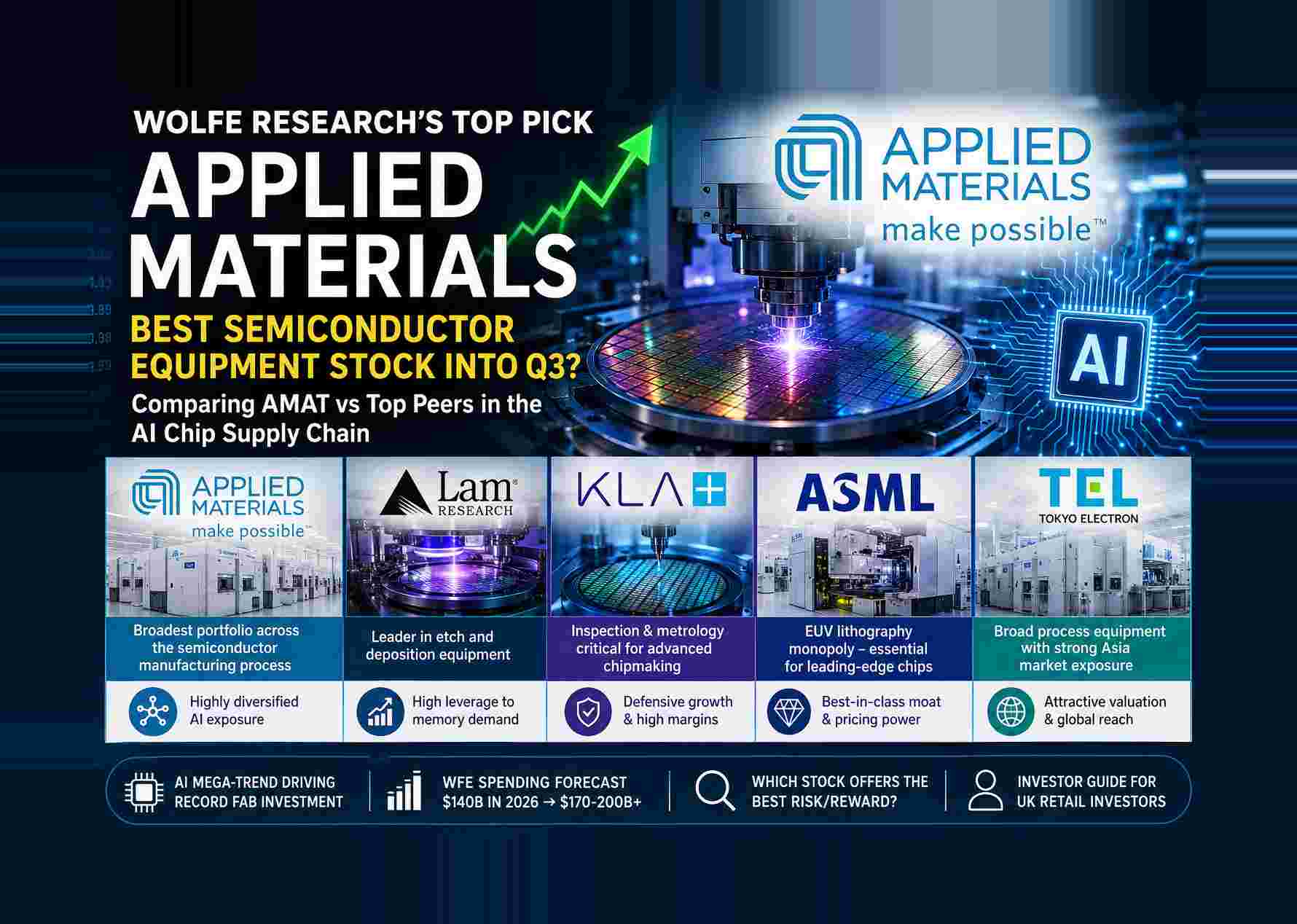
Wolfe Research has reportedly named Applied Materials (NASDAQ:AMAT) its preferred semiconductor capital equipment (SCE) stock ahead of the upcoming earnings season. It is an understandable call given Applied Materials is well supported by industry fundamentals, but UK retail investors should recognise that the sector offers several high-quality alternatives, each with different risk/reward characteristics.
The AI investment boom is no longer just about buying chip designers like Nvidia (NASDAQ:NVDA). Every advanced AI processor must first be manufactured in a semiconductor fabrication plant (‘fab’), and those fabs cannot operate without equipment supplied by companies such as Applied Materials, ASML (AMS:ASML), Lam Research (NASDAQ:LRCX), KLA (NASDAQ:KLAC) and Tokyo Electron (TYO:8035).
| Applied Materials (NASDAQ:AMAT) | Price: $575.39 (+114% YTD) | Market cap: $456.84bn |
Applied Materials investor relations
With hyperscalers including Meta Platforms (NASDAQ:META), Microsoft (NASDAQ:MSFT), Amazon (NASDAQ:AMZN) and Alphabet (NASDAQ:GOOG) continuing to invest hundreds of billions of dollars into AI infrastructure, demand for wafer fabrication equipment (WFE) continues to strengthen. Industry forecasts now expect global semiconductor equipment spending to keep rising through 2027-28 as AI drives unprecedented fab investment.
AI leadership drives another standout year for popular Polar Capital Technology Trust
What does Applied Materials do?
Applied Materials is one of the world’s largest manufacturers of semiconductor production equipment.
Its tools are used during multiple stages of chip production, including:
- Thin film deposition
- Materials engineering
- Etching
- Inspection
- Advanced packaging
- Process control software
Unlike ASML, which dominates only lithography, Applied Materials sells equipment across a much broader range of manufacturing steps, making it one of the most diversified businesses in semiconductor equipment.
Where does Applied Materials sit in the AI supply chain?
The AI supply chain broadly looks like this:
| Stage | Companies |
| AI chip designers | Nvidia, AMD, Broadcom, Marvell |
| Foundries | TSMC, Samsung, Intel Foundry |
| Equipment suppliers | Applied Materials, ASML, Lam Research, KLA, Tokyo Electron |
| Memory manufacturers | Micron, SK Hynix, Samsung |
| Cloud operators | Microsoft, Amazon, Alphabet, Meta |
Applied Materials effectively sells the ‘picks and shovels’ used to manufacture AI chips, regardless of which chip designer ultimately wins.
That diversification is a major attraction for investors.
Applied Materials’ main international competitors
| Company | Core strength | AI exposure |
| Applied Materials | Broad wafer fabrication equipment | Very high |
| ASML | EUV lithography monopoly | Extremely high |
| Lam Research | Etch and deposition | Extremely high |
| KLA | Inspection and metrology | High |
| Tokyo Electron | Broad process equipment | Very high |
Each benefits from rising semiconductor capital expenditure, but each occupies a different niche.
Why Wolfe likes Applied Materials
Applied Materials arguably has the best balance between:
- exposure to leading-edge logic chips
- rapidly growing DRAM memory spending
- advanced packaging
- recurring service revenues
Several Wall Street firms have become increasingly bullish on semiconductor equipment spending after hyperscalers accelerated AI investment.
Recent forecasts suggest wafer fabrication equipment spending could approach $140bn in 2026 before rising further towards $170bn-$200bn over the following few years.
That is supportive for virtually the whole sector.
Relative valuation
Approximate consensus forward valuations are:
| Company | Approx. forward P/E | Investment view |
| Applied Materials | ~38x | Attractive growth at premium price |
| Lam Research | ~41.5x | Premium justified by memory exposure |
| ASML | ~40x | Highest quality, expensive |
| KLA | ~43x | Defensive compounder, high valuation |
| Tokyo Electron | ~38x | Similarly valued major global peer |
Source: Stockopedia, Finbox. Figures are approximate consensus estimates and change as earnings forecasts are updated.
Applied Materials therefore sits towards the lower end of the valuation range.
It is no longer cheap after its strong 2026 rally, but neither does it command the premium valuation attached to some of its peers.
Growth opportunities
Applied Materials (NASDAQ:AMAT) $575.39
Pros
- Exposure to almost every advanced fab
- Benefiting from AI memory investment
- Strong advanced packaging business
- Large recurring services revenue
- Diversified customer base
Risks
- China export restrictions
- Cyclical semiconductor spending
- Already enjoyed a significant share price recovery
ASML (NASDAQ:AMAT) €1,538
Pros
- Effective monopoly in EUV lithography
- Exceptional competitive moat
- Long-term pricing power
Risks
- Highest valuation
- China restrictions
- Lower potential for positive earnings surprises because expectations remain high
Lam Research (NASDAQ:LRCX) $329.92
Pros
- Perhaps the biggest beneficiary of AI memory spending
- Strong DRAM exposure
- Historically delivers large earnings beats during upcycles
Risks
- More cyclical than Applied Materials
- Greater dependence on memory spending
KLA (NASDAQ:KLAC) $222.25
Pros
- High recurring software and service revenue
- Inspection demand rises with chip complexity
- Excellent margins
Risks
- Less operational leverage than peers during investment booms
Tokyo Electron (TYO:8035) ¥71,130
Pros
- Attractive valuation
- Significant Asian market exposure
- Broad equipment portfolio
Risks
- Higher exposure to Japanese currency movements
- Greater China revenue exposure
Which stock has the greatest upside surprise potential?
If AI spending remains stronger than expected:
- Lam Research
- Applied Materials
- Tokyo Electron
- KLA
- ASML
Lam Research’s larger exposure to memory equipment arguably provides the greatest operating leverage if DRAM investment continues accelerating.
Applied Materials ranks close behind because it participates across multiple parts of the manufacturing process rather than relying on one technology.
What could go wrong?
Investors should also remember the risks:
- AI capital expenditure could eventually moderate.
- US export restrictions to China remain an ongoing uncertainty.
- Semiconductor equipment has historically been highly cyclical.
- Expectations have risen sharply after recent share price gains, making earnings guidance especially important. Applied Materials has also previously faced regulatory scrutiny relating to export controls.
Investor verdict
Wolfe Research’s preference for Applied Materials is well supported by industry fundamentals.
Unlike many AI stocks that depend on one winning chip architecture, Applied Materials benefits whenever semiconductor manufacturers build more advanced fabs. Its broad exposure to logic chips, memory, advanced packaging and services makes it one of the most diversified AI infrastructure investments available.
However, it may not offer the biggest upside. Investors seeking maximum leverage to the current AI memory boom could prefer Lam Research, while those prioritising an unrivalled competitive moat may still favour ASML despite its richer valuation.
For most UK retail investors wanting long-term exposure to the AI infrastructure build-out, Applied Materials arguably offers one of the best combinations of growth potential, diversification and valuation in the semiconductor equipment sector. It may not be the cheapest stock in the wider group, but it arguably provides the most balanced risk-reward profile heading into Q3 earnings.
You might also like:
