




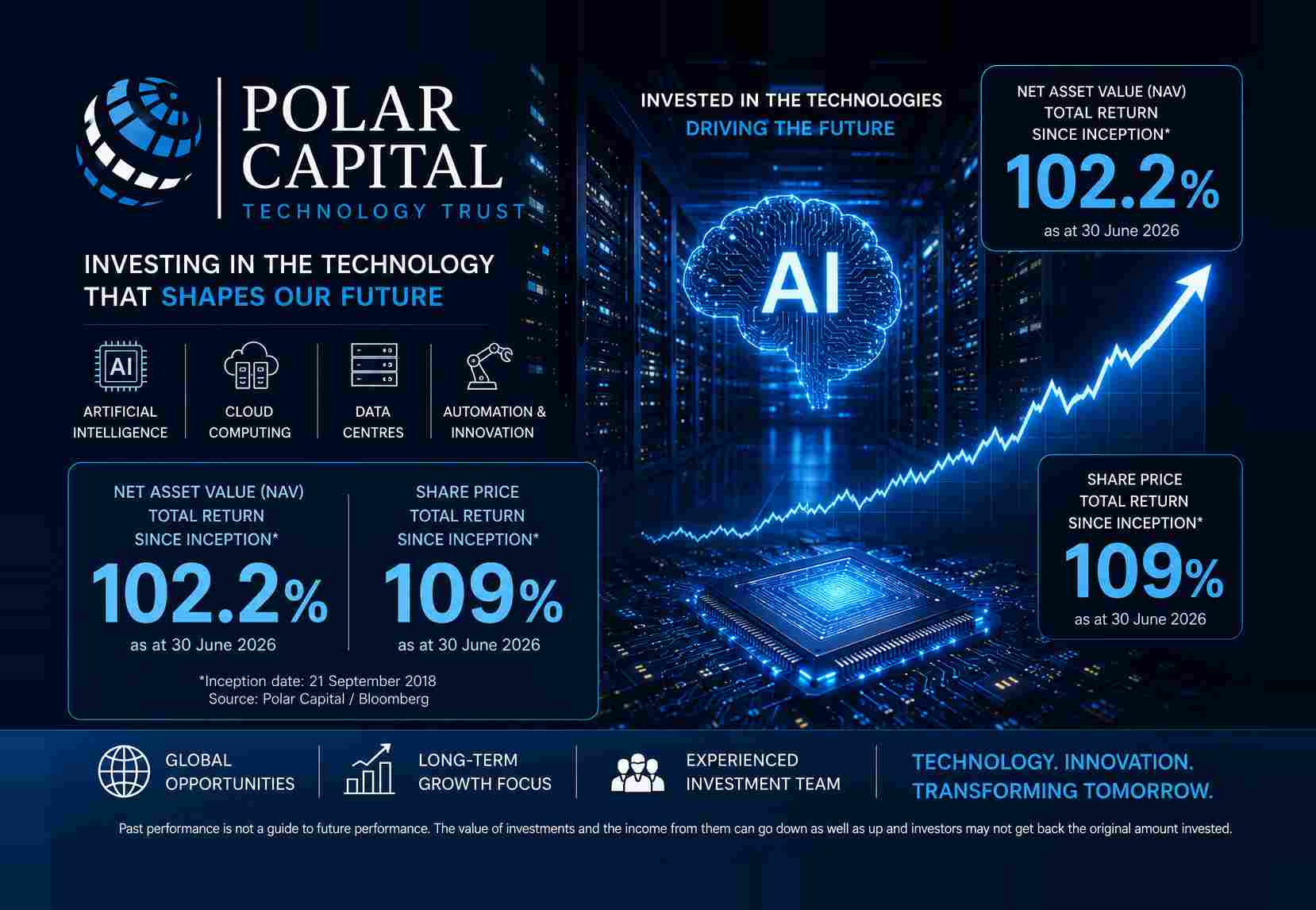
FTSE 100 tech specialist trust Polar Capital Technology Trust (LON:PCT) delivered another exceptionally strong year to 30 April 2026, comfortably outperforming global equity markets as artificial intelligence (AI), semiconductor and cloud infrastructure spending continued to accelerate. The hugely popular trust remains one of the strongest ways to access global AI and technology through the London market.
Although the trust’s shares produced excellent returns, they still trade at a meaningful discount to net asset value (NAV), leaving investors with exposure to one of the strongest long-term technology portfolios at less than the value of its underlying assets.
Polar Capital Technology Trust key investor information
| Polar Capital Technology Trust (LON:PCT) | Price: 680p (0%, flat) | Market cap: ~£7.53bn |
Performance at a glance
| Metric | FY2026 |
| NAV total return | 102.2% (Strongly ahead of global equities) |
| Share price total return | 109% (Outperformed benchmark thanks to discount narrowing) |
| Benchmark | 55% (Dow Jones Global Technology Index Sterling) |
The trust benefited from two return drivers:
- exceptional appreciation in its underlying technology holdings; and
- a narrowing of the long-standing discount to NAV as investor enthusiasm for AI-related assets returned.
Despite this improvement, the shares continue to trade at roughly an 8%-10% discount to NAV, below asset value but materially narrower than levels seen during the technology sell-off of 2022-24.
Why performance was so strong
Lead manager Ben Rogoff says the investment case remains centred on the early stages of a multi-year AI infrastructure build-out rather than a short-lived technology boom.
Management argues AI spending is progressing through several phases:
- AI infrastructure (GPUs, memory and networking)
- Cloud deployment
- Enterprise software adoption
- Productivity gains across the wider economy
The trust remains heavily invested in companies benefiting from each stage.
Six of the largest investment trusts: why UK retail investors own them, and should you?
The manager also highlights that technology earnings growth continues to exceed the wider market, with sector earnings forecasts for 2026 comfortably ahead of broader market expectations, supporting premium valuations.
Best-performing investments
The biggest contributors included companies directly exposed to AI infrastructure, although underweight positions in Microsoft (NASDQ:MSFT) (+417bps) and Apple (NASDQ:AAPL) (+360bps) were among the largest stock-level contributors.
| Strong contributors | Why |
| Nvidia | Continued AI GPU demand |
| Broadcom | AI networking and custom silicon |
| Micron Technology | HBM memory demand |
| Taiwan Semiconductor Manufacturing Company | AI chip manufacturing |
| SK Hynix | AI memory leadership |
These companies have become the essential ‘picks and shovels’ suppliers for hyperscale AI investment.
Stocks that lagged
Although the annual results note strong overall returns, weaker contributors generally came from:
- consumer electronics
- selected software names
- companies where AI monetisation is taking longer than investors expected
- businesses facing cyclical demand weakness
The portfolio avoided major structural losers and remained concentrated in businesses with improving earnings expectations rather than speculative AI themes.
Portfolio changes
The managers continued to rotate capital toward companies with stronger AI exposure.
Recent additions and increased positions generally focused on:
- AI semiconductor equipment
- advanced memory
- networking infrastructure
- cloud software
- selected cybersecurity businesses
Meanwhile positions were reduced or sold where:
- valuation became excessive
- AI opportunity looked fully priced
- capital could be deployed into stronger opportunities
Rather than making wholesale changes, the managers continue to run a relatively concentrated, high-conviction portfolio – 97 stocks at 30 April.
Top 10 holdings
As at the latest published portfolio update:
| Holding | Approx. portfolio weight* |
| Nvidia | 8.9% |
| Alphabet | 8.5% |
| TSMC | 5.1% |
| Broadcom | 4.9% |
| Advanced Micro Devices | 3.8% |
| Samsung Electronics | 2.6% |
| Apple | 2.4% |
| Meta Platforms | 2.4% |
| Intel | 2.2% |
| Micron Technology | 2.0% |
* = At 30 April 2026
Collectively, the top 10 holdings represent around 42.8% of assets, illustrating the managers’ high-conviction approach.
Manager commentary
This year saw manager Ben Rogoff celebrate his 20th anniversary leading the trust, during which NAV has increased 2,498% versus the benchmark’s 1,825% increase. Rogoff remains highly constructive on technology despite the sector’s powerful rally.
His principal observations include:
- AI investment remains in its early innings rather than approaching a peak.
- Enterprise AI adoption is accelerating beyond simple chatbot applications into software development, healthcare, cybersecurity and industrial automation.
- Cloud providers continue investing aggressively in data centres.
- Semiconductor demand is becoming broader rather than concentrated solely in Nvidia.
- Technology companies continue generating superior earnings growth compared with the wider market.
Management believes investors continue to underestimate how much AI infrastructure will ultimately be required.
Key opportunities
The trust sees several powerful long-term drivers:
- expanding AI datacentre investment
- enterprise AI software adoption
- semiconductor content growth
- memory demand
- robotics and automation
- cybersecurity
- cloud computing
- autonomous systems
Many of these trends are expected to play out over many years rather than a single economic cycle.
Principal risks
Retail investors should also recognise several risks:
| Risk | Potential impact |
| High technology valuations | Greater share price volatility |
| Slower AI spending | Earnings disappointments |
| Semiconductor cycle | More volatile profits |
| US-China tensions | Supply-chain disruption |
| Regulation | Pressure on mega-cap platforms |
| Market concentration | Greater dependence on a small number of winners |
Technology trusts can fall much faster than global equity funds during market corrections.
Charges
A new fee structure was introduced in May 2025 over two tiers, with the complete removal of performance fees. This enhances the trust’s competitive charges for an actively managed specialist technology portfolio.
• Tier 1: 0.75% on NAV up to and including £2bn
• Tier 2: 0.60% on NAV above £2bn
| Charge | Current level |
| Ongoing charge | 0.60%-0.75% tiered |
| Performance fee | None |
| Gearing | Used selectively |
What does the NAV discount mean?
One attraction for UK investors is that the shares still trade below NAV.
For example:
- £1,000 invested buys exposure to more than £1,000 worth of underlying technology assets.
- If performance remains strong and the discount narrows further, shareholders can benefit from both portfolio gains and an improving valuation of the trust itself.
- However, discounts can widen again during periods of market stress, amplifying losses even if the portfolio performs relatively well.
Outlook
The medium-term outlook remains favourable. AI capital expenditure from hyperscalers is still increasing, enterprise adoption continues to broaden, and semiconductor demand extends well beyond graphics processors into networking, memory and manufacturing equipment.
While valuations across parts of the technology sector are elevated, the managers argue that unusually strong earnings growth provides fundamental support.
Investor verdict
For UK retail investors, Polar Capital Technology Trust remains one of the strongest ways to access global AI and technology through the London market. It is best suited to investors with a long investment horizon who can tolerate periods of sharp volatility.
The recent rally means short-term gains may be less spectacular than over the past year, but if AI investment continues expanding as management expects, the trust appears well positioned to deliver further capital growth over the next three to five years. The remaining discount to NAV also provides an additional potential source of upside if investor demand for technology investment trusts remains strong.
Disclaimer: The author Steven Frazer has a personal interest in Polar Capital Technology Trust.
You might also like:
