


Facebook and Instagram-owner Meta Platforms (NASDAQ:META) delivered another quarter of exceptional revenue growth, but investors focused instead on the enormous cost of CEO Mark Zuckerberg’s AI ambitions. Although advertising demand remained extremely strong, soaring capital expenditure, sharply lower free cash flow and increased legal costs overshadowed the operating performance, sending the shares sharply lower in after-hours trading.
| Meta Platforms (NASDAQ:META) | Price: $534.39 (-9% after-hours) | Market cap: ~$1.36tn |
Q2 2026 at a glance
| Metric | Q2 2026 | Market expectation | Verdict |
| Revenue | US$60.8bn | US$60.2bn | ✅ Beat |
| EPS | US$6.18 | ~US$7.13 | ❌ Miss |
| Revenue growth | +28% YoY | +27% | Strong |
| Free cash flow | US$784m | n/a | Sharp decline |
| 2026 Capex guidance | US$130-145bn | Raised | Negative surprise |
Revenue remains world class
Meta’s advertising engine continues to outperform almost every other internet platform.
Its AI recommendation algorithms are increasing user engagement across Facebook, Instagram, Reels and Threads while simultaneously improving advertising targeting and pricing.
Daily users across Meta’s family of apps reached roughly 3.6 billion, underlining just how dominant the ecosystem has become. Instagram alone is estimated to have surpassed 2 billion daily users, while Threads continues growing rapidly.
For UK investors, this reinforces one important point:
Meta remains primarily an advertising company—and arguably the world’s highest-quality digital advertising franchise.
The market focused on one number: capital spending
Instead of celebrating 28% revenue growth, investors worried about how much cash Meta intends to spend.
Management lifted expected 2026 capital expenditure to around US$130-145bn, almost entirely driven by AI infrastructure including:
- AI training clusters
- custom silicon
- networking equipment
- power infrastructure
- new hyperscale data centres
Reuters estimates Meta now has around 32 major AI datacentre sites under development or expansion.
This spending caused quarterly free cash flow to collapse.
Meta’s cloud ambitions: What they could mean for UK retail investors
Cash flow versus capex
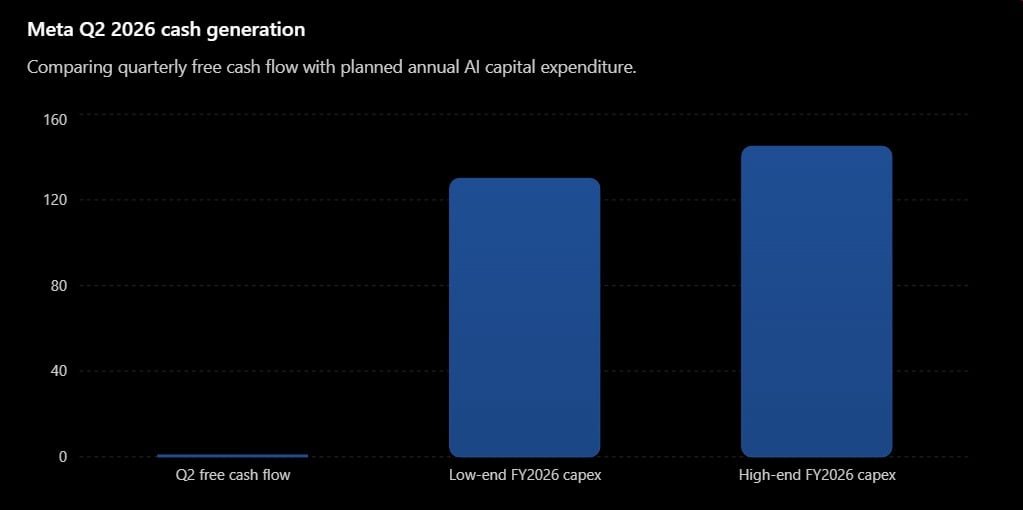
The comparison illustrates why investors reacted negatively.
Meta still generates enormous operating cash flow, but virtually all of it—and more—is now being reinvested into AI infrastructure.
Analyst reaction
Initial analyst commentary has been mixed.
Positive arguments
- Advertising business remains exceptionally strong.
- AI continues improving engagement and monetisation.
- Meta’s scale advantage is widening.
- Revenue growth remains among the strongest within mega-cap technology.
Several analysts argue that today’s spending resembles Amazon’s cloud investment cycle over a decade ago—painful initially but potentially value creating over many years.
More cautious views
Other analysts highlighted:
- Free cash flow fell around 91%.
- Capital intensity continues rising.
- Legal charges hurt profitability.
- Investors may have to wait several years before AI investments generate attractive returns.
The share price decline suggests markets are questioning whether returns on AI investment will justify today’s enormous spending.
Market position
Meta remains one of only a handful of companies capable of funding AI at unprecedented scale.
Competitive strengths include:
| Area | Position |
| Digital advertising | Global leader alongside Alphabet |
| Social media | Facebook, Instagram, WhatsApp, Threads |
| AI infrastructure | One of world’s largest buyers of AI chips |
| Consumer AI | Llama ecosystem expanding rapidly |
| Wearables | Ray-Ban Meta smart glasses gaining traction |
Few companies possess:
- billions of daily users
- enormous advertising cash generation
- global AI infrastructure
- proprietary AI models
That combination gives Meta considerable long-term advantages.
Valuation versus peers
Approximate forward valuation multiples:
| Company | Forward P/E | EV/EBITDA | FCF Yield |
| Meta | ~17x | ~12x | ~0.06%* |
| Alphabet | ~20x | ~12x | ~0.6%* |
| Microsoft | ~20x | ~22x | ~2.5%* |
| Amazon | ~17x | ~18x | ~0.5%* |
| Apple | ~35x | ~31x | ~2.6% |
*Near-term free cash flow temporarily depressed by record AI investment.
Despite today’s sell-off, Meta still trades on a lower earnings multiple than Microsoft while offering significantly faster revenue growth.
Opportunities
✓ AI-driven advertising improvements
✓ WhatsApp monetisation
✓ Threads advertising rollout
✓ AI assistants
✓ Smart glasses and wearable AI
✓ Higher operating leverage once AI investment moderates
Risks
⚠ AI spending may remain elevated for years.
⚠ Free cash flow could stay under pressure.
⚠ Competition from OpenAI, Google and emerging AI models.
⚠ Regulatory investigations in Europe and the US.
⚠ Ongoing legal cases relating to child safety and platform design.
Bull vs Bear case
| 🐂 Bull case | 🐻 Bear case |
| AI improves advertising productivity dramatically. | AI investment never earns adequate returns. |
| Revenue continues growing above 20%. | Margin compression continues. |
| WhatsApp and Threads become major profit centres. | Free cash flow remains weak for several years. |
| Llama ecosystem becomes a leading AI platform. | Competition erodes pricing power. |
| Valuation expands as AI monetisation becomes clearer. | Investors assign a permanently lower valuation multiple because of heavy capital intensity. |
Investor verdict
For UK retail investors, the headline earnings miss arguably matters less than the strategic shift underway, illustrated by that fact that investors focused instead on the enormous cost of CEO Mark Zuckerberg’s AI ambitions.
Meta is transforming from a highly cash-generative advertising platform into one of the world’s largest AI infrastructure investors. Revenue growth remains exceptional, and the core advertising business appears stronger than ever. However, shareholders must now accept that a much larger share of operating cash flow will be reinvested rather than returned via buybacks or balance-sheet accumulation.
If Zuckerberg’s AI strategy delivers, today’s spending could look visionary in hindsight. If returns disappoint, the market is likely to continue questioning whether Meta deserves its previous premium valuation. After the post-results sell-off, the shares may appeal to long-term investors willing to tolerate significant near-term volatility in exchange for exposure to one of the strongest AI ecosystems in global technology.
You might also like:


