





As the last few weeks have shown, having too much of a good thing – like a portfolio full of US tech stocks – carries risks. Even global index products like ETFs are 72% weighted to the US and 30% to technology.
For years, cheap capital has enabled businesses without any earnings, including tech firms, to raise billions of dollars. Investors believed the ‘story’ was more important than profits and growth was more important than return on invested capital.
However, as interest rates have increased, companies which burn through cash are discovering capital comes at a price. Investors don’t have to finance stocks on sky-high multiples when they can get a meaningful return on government bonds.
The question is, will investors keep financing these businesses? The sharp move up in credit default swaps on Coreweave (NASDAQ:CRWV) suggests confidence in the AI spending splurge is waning.
Growth at a reasonable price
Before the AI ‘story’, GARP (growth at a reasonable price) was a popular investment strategy. However, in recent years owning growth stocks at reasonable prices has produced mediocre results compared with owning tech stocks.
We believe that is changing as investors come to appreciate the qualities of well-run, well-financed companies outside the tech sector. We also believe valuation will matter again, rather than investors ignoring it as some fusty relic of a bygone age.
The good news is, there are plenty of UK growth companies which have nothing to do with AI or tech. Not only that, AI isn’t likely to disintermediate their businesses either. To our knowledge, no-one has yet coded a pizza or a sausage roll.
Finding non-tech growth companies
We screened our model for companies which have increased earnings by 10% or more over at least the last decade. Some companies have much longer trading histories, but we feel a minimum of 10 years is a good start.
We also looked at the volatility of earnings over time and weeded out companies which appeared overly cyclical. Then we compared consensus forecasts for FY26 through FY28 with our presumed ‘trend’ to make sure they tallied.
Next we looked at their balance sheets, and eliminated those we felt had too much net debt or gearing. Having some debt isn’t a bad thing, but we prefer businesses which are self-financing and generate surplus cash.
Finally, we looked at the valuation using a CAPE (cyclically-adjusted PE) approach for stocks trading well below their historic mean. The resulting selection represents what we believe are six of the best non-tech UK growth stocks trading at attractive valuations. They also represent companies which, instead of seeing AI as a threat, could harness it to improve their businesses.
Non-tech UK growth stocks ranked by EPS growth rate
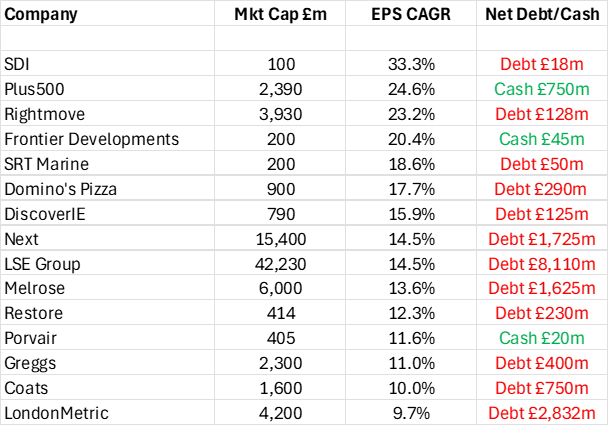
Source: Sharesify, company accounts, Marketscreener
Note: Net debt/cash based on FY27 forecasts from S&P Global Market Intelligence
Plus500 (LON:PLUS)
While it boasts a proprietary technology, we regard trading platform Plus500 (LON:PLUS) as a financial firm not a tech firm. Since it listed in July 2013, we calculate the company has grown its earnings per share by 24.6% per year.
Growth is largely organic, driven by new product development, supplemented by targeted bolt-on acquisitions in new markets. Plus500 then uses its infrastructure and technology to build out its offering and capture new clients.
This year has seen a spate of small-ish acquisitions, including two this month, in the US and Brazil. The acquisition of Hedge Capital Markets in New York marks the group’s entry into the SEC-regulated part of the market.
As well as providing access to exchange-listed stocks and ETFs, the deal strengthens Plus500’s presence ahead of the launch of its US ‘super-app’ next year. The company hopes the app will drive deeper customer engagement, higher retention and monetisation.
In Brazil, which is one of the world’s most dynamic retail trading markets, the firm has bought a local broker-dealer. As well as increasing its local product base, the firm plans to offer customers access to US derivatives markets.
With the shares 35% below their 2026 high and on 11 times earnings, Plus500 represents exceptional growth at a reasonable price. Moreover, subtracting its $860 million cash pile, the underlying business trades on eight times forward earnings, which is a bargain.
Added to the upside potential, shareholders can look forward to a substantial return of capital via dividends and buybacks. After an ‘outstanding’ H1, the firm announced FY dividends of $82.5 million (£62 million) and a $100 million (£75 million) buyback.
Rightmove (LON:RMV)
Again, while it uses its own proprietary technology, we don’t believe property portal Rightmove (LON:RMV) is a tech stock. We also don’t believe AI will disintermediate its structural advantages or its ‘network effect’.
The portal was formed in 2000 by four leading estate agencies and came to the market in March 2006. We calculate that since then the company has compounded its EPS by 23% per year or thereabouts.
After peaking in late 2021 following the Covid-driven surge in house-buying, the shares took until July 2026 to hit another high. This was short-lived, however, as the firm then lowered its FY26 revenue growth forecast due to weak new-build sales.
Rightmove doesn’t sell houses itself, it charges estate agents and developers a monthly fee to advertise their properties. According to Comscore, it is the dominant site for UK listings with a 90% market share of viewing time.
Simply put, the more viewers come to the site, the more the advertisers need to make sure they are visible. The more advertisers that subscribe, the more likely viewers are to continue visiting, which all creates the ‘network effect’.
Because it is a near-pure subscription business, the more revenue it generates the higher the margin and cash flow generation. And while the firm is constantly improving its offering, allowing it to increase fees, its capex spend is absolutely miniscule.
The market perceives two threats to the business: AI and litigation. As we have said, we think concerns over AI are overdone. The litigation issue is less clear, however, as a class action for up to £1.56 billion of damages was lodged in April 2026 with a hearing scheduled for November 2026.
Frontier Developments (LON:FDEV)
We’re the wrong demographic to play its games, but we still appreciate Frontier Developments’ (LON:FDEV) quality growth characteristics. The Cambridge-based games developer and publisher has built three enviable franchises in Planet Coaster, Planet Zoo and Jurassic World.
Since joining the market in July 2013, we calculate the firm has grown its earnings by around 20% per year. Growth hasn’t been linear, however, with a steep fall from 2019 to 2023 culminating in losses followed by a recovery.
The losses stemmed from disappointing sales of F1 Manager and weak sales of Planet Coaster and Jurassic World Evolution. The firm also over-spent on development and its diversification strategy backfired, leading to write-downs.
New CEO Jonny Watts refocused the business on its core CMS (construction and management simulation) franchises, restoring growth and profitability. This year the company posted record profit, beating its upgraded guidance, and announced a special dividend.
Current CEO Jo Cooke, who was chief marketing officer from 2014 to 2017, has maintained the firm’s focus on its core strengths with the success of Jurassic World Evolution 3. In addition, Cooke has secured a deal to develop and publish games drawing on Disney’s (NYSE:DIS) iconic portfolio of characters.
Also, the firm has developed the next installment in the hugely-popular Warhammer 40000: Chaos Gate series. Deathwatch is a direct sequel to Daemonhunters, and is due for release on PC and major consoles this winter.
Ironically, neither the turnaround under Watts nor the progress made under Cooke has been rewarded by the market. The shares trade at a fraction of their peak, despite FY26 EPS being comfortably higher, offering significant mean reversion potential.
Domino’s Pizza (LON:DOM)
As we said earlier, AI can do many things but it has yet to create a pizza from code. Domino’s (LON:DOM), on the other hand, has been making pizzas and increasing its sales and earnings for over 25 years.
We calculate the firm has grown its EPS by an average of over 17% per year over that period, including during Covid when traditional restaurants were closed. Sadly, shareholders haven’t seen much benefit as the shares have de-rated over the last decade and currently trade close to their lowest valuation since listing.
Quite why is a mystery to us, unless it’s just another example of the market being unwilling to pay up for growth stocks. And despite the gloomy narrative around the UK consumer, Domino’s has grown its sales every quarter this year.
The firm has pursued a two-pronged strategy of a more traditional core product range and targeting new customers. Its Italianos range of thinner-crust pizzas appeals to a more discerning diner, while its CHINK ‘N’ DIPS range is aimed at chicken lovers.
Using the trusted Domino’s brand to offer chicken opens up a vast new addressable market. That is feeding into larger order sizes and customer feedback has been overwhelmingly positive.
Having fixed its input costs for FY26 and part of FY27, the firm’s short-term priority is to scale these new initiatives while maintaining strong cash discipline. Also, with its new Avonmouth supply centre boosting network efficiency, cash flow can be used to reduce debt, which is higher than we would like but is trending lower.
With a stronger platform, a clear plan and evidence its strategy is working, we belive Domino’s can deliver attractive organic growth. Once the market starts to appreciate this opportunity, we believe the upside could be substantial.
Porvair (LON:PRV)
Filtration, laboratory equipment and environmental technology group Porvair (LON:PRV) is one of the few industrials to make our list. That’s because most small-cap, double-digit-growth industrials are either expensive or have been taken over in the M&A wave.
The Norfolk-based firm joined the market in 1992, and has grown annual earnings by around 11.5% over the last 20 years. Interestingly, it has achieved this with very little volatility, suggesting it is non-cyclical which is a bonus in our view.
Its three divisions, Aerospace & Industrial, Laboratory and Metal Melt Quality, serve a range of specialist markets. Many components are designed specifically for particular applications, for example in fuel and hydraulic systems for commercial aircraft or in hot gas and pulse jet filtration systems for the energy industry.
A high proportion of revenue is recurring, as is cash flow, and cash conversion is typically around 90% or more. Earlier this month, the firm said trading was slightly ahead of the prior-year period and the full year would be ahead of expectations.
Also, the board set out new financial targets as it seeks to make Porvair more scaleable and more cash-generative with higher growth and higher returns. These targets included revenue growth of over 10%, an operating profit margin of 16% to 18%, a return on invested capital of over 18% and EPS growth of 10% to 20%.
While Porvair shares aren’t as undervalued as the rest of the companies on our list, they are cheap versus their own history. Therefore it joins the ranks of great companies available at a fair price rather than an exceptional price.
If the firm can achieve an 18% ROIC and 10% to 20% EPS growth, the shares can compond in the high teens without re-rating and still generate a very healthy shareholder return.
Greggs (LON:GRG)
Another company unlikely to be troubled by AI is Greggs (LON:GRG), the British food brand with tasty long-term growth opportunities ahead of it. Even as AI plays an increasing role in our lives, Greggs’ value offer should continue to resonate with cash-strapped consumers.
There is an argument that a rise in redundancies driven by increased AI adoption could boost takings at Greggs. In this scenario, consumers on a budget might trade down to its cut-price sausage rolls, sandwiches, coffees and pizza slices.
In our view, the idea that the UK has reached ‘peak Greggs’ is overcooked and the firm still has plenty of growth avenues to explore. At the last count, Greggs traded from 2,796 shops, yet management sees a clear opportunity for at least 3,500 UK shops over the longer term.
Greggs also has opportunities to grow sales and earnings through menu innovation and by developing B2B partnerships with the likes of Iceland Foods and Tesco (LON:TSCO). It is also rolling out new formats such as ‘bitesize Greggs’ and ‘Greggs Express’, a smaller self-service offer suited to the convenience sector.
Furthermore, the recent opening of a first overseas airport outlet in Tenerife suggests management believes the quintessentially British brand can travel.
Under CEO Roisin Currie, Greggs continues to deliver share gains in a challenging food-to-go market. On 30 September, Greggs reported an acceleration in Q3 like-for-like sales and served up a surprise profit upgrade.
Company-managed shop LFL sales grew 3.4% for the 13 weeks to September, supported by the successful launch of new products and more settled weather in August and September.
Thanks to improved trading in recent months and strong cost control, the sausage roll purveyor now expects a ‘modestly improved’ outcome for FY26, having previously guided for flat pre-tax profits.
Disclaimer: The author (James Crux) owns shares in Greggs
