




For UK retail investors, the most interesting feature of the 20 October 2026 earnings updates from SpaceX (NASDAQ:SPCX) and Super Micro Computer (NASDAQ:SMCI) is that they provide two largely positive views of the AI boom: SpaceX is becoming an AI infrastructure operator, while Super Micro is supplying the physical hardware needed to build AI data centres.
Super Micro investor relations
Taken together, the announcements suggest that AI spending remains exceptionally strong as Q3 2026 gets under way — but they also highlight the enormous capital requirements and valuation expectations behind the trade.
| SpaceX (NASDAQ:SPCX) | Price: $163.40 (+10.5% after-hours) | Market cap: $2.01tn |
| Super Micro Computer (NASDAQ:SMCI) | Price: $36.50 (+12.4% after-hours) | Market cap: ~$21.33bn |
SpaceX: AI revenue is becoming a major business
SpaceX delivered a striking Q3. Revenue jumped 161% year on year to $14.58bn, comfortably ahead of the roughly $12.72bn–$12.98bn analyst expectation. Net income was $4.4bn, compared with a $1.1bn loss a year earlier, while EPS came in at $0.35, more than twice the consensus expectation of around $0.17.
The biggest surprise, however, was AI.
SpaceX’s AI revenue increased more than ninefold to $7.6bn, with the company increasingly monetising data centre and computing capacity for customers including Google, Anthropic and Reflection AI. That makes AI roughly 52% of quarterly revenue, although investors should remember that this is infrastructure/computing revenue rather than revenue from an AI software product.
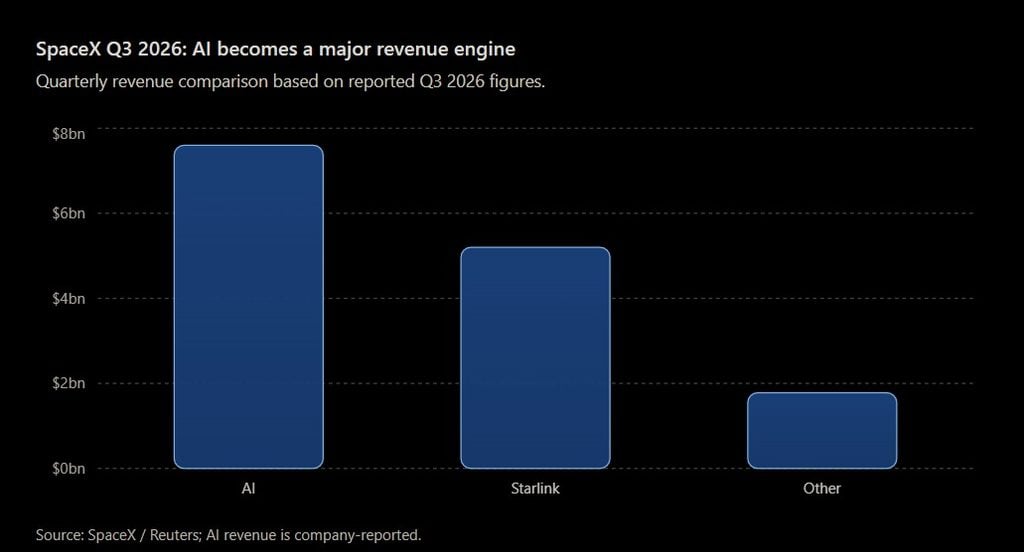
Starlink remains impressive in its own right. Revenue reached $5.2bn, up 69%, while operating income doubled to $2.4bn. Subscribers reached 13.6m, although that was below the 14.2m Bloomberg forecast.
The catch is capital intensity. SpaceX spent $19.6bn on capex, of which approximately $16.4bn went towards its Super Intelligence/AI activities. That is more than the company generated in quarterly revenue and substantially above the roughly $18.05bn analysts had expected.
After-hours reaction: SpaceX shares surged more than 10% in after-hours trade. Despite the spectacular numbers – growth and capex, the response from markets tells UK investors something important: expectations maybe already extremely high but is clearly an appetite for perceived outlier AI growth potential even at a high apparent cost. Stockopedia data notes that the shares were trading at around 102x forward earnings before the report, versus roughly 19x for the S&P 500.
How much of the enthusiasm for SpaceX is owed to any Elon Musk-factor is not clear.
Super Micro: demand for AI servers remains enormous
Super Micro provided another side to this complex equation.
The server maker said preliminary fiscal Q1 revenue should be $18.5bn-$19.5bn, dramatically above the $15.23bn consensus estimate. The company attributed the upside principally to strong demand for AI platforms.
| Q3/Q1 indicator | Reported / expected | Street expectation | Read-through |
| SpaceX revenue | $14.58bn | ~$12.72bn | Major beat |
| SpaceX EPS | $0.35 | ~$0.17 | >2x consensus |
| SpaceX AI revenue | $7.6bn | — | >9x YoY |
| SpaceX capex | $19.6bn | ~$18.1bn | Extremely capital intensive |
| Starlink revenue | $5.2bn | — | +69% YoY |
| SMCI preliminary Q1 revenue | $18.5–19.5bn | $15.23bn | ~21–28% above consensus |
The scale of Super Micro’s revenue guidance is particularly revealing. At the midpoint, $19bn is about 25% above the Street’s $15.23bn forecast.
That is difficult to reconcile with the idea that AI infrastructure spending is already rolling over.
Super Micro has also previously disclosed an approximately $39bn AI-server order backlog, while its longer-term revenue guidance has been dramatically raised as hyperscalers and other customers continue expanding data-centre investment.
What analysts are saying
The key analyst message is increasingly about how long the AI investment cycle can continue and whether suppliers can convert the biggest capital splurge in history into attractive margins and cash flow.
2026 looks like going down as the year in which investors stopped buying AI, and started buying superior AI returns.
For SpaceX, the concern is obvious: enormous AI revenue growth is being accompanied by enormous capital expenditure. Its AI business is growing much faster than expected, but investors are being asked to fund a gigantic infrastructure build-out.
For Super Micro, the debate is slightly different. The demand signal is exceptionally strong, but investors need to watch gross margins, working capital, financing requirements and execution. AI servers can generate huge revenue without necessarily producing Nvidia-like economics.
This distinction matters.
What does this tell us about the AI trade?
1. AI infrastructure demand is not showing obvious signs of collapsing.
SpaceX’s $7.6bn AI revenue and Super Micro’s preliminary $18.5bn-$19.5bn quarterly sales outlook provide two substantial data points pointing towards continued hyperscaler spending.
2. The AI boom is becoming increasingly capital intensive.
SpaceX’s $19.6bn quarterly capex is the clearest warning. AI revenue is growing rapidly, but so is the amount of capital required to build computing capacity.
3. Revenue growth is becoming easier to find than attractive returns.
This may be the next phase of the AI trade. Investors should increasingly ask not ‘How fast is AI revenue growing?’ but ‘Who captures the profits?’
4. Expectations remain exceptionally high.
SpaceX’s muted after-hours reaction despite a huge earnings beat is a useful warning for UK investors. A company can deliver spectacular numbers and still struggle to outperform if the market has already priced in extraordinary growth.
Sharesify investor verdict
The early Q3 evidence is bullish for AI demand but more complicated for AI valuations.
SpaceX demonstrates that AI computing is already becoming a multi-billion-dollar revenue stream, while Super Micro’s latest forecast suggests customers are still ordering AI infrastructure at extraordinary rates.
For UK retail investors, therefore, the message is not ‘the AI trade is over’. It is that the trade is moving into a more demanding phase.
The winners may increasingly be determined by returns on capital, margins, free cash flow and balance sheet strength, rather than simply headline AI revenue growth.
That makes the next earnings reports from Nvidia (NASDAQ:NVDA), Microsoft (NASDAQ:MSFT), Alphabet (NASDAQ:GOOG), Amazon (NASDAQ:AMZN), Meta (NASDAQ:META), and the semiconductor supply chain arguably even more important. If they continue to show accelerating AI demand without a corresponding deterioration in returns, the current AI investment cycle still has considerable room to run.
How to invest in semiconductor stocks: A UK beginner’s guide 2026
If, however, capex keeps accelerating while margins and cash returns deteriorate, today’s SpaceX and Super Micro numbers could eventually be remembered as evidence of peak AI spending rather than the beginning of another leg higher.
Disclaimer: The author Steven Frazer has a personal interest in Nvidia.
You might also like:
