




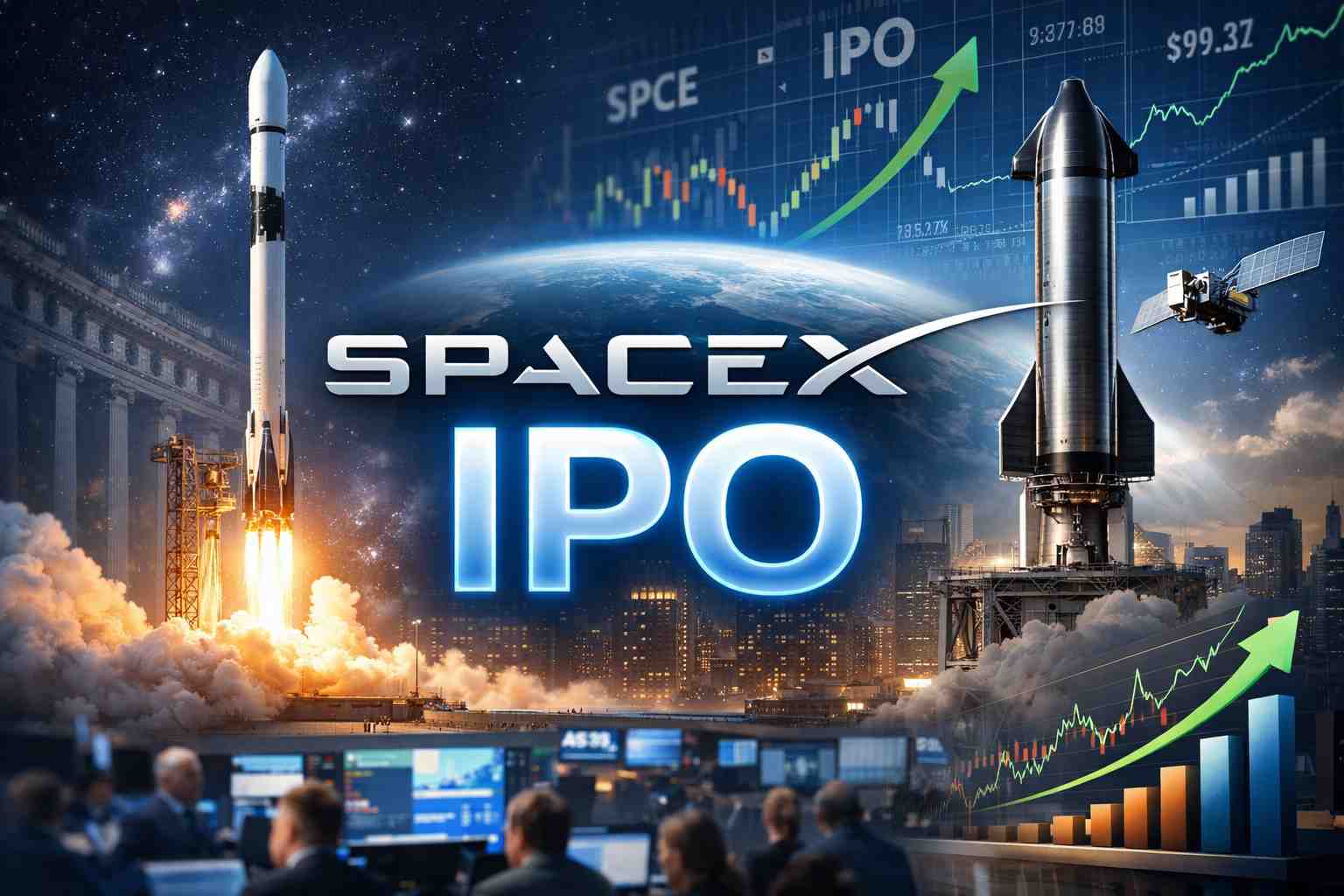
The incoming IPO of SpaceX has sparked hysteria like never before. Sure, Artemis II has rekindled mass excitement about space and our solar neighbourhood. Millions around the world have tuned in to the Nasa ‘Moon’ odyssey in recent weeks. This mission has taken humans further from earth than ever before.
But SpaceX is something altogether different because it will give ordinary people a chance to directly buy their own bit of the new space race. The company plans to raise around $75 billion at a valuation that could top $2 trillion. In addition, if talk is true, it could also include the biggest retail investor offer ever. However, UK investors may be excluded, so talk to your investment platform.
Mind-boggling valuation?
SpaceX is one of the world’s most valuable private companies. In a fundraise in December 2025 it had an implied $800 billion valuation, one that itself had doubled in a year.
Yet SpaceX’s valuation is grounded in its profitable, fast-growing Starlink satellite network, which has over 10 million subscribers, and a launch business that analysts and investors say has transformed access to orbit. The Falcon 9 rocket, which in December 2015 became the first large rocket to make a controlled recovery after delivering a payload into orbit, completed 165 launches in 2025. This set a new annual record.
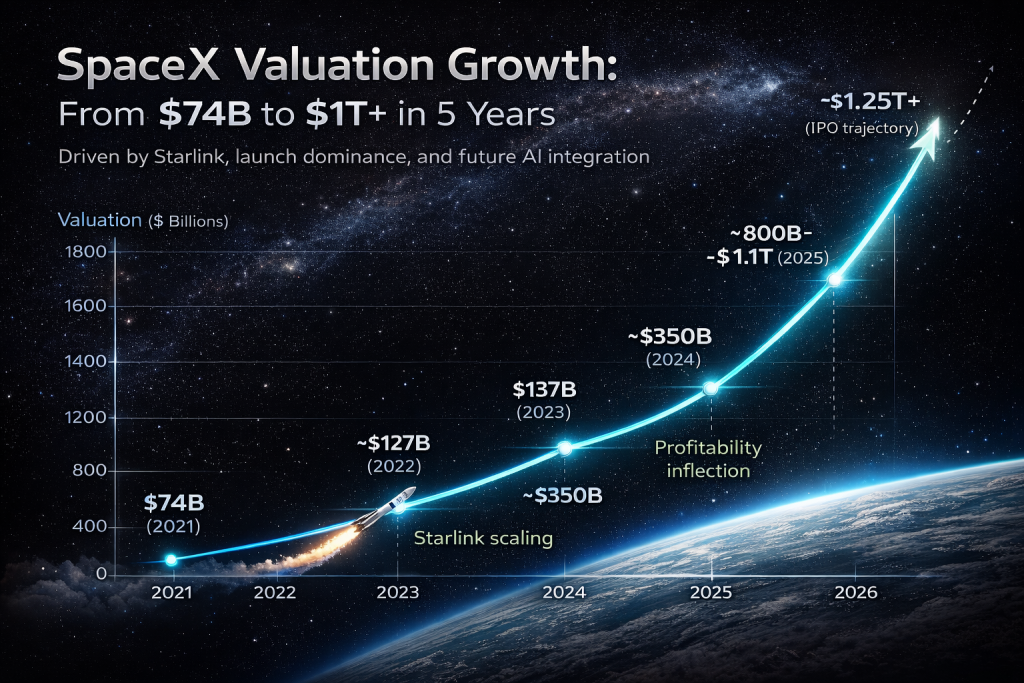
SpaceX made roughly $8 billion in EBITDA (earnings before interest, taxes, depreciation, and amortisation) on $15 billion to $16 billion in revenue last year. That implies an EV/EBITDA multiple of 240+ (where EV = enterprise value, or its market value less cash).
Now the company also includes social media platform X, Musk’s artificial intelligence project xAI, as well as the brain-chip company Neuralink.
‘It’s not about what happens today, but if these exponential technology trends continue, what happens in four or five years’ time?’
Tom Slater, Scottish Mortgage
But investors are not being wooed by last year’s profits and cashflows, that’s yesterday’s news… new investors are excited by the promise of growth that could run years into the future.
‘It’s not about what happens today, but if these exponential technology trends continue, what happens in four or five years’ time’, says Scottish Mortgage (SMT) manager Tom Slater, who first backed SpaceX in 2018.
Sovereign stack
‘SpaceX is constructing the world’s first sovereign AI platform through full control of chips, models, data centres and delivery infrastructure’, according to Deepwater Asset Management’s Gene Munster. He believes the company has assembled the only set of assets capable of building a fully sovereign AI system free from third-party cloud providers, rented silicon or borrowed infrastructure. That could give it unprecedented control, over its own future.
That’s something Scottish Mortgage’s Slater recently discussed in a fascinating webinar conversation (tune in here), where he believes SpaceX has the potential to be ‘the monopolistic provider of AI to the world.’
‘These four pillars create a closed-loop intelligence system spanning from raw silicon to satellite distribution’
Gene Munster, Deepwater Asset Management
Crucially, SpaceX has consolidated four key infrastructure components for sovereign AI: a launch monopoly through proven rocket reusability, Starlink as a global network, Grok frontier model trained on proprietary X data, and the Terafab for internal chip manufacturing.
‘These four pillars create a closed-loop intelligence system spanning from raw silicon to satellite distribution’, says Deepwater’s Munster, eliminating dependence on external providers like TSMC, AWS or traditional internet service providers.
Deep margin capture
The sovereign stack allows SpaceX to capture margin across every layer of AI production, from chips to models to intelligent output, like Apple’s integrated hardware-software model.
Other major AI players including OpenAI, Meta, Amazon and Microsoft lack full vertical integration. Google represents the closest competitor despite gaps in external fabrication reliance and lack of launch vehicles.
‘Grok’s commitment to truth-seeking with minimal creator-imposed restrictions forms the intellectual foundation of the sovereign thesis’, according to Munster. A model optimised for maximal truth-seeking will likely be the best performing model for most tasks over time, as nature serves as the only real arbiter, according to Munster.
The physical AI connection through Tesla adds another dimension, with Optimus robots and Tesla vehicles potentially running on Grok. Meanwhile, internet comes through Starlink and queries process on SpaceX silicon.
‘SpaceX represents the only company building a fully sovereign AI system with its own chips, models, data, internet and rockets, positioning it to compete in an AI-first world in ways other companies cannot replicate’, Munster says.
Disclaimer: The author Steven Frazer has a personal interest in Scottish Mortgage.
You might also like: