




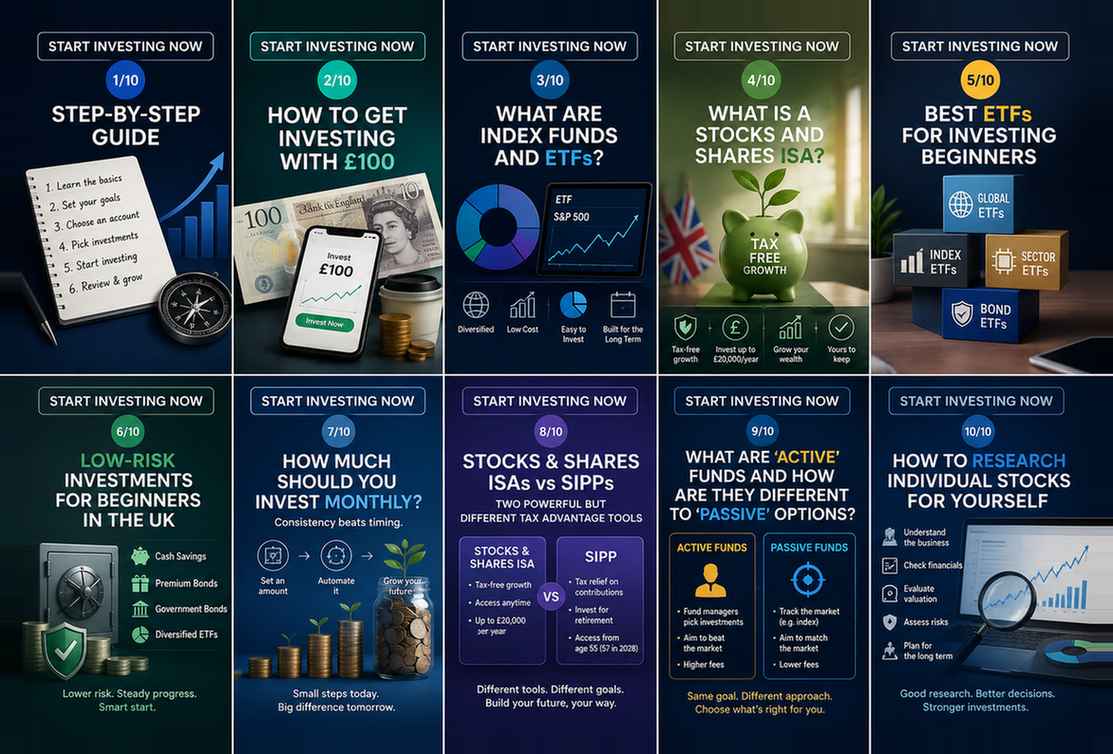
You can very easily join the millions of Brits who invest for themselves. Investing can feel intimidating when you’re just starting out. You hear words like ‘stocks’, ‘shares’, ‘ETFs’, and ‘ISAs’ and it can quickly feel like something only experts or wealthy people do. The truth is, you can start investing in the UK with as little as £1–£100, and you don’t need any financial background to begin.
In this first part of our‘Start investing now’ series, we will walk you through everything step-by-step in simple language, so you can go from ‘I don’t know where to start’ → ‘more informed’ → ‘confident’ → ‘active investor’ making your first investment and beyond.
[NB: Stocks and shares are fundamentally the same thing, small parts of a company listed on a stockmarket – but they are typically used interchangeably by experts and media outlets, so don’t get confused.]
🧭 Step 1: Understand what investing is
At its simplest, investing means:
- Putting your money into something with the expectation that it grows over time.
- Instead of leaving your money in a savings account, you’re buying assets that can increase in value, such as:
- Stocks/shares (pieces of companies)
- Funds/ETFs that hold many companies
- Bonds (loans to governments or companies)
The goal is long-term growth, not quick profit.
In this article we explore everything you need to know as a retail investor in bonds
Sharesify
💡 Step 2: Set a simple goal
Before you invest, ask yourself:
- Are you investing for retirement?
- A house deposit?
- Long-term wealth building?
You don’t need a perfect plan. Even a basic goal like:
👉 ‘I want to grow my money over the next 10–20 years’
is enough to start.
💰 Step 3: Decide how much to invest
A common myth is that you need a lot of money to invest. You don’t. Many UK beginners start with:
- £25 per month
- £50 per month
- £100 one-off
The key is consistency, not the amount. Even small amounts are likely to grow significantly over time thanks to compound growth.
🏦 Step 4: Choose the right type of account
In the UK, this is one of the most important steps. The main option for beginners:
📊 Stocks and Shares ISA
A Stocks and Shares ISA is a tax-free investing account.
Why it matters:
- You don’t pay tax on investment growth
- You can invest up to £20,000 per year (2026 limit)
- Perfect for long-term investing
👉 If you’re a beginner, this is usually the best place to start.
📱 Step 5: Choose an investing app
You need to open an account with an investing platform to start investing.
Popular UK platforms (2026) include:
- Hargreaves Lansdown (largest provider by market share)
- AJ Bell is recommended for comprehensive investment options
- Interactive Investor is often cited for its flat monthly fee structure, making it cost-effective for larger portfolios
- Trading 212 (low cost/no commission)
- Freetrade (also low cost/no commission, plus fractional shares
- Vanguard is a primary choice for buying low-cost passive index funds
What to look for:
- Fees: Compare platform fees (usually a percentage) vs flat-fee brokers, plus trading fees and foreign exchange costs.
- An easy-to-use and understand interface
- ISA availability
- Fractional shares
[NB: Fractional shares are another option, which allow you to buy a stock a bit at a time. For example, if you start investing £25 a month, and wanted to invest in British fashion retailer Next (NXT), you’d normally have to wait six months to save up the required money, based on their £134.90 cost (15 April 2026). Fractional shares would allow you to buy £25 worth of a Next share right away. But fractional shares are only offered by some UK investing platforms.]
👉 Tip: Don’t overthink this step. The best app for you is the one you are most comfortable using.
📊 Step 6: Choose what to invest in
This is where most beginners get stuck. You do NOT need to pick individual ‘winning’ stocks. A safer, simpler approach is:
🌍 Index funds or exchange-traded funds (ETFs for short)
An index fund is a type of investment that holds lots of companies at once. That helps you spread risk. For example, if some of the shares in the fund fall over a period of time, these declines will be counter-balanced by others that rise, helping to smooth your investment returns.
Why beginners like them:
- Instant diversification (less risk)
- No need to pick individual stocks
- Long-term steady growth
Example beginner strategy:
- 1 global index fund or ETF
- Invest monthly
- Hold for 10+ years
That’s it.
⚖️ Step 7: Understand risk (important)
All investing carries risk. There’s a simple truth that stocks sometimes go up AND sometimes go down. Short-term losses are normal and are not something to get too worried about if you are investing over many years. Long-term investing reduces risk.
👉 Tip: Only invest money you won’t need for at least 5–10 years
📈 Step 8: Make your first investment
Here’s the simple process:
- Open your ISA account
- Deposit money (even if it is only £25–£100)
- Choose a global index fund or ETF
- Buy it
That’s your first investment. It doesn’t need to be perfect, but it does need to happen if you want to start building real wealth for yourself. Following the herd and buying ETFs that are popular with other investors can be a great way to feel more comfortable about what you choose.
Three of the most popular global ETFs with UK investors, according to JustETF data, are:
- Vanguard FTSE All-World UCITS ETF (VWRP): Best-selling, low-cost passive tracker covering developed & emerging markets.
- Invesco FTSE All-World UCITS ETF (FWRG): Frequently cited as a popular, easy-to-buy competitor.
- SPDR MSCI All Country World (ACWI) ETF: Another popular, well-diversified choice.
🔁 Step 9: Build a habit (this is where wealth is made)
The biggest difference between beginners and successful investors is consistency. Try:
- £25/month → steady growth habit
- £100/month → strong long-term results
- Increase over time as your salary increases
Even small monthly investing beats trying to ‘time the market’.
🚀 Common mistakes to avoid
❌ Trying to ‘get rich quick’ – investing is slow and steady, not overnight
❌ Picking random or ‘hot’ stocks from social media – beginners often lose money this way
❌ Waiting for the ‘perfect time’ – there is no perfect time, only time in the market, so the sooner you start, the better
🧠 Key takeaway
You don’t need:
- A lot of money
- Finance knowledge
- Perfect timing
You just need:
- A simple account
- A basic index fund
- Consistency
👉 What to do next
If you’re serious about starting:
- Open a Stocks and Shares ISA
- Deposit a small amount (£25–£100)
- Buy a global index fund
- Set up monthly investing
Follow these simple steps and you will be joining the millions across Britain who are investors, and on your way to better financial security for your future.
Want to learn more? Read part 2 of Sharesify’s 10-part ‘Start investing now’ simple guide…
You might also like:
