




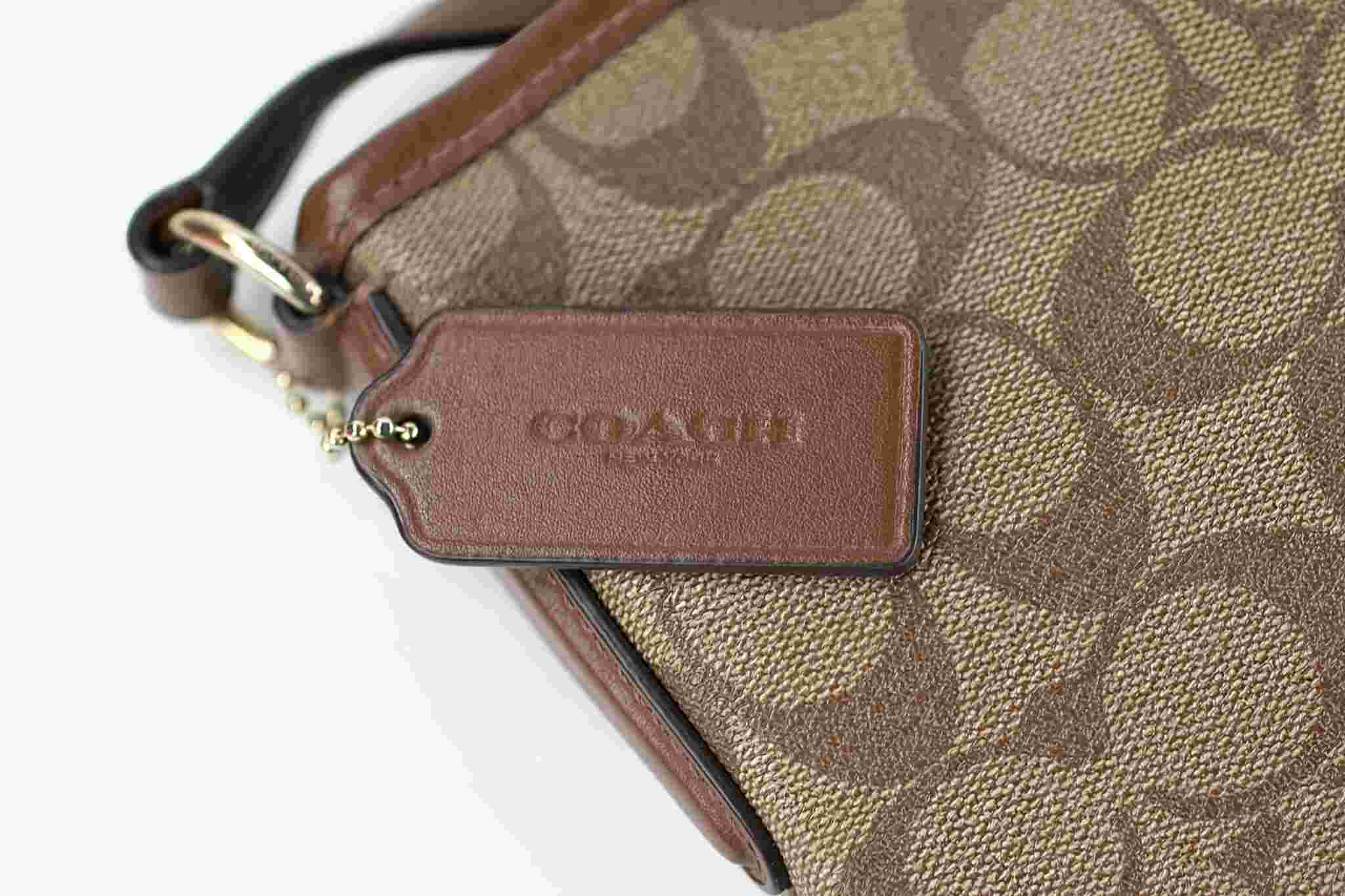
Affordable luxury goods group Tapestry (NYSE:TPR) delivered (13 August) forecast-beating Q4 earnings driven by margin expansion and double-digit sales growth at core brand Coach.
The New York-based company’s sales grew in North America, China and Europe as the firm continued to bag market share.
| Share price: $128.39 (-16.5%) | Market cap: $26bn |
| PE FY27: 16.7 | Yield FY27: 1.4% |
So why did shares in Tapestry tumble 16.5% to $128.4 in after-hours trading on Wall Street? Well, FY27 guidance for sluggish sales growth disappointed investors. As did the protracted turnaround at Kate Spade New York, a brand Tapestry is struggling to revive.
Tapestry weaves forecast-beating results
The handbags-to-accessories company wove a 28% increase in Q4 earnings per share (EPS) to $1.32, which topped the $1.28 Wall Street was looking for.
Revenue rose 9% to $1.9 billion, in line with analysts’ estimates and driven by the performance of Coach, where sales grew 14%.
| Region | Q4 sales growth (%) |
| North America | 7 |
| Europe | 19 |
| Japan | (4) |
| Greater China | 28 |
Source: Tapestry Inc
Geographically, China proved a bright spot for Tapestry, generating constant-currency revenue growth of 28%. Elsewhere, Japan revenue continued to decline, while North America sales rose 7%, albeit a slowdown on the 20% growth delivered in Q3.
Guidance and Kate Spade disappoint
For FY27, Tapestry guided for revenue in the $8.4 billion to $8.5 billion range. Unfortunately, the midpoint of $8.45 billion was below the $8.47 billion Wall Street was looking for.
And investors were left frustrated by the performance of Kate Spade, where Q4 sales fell by 7%. Management acknowledged that the brand’s recovery is taking longer than planned and expects a high-single-digit decline in FY27.
Success by design
CEO Joanne Crevoiserat said: ‘Our fourth quarter outperformance capped a year of strong growth, as we meaningfully exceeded expectations and achieved key financial commitments we established at our investor day two years ahead of plan.
‘Our success is by design, demonstrating the power of our Amplify strategy,’ insisted Crevoiserat.
She stressed that Tapestry’s strengths ‘enable us to deliver creativity, value, and relevance at scale, deepening our connections with consumers globally. We are confident our advantages will continue to compound, driving durable growth and long-term shareholder value.’

Shares in Tapestry have soared since the Federal Trade Commission (FTC) blocked its affordable luxury merger with Capri (NYSE:CPRI) in 2024. This left the high-flying stock vulnerable to a sell-off.
Given the tough global luxury market backdrop, we think Tapestry’s Q4 results were pretty good. But muted sales growth guidance and the pedestrian pace of the Kate Spade turnaround prompted profit-taking.
Sharesify would like to see a faster turnaround at Kate Spade. This would prove Tapestry is more than just a play on Coach, a label that is seeing robust demand from Gen Z shoppers.
All things considered, we think the share price drubbing Tapestry received was harsh. The firm is in growth mode and generating significant amounts of free cash flow. And this should enable it to return roughly $1.7 billion to shareholders through dividends and buybacks in FY27.