




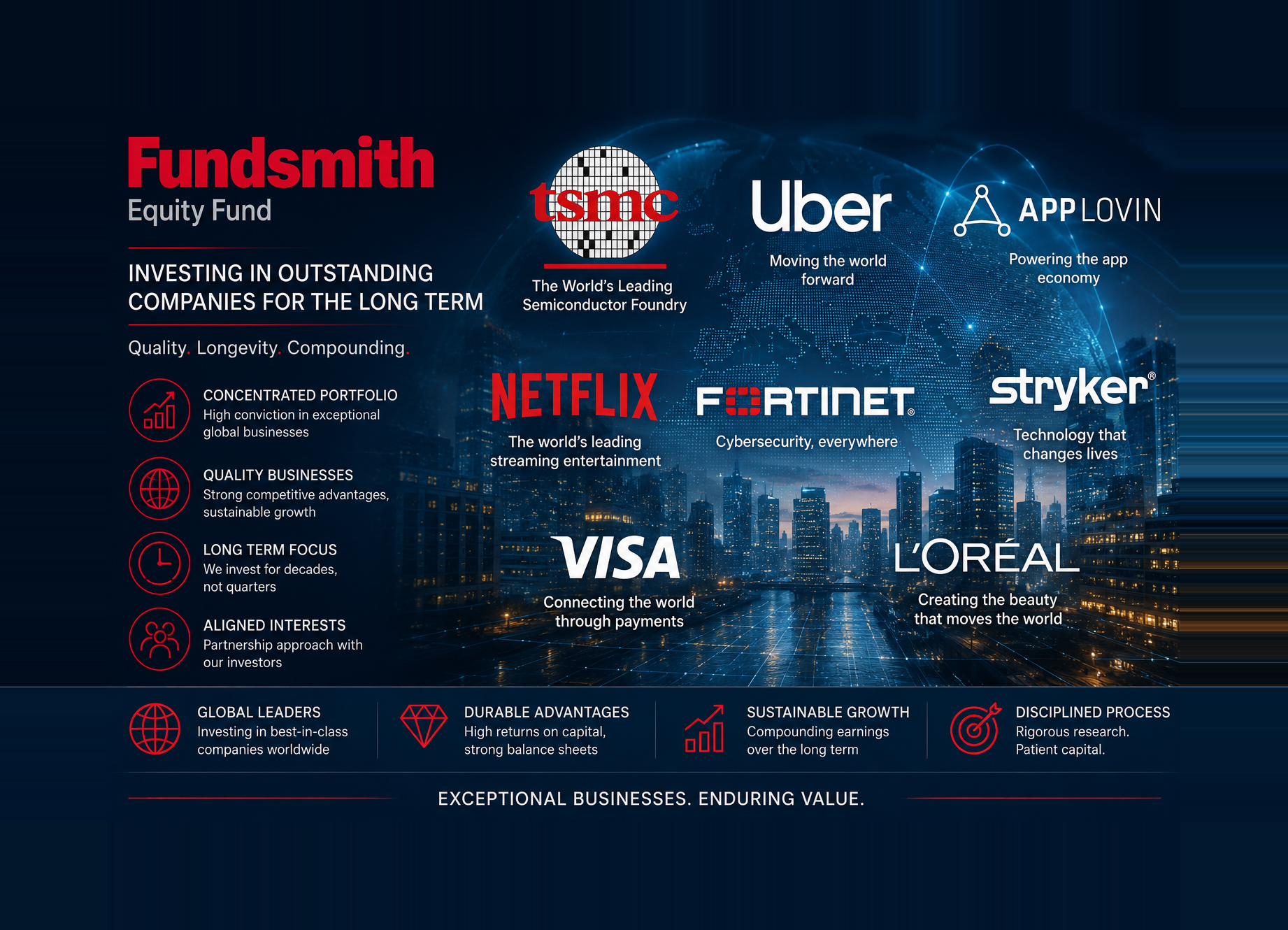
The 1 July 2026 semi-annual shareholder letter from Fundsmith Equity marks the biggest change in the fund’s investment process since its launch in 2010. Founder and lead manager Terry Smith acknowledges that the market environment has shifted materially and outlines a significant overhaul designed to improve returns after several years of lagging global equity markets.
The key messages for UK retail investors are:
- Fundsmith has materially underperformed the MSCI World over the last three and five years after years of market-leading returns.
- Terry Smith believes today’s market is increasingly driven by passive flows and momentum rather than company fundamentals.
- The portfolio has undergone its largest restructuring since launch, with turnover rising above 50% during H1 2026.
- While Fundsmith is NOT abandoning its ‘buy good companies, don’t overpay, do nothing’ philosophy, it is placing much greater emphasis on positive earnings revisions and share price momentum when constructing the portfolio.
Fundsmith letter to shareholders, July 2026
Performance has become increasingly challenging
Fundsmith enjoyed one of the strongest long-term records in UK retail investing during its first decade.
However, recent years have been much more difficult.
Relative performance
| Period | Fundsmith Equity | IA Global average* | MSCI World (£) |
| H1 2026 | -2.9% | Positive mid-single digit gain | +11.2% |
| 3 Years | Behind both comparators | Ahead | Ahead |
| 5 Years | Meaningful underperformance | Ahead | Significantly ahead |
| Since launch (2010) | 592.6% (13.1% annualised) | – | 530.9% (12.5%) |
*IA Global figures vary slightly depending on share class and measurement period. H1 2026 and long-term comparisons are based on Fundsmith’s shareholder letter and industry data.
Although the long-term record remains impressive, most investors who entered during the post-pandemic period have experienced returns well below expectations.
Fundsmith Equity underperforms for fifth year running
Assets under management have also fallen
The fund’s size has changed significantly.
| Date | Estimated Assets |
| Peak (2021-22) | ~£25-27bn |
| Mid-2026 | ~£12.3bn following market weakness and investor withdrawals |
Lower assets reflect a combination of:
- weaker relative performance
- market declines
- investor redemptions
- reduced inflows
Despite this, Fundsmith remains one of the UK’s largest actively managed equity funds.
Why has performance disappointed?
Terry Smith gives several reasons.
1. Passive investing dominates markets
His biggest argument is that markets have become increasingly driven by passive ETF inflows.
Money automatically flows into the largest index constituents regardless of valuation.
This has particularly benefited:
- Nvidia
- Microsoft
- Meta
- Amazon
- Broadcom
rather than companies simply generating the highest returns on capital.
2. Momentum has overwhelmed quality
Historically Fundsmith focused on:
- return on capital
- cash generation
- resilient franchises
- predictable growth
Smith now accepts that markets increasingly reward:
- earnings upgrades
- price momentum
- AI excitement
- index inclusion
rather than traditional valuation disciplines.
3. Several holdings simply disappointed
A number of long-term holdings suffered operational setbacks or valuation deratings.
Examples include healthcare names and selected consumer businesses that failed to deliver the growth rates previously expected.
Adapt or die – biggest portfolio overhaul in Fundsmith’s history
Perhaps the most important announcement is the extensive reshaping of the portfolio.
Portfolio turnover exceeded 50% during H1 2026—an unprecedented level for a fund that historically prided itself on very low trading.
Major exits
| Company | Reason given |
| Zoetis | Growth slowing and weaker momentum |
| Otis | Better opportunities elsewhere |
| Magnum Ice Cream | Spin-off no longer met investment case |
| Unilever | Concern over strategic direction and corporate actions |
| Several reduced positions | Capital recycled into stronger momentum opportunities |
Smith also criticises Unilever’s (LON:ULVR) strategic changes following the sale of his holding, arguing management shifted towards activist-led restructuring rather than operational improvement.
Sharesify podcast with Simon Barnard of Smithson Equity Fund
New investments
The letter discusses several new additions focused on businesses benefiting from powerful structural trends.
| New Holding | Investment rationale |
| GE Vernova | Electricity infrastructure and power demand from AI |
| Nextpower | Utility-scale solar infrastructure with strong earnings momentum |
| TSMC | World’s largest contract microchip manufacturer, huge AI beneficiary |
| Uber Technologies | Ride hailing and food delivery platform, seen as a self-driving tech winner |
| Netflix | World’s leading streaming platform, expanding content in to ‘live’ sports |
| AppLovin | Helps mobile apps find new customers and manage ad sales |
| Additional technology positions | Strong earnings revisions and improving momentum |
The fund also increased exposure to companies benefitting from AI infrastructure and accelerating capital expenditure.
Momentum becomes part of investment process
This is arguably the most significant philosophical shift.
Previously Fundsmith largely ignored:
- share price momentum
- technical trends
- earnings revisions
Now management intends to incorporate these much more actively.
That does not mean becoming a momentum fund.
Instead, Smith argues momentum has become too important to ignore in modern markets.
Potential advantages
Greater emphasis on momentum could:
- avoid value traps
- reduce exposure to structurally weakening companies
- capture AI winners earlier
- improve relative performance during momentum-led markets
- limit exposure to declining businesses for too long
Potential risks
However, there are also important drawbacks.
Momentum investing can:
- encourage buying expensive stocks
- increase turnover
- create higher transaction costs
- reduce tax efficiency
- increase volatility
- undermine Fundsmith’s long-established identity
Many investors chose Fundsmith precisely because it largely ignored market fashions. This evolution therefore represents a meaningful change to the investment proposition.
Charges
Fundsmith remains competitively priced.
| Fund | Ongoing Charge |
| Fundsmith Equity | ~1.04%-1.54%, retail T and R Class* |
| Typical IA Global active fund | Approximately 0.85-1.0% |
| Global passive ETF | 0.10-0.25% |
* T Class shares are designed for direct retail investors; this is the most common and accessible share class. R Class are aimed at retail investors accessing through financial advisors or wealth managers.
Fundsmith is therefore cheaper than many active peers but significantly more expensive than passive global index trackers.
What does this mean for investors?
The shareholder letter is notable because Terry Smith openly accepts that aspects of his investment process need adapting.
Few long-established managers publicly acknowledge such a significant change in philosophy.
For investors, the key questions are:
- Can Fundsmith successfully combine quality investing with greater attention to momentum?
- Will higher turnover prove temporary or become permanent?
- Has recent underperformance created an attractive entry point, or does it reflect a lasting change in market leadership?
The answers will determine whether Fundsmith can restore its reputation as one of the UK’s premier active global equity funds.
Investor verdict
Fundsmith remains a portfolio of high-quality global businesses with an exceptional long-term record since inception in 2010. However, the prolonged underperformance against the MSCI World has tested investor confidence, particularly during the AI-driven rally led by mega-cap US technology stocks. Terry Smith’s willingness to overhaul the portfolio and incorporate momentum signals is a significant departure from the fund’s traditional ‘buy good companies, do nothing’ philosophy.
Fundsmith Equity Top 10 Holdings, 9 July 2026
| Marriott | Visa |
| Waters | Philip Morris |
| Stryker | Fortinet |
| L’Oréal | Automatic Data Processing |
| Amadeus | Church & Dwight |
Source: Fundsmith Equity
If the new approach helps avoid prolonged exposure to weakening businesses while retaining the fund’s emphasis on quality and capital discipline, it could improve relative returns. On the other hand, a stronger focus on momentum risks diluting the distinctive characteristics that attracted many long-term investors in the first place.
For UK retail investors, Fundsmith remains a credible long-term global equity holding but the biggest change in the fund’s investment process since its launch in 2010 raises questions. That means, the the next 12–24 months will be critical. Investors should look beyond short-term performance and monitor whether the revised process delivers improved stock selection without sacrificing the disciplined quality investing that underpinned the fund’s success over its first decade.
Disclaimer: The author Steven Frazer has a personal interest in Fundsmith Equity.
You might also like:
