


South Korea’s SK Hynix has become one of the biggest beneficiaries of the artificial intelligence investment boom. Now UK retail investors are about to get a much easier way to own the stock.
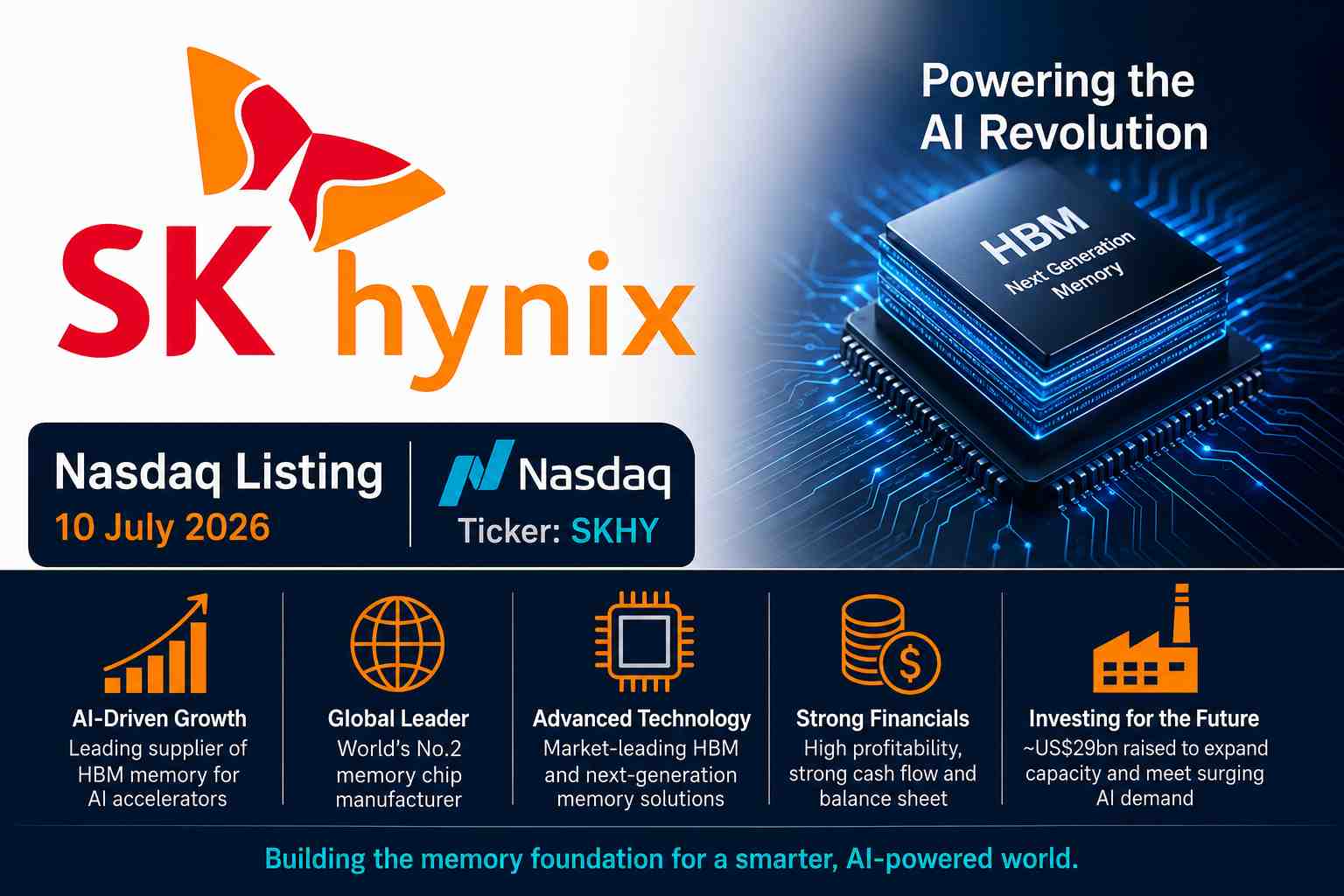
The world’s second-largest memory chipmaker plans to launch American Depositary Receipts (ADRs) on Nasdaq under the ticker SKHY, giving investors access through most international share dealing platforms without having to trade directly on the Korean Exchange. Trading is expected to begin on 10 July 2026, subject to final pricing.
For UK retail investors who have struggled to access Korean shares, the listing could prove almost as significant as the capital raising itself.
Key facts
| Metric | Detail |
| Business | World’s No.2 memory semiconductor producer |
| Products | DRAM, NAND flash and High Bandwidth Memory (HBM) chips |
| Nasdaq ticker | SKHY (ADR) |
| Expected first trading day | 10 July 2026 |
| Funds targeted | Approximately US$29.4bn |
| Shares issued | 17.79 million new shares |
| ADR ratio | 10 ADRs represent one common share |
| Main customers | AI GPU manufacturers, hyperscalers, smartphone and server makers |
| Main AI exposure | Market-leading HBM memory used alongside AI accelerators |
Figures based on company filings and offering documents.
Financial snapshot
| Metric | Position |
| Market capitalisation | Above $1 trillion* |
| Forward PE | ~25 (Morningstar data) |
| Revenue growth | Triple-digit growth during the AI cycle |
| EPS growth | Among the fastest globally in semiconductors |
| Operating margins | Among highest in global memory industry |
| Balance sheet | Strong cash generation supporting heavy investment |
*Market value fluctuates with the share price.
The company has transformed from a highly cyclical memory manufacturer into arguably the world’s leading supplier of premium AI memory.
Why investors care
Several years ago, memory chips were viewed as commodity products.
Today, that is no longer true.
Training large language models requires enormous quantities of High Bandwidth Memory (HBM) connected to AI processors from companies including Nvidia.
HBM has become one of the semiconductor industry’s biggest bottlenecks.
SK Hynix established an early technological lead and remains the dominant supplier of advanced HBM used in Nvidia’s latest AI accelerators, allowing it to command premium pricing and much higher profitability than conventional memory.
How crazy could the memory chip shortage become – and what does it mean for UK investors?
How SK Hynix makes money
Revenue comes from several businesses:
| Segment | Investment case |
| High Bandwidth Memory (HBM) | Fastest-growing and highest-margin division |
| DRAM | Core earnings engine for servers and PCs |
| NAND Flash | Storage for SSDs and mobile devices |
| Enterprise SSDs | Benefiting from AI data centre investment |
| Mobile memory | Smartphones and premium devices |
The AI memory business has become increasingly dominant, reducing dependence on traditional consumer electronics demand.
Why raise almost $30 billion?
Rather than repairing its balance sheet, management plans to use the proceeds to accelerate expansion.
Investment includes:
- construction of new semiconductor fabs
- additional advanced packaging capacity
- purchase of next-generation EUV lithography tools from ASML
- expanding production to meet AI demand through the end of the decade.
That is an important distinction.
The fundraising is primarily designed to finance growth rather than plug financial weaknesses.
Global peer comparison
| Company | Main strength | AI positioning | Relative valuation |
| SK Hynix | HBM leader | Excellent | Moderate |
| Micron Technology | DRAM & HBM | Strong | Higher |
| Samsung Electronics | Diversified memory & foundry | Improving | Discount for diversification |
| Kioxia | NAND storage | Limited AI leverage | Lower |
Among pure memory manufacturers, many analysts view SK Hynix as having the strongest competitive position in premium AI memory.
Why the Nasdaq listing matters
For UK investors, the biggest benefit is accessibility.
Advantages
- easier dealing through UK investment platforms
- dollar-denominated trading
- improved liquidity
- potentially broader analyst coverage
- wider US institutional ownership
- inclusion in more international portfolios
Previously investors generally needed direct access to Korean markets or an ETF holding SK Hynix.
Potential drawbacks
The ADR is unlikely to eliminate every complication.
Investors should remember:
- returns will still depend on movements in the underlying Korean shares
- sterling investors retain currency exposure to both the US dollar and Korean won
- semiconductor shares remain volatile
- ADRs occasionally trade at small premiums or discounts to underlying shares
Growth opportunity
Several structural trends continue supporting demand.
| Growth driver | Outlook |
| AI infrastructure | Very strong |
| Hyperscale cloud investment | Strong |
| AI inference | Accelerating |
| Enterprise servers | Improving |
| Consumer electronics | Recovering |
Industry forecasts continue suggesting HBM demand could grow significantly faster than conventional memory throughout the remainder of the decade, although annual growth rates are expected to moderate after the current surge.
Risks investors should consider
No semiconductor company is risk-free.
Major risks include:
Memory pricing cycles
Memory has historically experienced boom-and-bust pricing.
Customer concentration
Large AI customers represent an increasing share of demand.
Technology leadership
Any loss of HBM leadership to Samsung or Micron could pressure margins.
Capital intensity
Building semiconductor fabs requires enormous ongoing investment.
Valuation
Following a spectacular rally, much optimism is already reflected in the share price.
Management message
Management says proceeds from the Nasdaq listing will accelerate construction of new fabrication plants and purchase advanced manufacturing equipment, positioning SK Hynix for sustained AI-driven demand while broadening its international shareholder base.
What analysts are saying
Analysts broadly see three themes emerging:
- the ADR listing makes ownership much easier for global investors
- SK Hynix remains one of the clearest ways to invest in AI infrastructure outside the United States
- while the listing itself does not materially change earnings forecasts, broader international ownership could support the company’s valuation over time.
Some portfolio managers have cautioned that the listing is not, by itself, a reason to buy the stock, arguing that the long-term investment case still depends on sustained AI memory demand rather than the change in trading venue.
Investor verdict
UK retail investors are about to get a much easier way to own the stock and the planned Nasdaq ADR is less about discovering a new company than removing a long-standing barrier to investing in one of the world’s most important AI semiconductor businesses
SK Hynix has evolved from a cyclical memory producer into the market leader in High Bandwidth Memory, a critical component powering the AI revolution. The planned Nasdaq listing should improve liquidity, visibility and ease of access, making it far simpler for UK investors to buy alongside US-listed semiconductor holdings.
The main question is no longer whether SK Hynix is a high-quality business—many analysts agree that it is—but whether today’s valuation already discounts several years of exceptional AI-driven growth. Investors confident that AI infrastructure spending will remain elevated through the decade may view any volatility around the ADR launch as an opportunity, while more cautious investors may prefer to wait for a pullback before initiating a position.
You might also like: