




Author: Steven Frazer

Steven Frazer
Steven Frazer has worked in the investment space for nearly 30 years and was Shares magazine's (owned by AJ Bell) technology word basher and analyst for close on 15 years, covering all the major tech developments right back to the dot com boom and bust (AI, cloud computing, cybersecurity, robotics, digital commerce and more). He is a Spurs obsessive, ska junkie and loves a good book about physics. Winner of the 2013 UKTech journalist of the year gong and a TytoPR #Tech500 influencer in 2018 & 2019. Find him at LinkedIn: Click Here
Broadcom (NASDAQ:AVGO) delivered another exceptional quarter, yet the initial stock reaction was negative. That apparent contradiction is the key to understanding where investors are now with Broadcom, but it is difficult to argue against investors’ bullish on the business narrative. Revenue rose 86% to $29.59bn, adjusted EPS increased 96% to $3.32, and AI semiconductor revenue surged 221% to $16.7bn. Yet shares initially fell sharply in after-hours trading, before recovering to stay largely flat at around $364, because investors were looking beyond the spectacular Q3 numbers to the pace of future growth. Broadcom investor relations Broadcom (NASDAQ:AVGO)Price: ~$364 (~flat after-hours)Market cap: $1.75tn…

Silicon Valley’s cybersecurity firm Palo Alto Networks (NASDAQ:PANW) delivered another powerful quarter, with revenue, earnings, ARR and remaining performance obligations all ahead of expectations. Yet the shares nudged modestly lower after-hours on 1 September, with the bar is now extremely high. The message for UK retail investors is important: Palo Alto’s fundamental story remains exceptionally strong, but expectations and valuation have moved so high that even excellent results are no longer necessarily good enough. Palo Alto investor relations Palo Alto Networks (NASDAQ:PANW)Price: $357.01 (~-1.4% after-hours)Market cap: ~$291bn Q4 FY2026: the numbers that mattered $bn unless statedQ4 FY2026YoYMarket expectationTakeRevenue3.41+34%~3.35BeatAdjusted EPS$1.02+7%~$0.98BeatNGS ARR$9.10bn+63%~$8.93bnStrong beatRPO$21.2bn+34%~$20.9bnBeatAdjusted…

Dell Technologies’ (NYSE:DELL) fiscal Q2 2027 results delivered another extraordinary demonstration of the AI infrastructure boom. Revenue jumped 58%, adjusted EPS more than tripled, AI-server orders reached a record $60.9bn and management raised full-year revenue guidance by $25bn, so the distinction between a great company and a great investment at today’s price is increasingly important. The initial reaction was strongly positive, with Dell shares rising around 6–10% after hours. However, the stock subsequently gave back those gains as investors weighed the exceptional results against a share price that had already risen more than 250% in 2026 and a broader technology-market…

At first glance, the agreed £1.1bn buyout of Gamma Communications (LON:GAMA) by private equity firm Epiris may look like a victory for shareholders. Epiris is offering £11.20 a share, a ~50% premium to Gamma’s 700p-750p price when talks first emerged earlier this year. The problem is that the ‘premium’ is largely a premium to a depressed market valuation. Gamma’s shares reached £23.50 in 2021 and traded around £17 as recently as 2024. Several analysts were still valuing the shares in the £14-£16 earlier in 2026. Gamma Communications investor relations Gamma Communications (LON:GAMA)Price: £11.46 (+0.5%)Market cap: £1.02bn The offer is therefore…

Apple’s (NASDAQ:AAPL) change of CEO on 1 September 2026 is more than a succession story. Tim Cook leaves behind one of the most successful shareholder-return machines in corporate history, but John Ternus inherits a company whose valuation increasingly assumes that Apple can find its next major growth engine. Ternus’s biggest challenge is therefore not fixing a broken Apple. It is proving that Apple can remain an innovation leader in the AI era without destroying the capital discipline that made Cook’s tenure so successful, creating new growth cycle capable of justifying a $4.6tn-plus valuation. Apple investor relations Apple (NASDAAQ:AAPL)Price: $316.85 (~+17% YTD)Market…

Autodesk (NASDAQ:ADSK) delivered a strong fiscal Q2, but investors focused on what comes next. The stock lost around 4% in after-hours trading, reversing the previous session ~6% rally, as the market viewed the results as good, but the forward earnings outlook as less convincing. The key concern is that higher revenue guidance is not yet translating into materially higher earnings or cash-flow. Autodesk beat both Wall Street expectations and the top end of its own guidance. Revenue increased 16% year-on-year, while adjusted EPS rose from $2.62 to $3.30. Autodesk investor relations Autodesk (NASDAQ:ADSK)Price: ~$260 (~-4% after-hours)Market cap: ~$54.8bn Q2: comfortably ahead…

Cybersecurity leader CrowdStrike (NASDAQ:CRWD) delivered the kind of quarter investors had been demanding — and then raised the bar again. Revenue, adjusted earnings and annual recurring revenue (ARR) beat expectations, net new ARR accelerated sharply, and management raised its full-year outlook. The result was an after-hours share price jump of roughly 9%, despite the stock already having soared more than 60% in 2026. CrowdStrike investor relations CrowdStrike (NASDAQ:CRWD)Price: $206.92 (~+9% after-hours)Market cap: ~$210bn For UK retail investors, the key question is therefore no longer simply whether CrowdStrike is benefiting from AI. The evidence increasingly says it is. The harder question…
AI chip champion Nvidia (NASDAQ:NVDA) delivered another blockbuster quarter, but the more important conclusion for UK retail investors is not simply that the chip designer beat forecasts. It is that Nvidia is increasingly becoming the infrastructure platform for the entire AI economy, from GPUs and networking to inference, CPUs, software and AI-factory infrastructure. For now, the numbers favour the bulls. The results released after the US market close on 26 August showed revenue of $96.2bn, up 106% year on year, while adjusted EPS of $2.22 beat the roughly $2.09 consensus. Data Centre revenue rose 117% to $89bn. Nvidia investor relations…
Intuit (NASDAQ:INTU) delivered a classic ‘good quarter, bad outlook’ earnings reaction. Q4 revenue and adjusted earnings comfortably beat expectations, but management’s fiscal 2027 guidance points to a much sharper slowdown than investors had been expecting. The shares fell sharply after hours — around 12% — adding to a brutal 2026 performance in which the stock had already fallen ~44%. Intuit investor relations Intuit (NASDAQ:INTU)Price: $314.86 (~-12%)Market cap: ~$86.0bn For UK investors, the key question is therefore no longer simply whether Intuit is a high-quality software company. It is whether the current valuation adequately reflects slower growth, TurboTax weakness, Mailchimp stagnation…
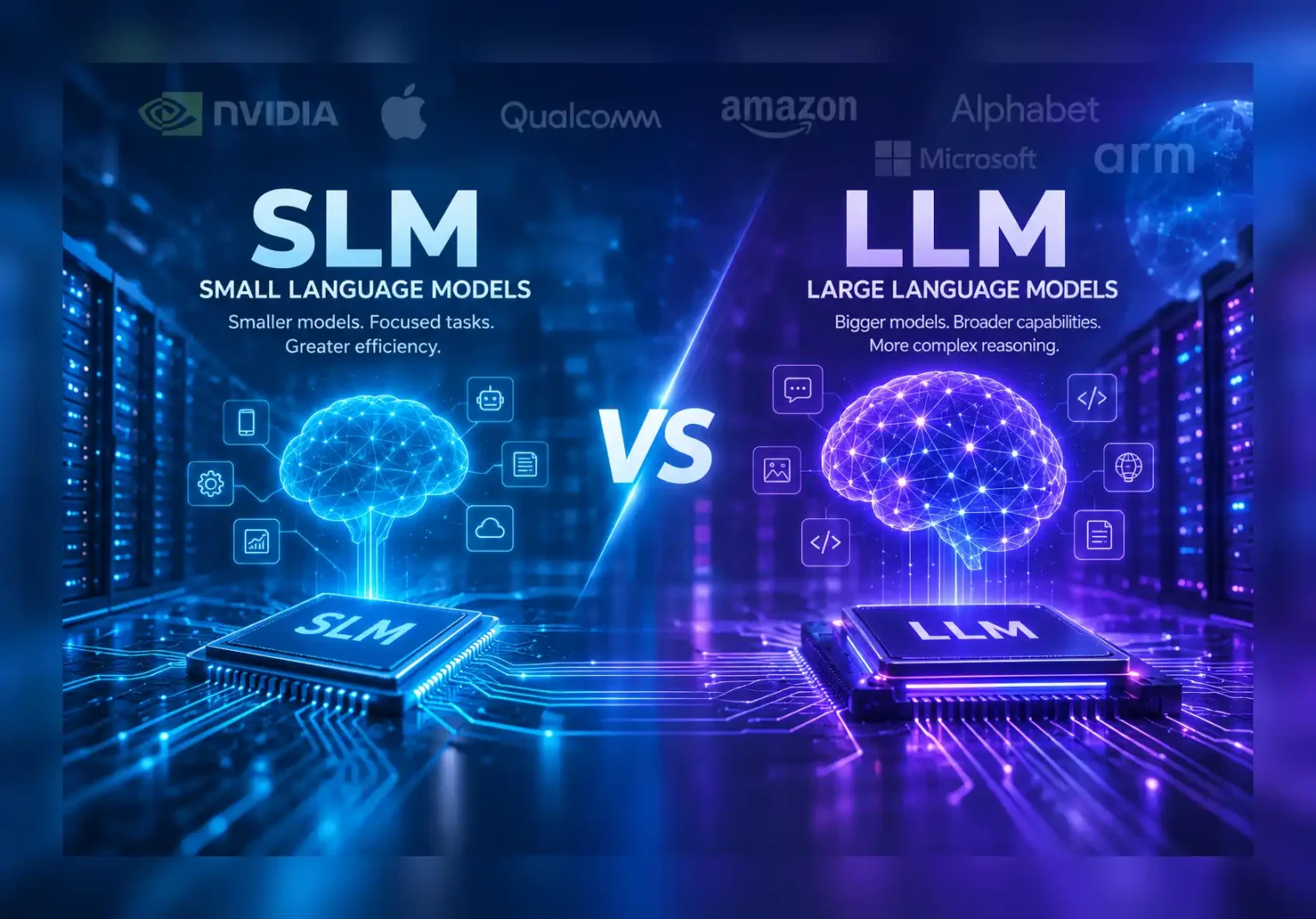
The AI investment story has been built around a simple assumption: as artificial intelligence becomes more capable, demand for computing power will soar, driving enormous spending on Nvidia (NASDAQA:NVDA) GPUs, datacentres, networking equipment and electricity. But new Stanford research raises a potentially disruptive alternative. Instead of every AI request travelling to a hyperscale datacentre, increasingly capable small language models (SLMs) could run directly on PCs, smartphones and edge devices. The attraction is obvious: dramatically lower latency, less bandwidth, potentially lower energy consumption and greater privacy. Stanford’s Intelligence per Watt study found that local models with 20 billion or fewer active…