




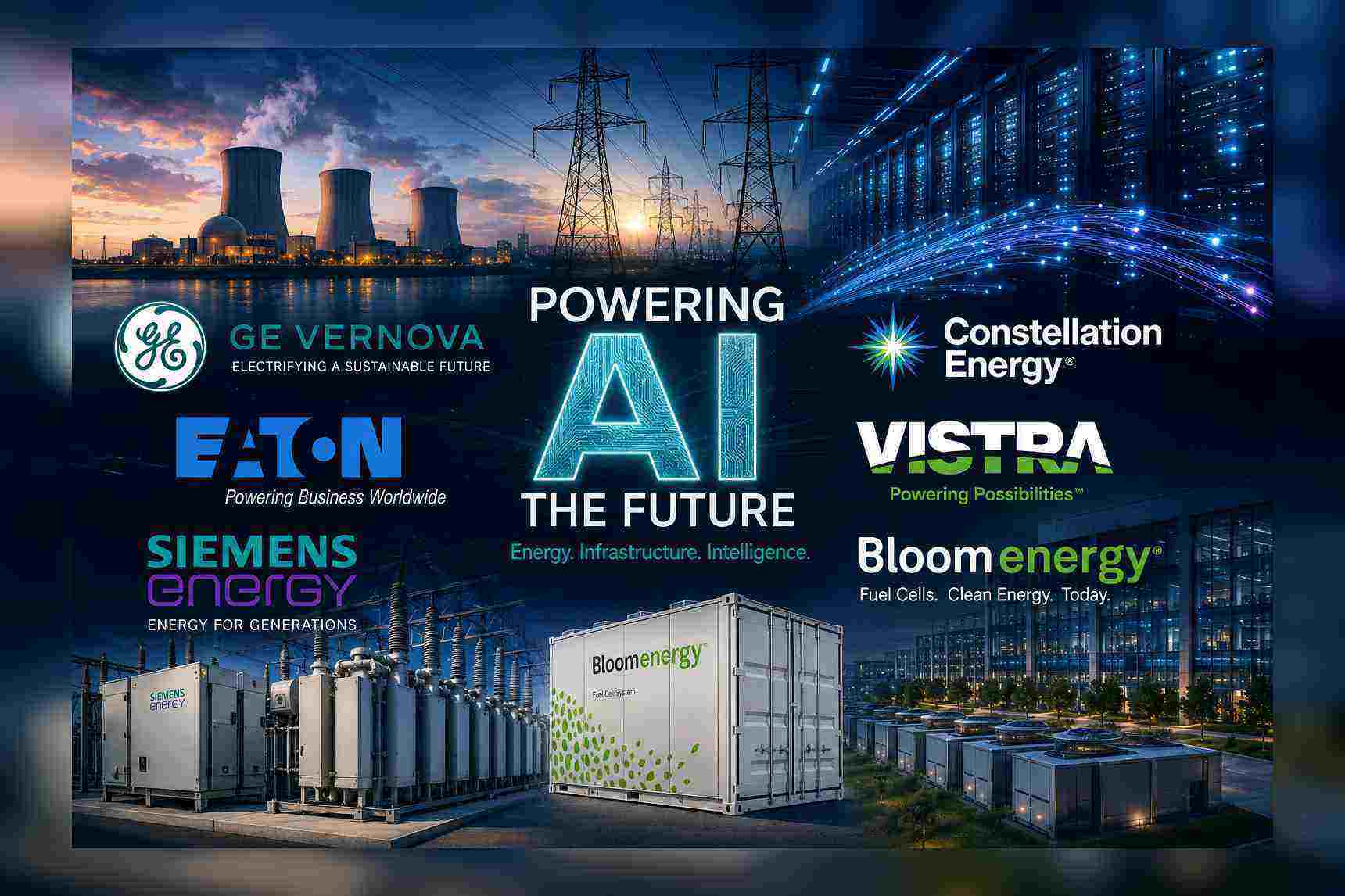
The next phase of the artificial intelligence investment boom may be powered by something fairly basic, if crucial: electricity. The headlines so far have largely focused on GPUs, LLMs and data transfer speed and efficiency as with have explained in previous analyses, AI opportunities are broadening and moving downstream.
Copper: The overlooked AI investment theme for UK retail investors
Lumentum vs Applied Optoelectronics vs Coherent: Which is the better optics stock?
AI datacentres consume enormous amounts of power, operate around the clock and increasingly require connections that existing electricity grids cannot provide quickly enough. The International Energy Agency estimates that global electricity generation supplying datacentres will rise from about 460 TWh (terawatt hour) in 2024 to more than 1,000 TWh by 2030.
Renewables are expected to provide almost half of the additional demand, while natural gas and nuclear also become increasingly important.
That creates a second AI investment opportunity: companies supplying the generation, transmission, electrical equipment, cooling, backup and on-site power needed to keep AI infrastructure running.
6 stock options to consider:
1. GE Vernova — best overall AI power infrastructure play
2. Constellation Energy — best nuclear/24-7 power play
3. Eaton — best grid/electrification play
4. Vistra — attractive value-oriented power generator
5. Siemens Energy — European alternative to GE Vernova
6. Bloom Energy — highest-risk/highest-upside on-site power bet
The important distinction is that these are not ‘AI stocks’ in the conventional sense. They provide the infrastructure that makes AI possible.
Why electricity has suddenly become an AI bottleneck
The AI industry has been extraordinarily successful at increasing computing power. The constraint is increasingly becoming where that computing power can physically operate.
A hyperscale AI datacentre can require hundreds of megawatts of electricity, while the largest planned facilities could eventually require gigawatts. That creates three problems.
1. The grid cannot expand instantly
Power generation can take years to build and grid connections can take even longer.
The IEA expects datacentre electricity demand to more than double this decade. Meanwhile, Capgemini found that almost 80% of utilities expect more extreme and volatile electricity demand patterns as datacentres expand.
That gives existing generators and electrical-equipment suppliers considerable pricing power.
2. AI needs reliability, not simply cheap electricity
A conventional office can tolerate an interruption. A massive AI cluster cannot.
Training and inference workloads require extremely reliable power, sophisticated backup systems and increasingly dedicated electrical infrastructure.
This favours:
- nuclear generation;
- natural-gas turbines;
- grid infrastructure;
- batteries and energy storage;
- fuel cells;
- sophisticated power-management equipment.
3. Renewable power is essential — but not sufficient on its own
Renewables will be a major part of the solution. The IEA expects renewables to meet almost 50% of incremental datacentre electricity demand between 2024 and 2030, with renewable generation for datacentres growing at roughly 22% annually.
But solar and wind are intermittent.
An AI datacentre does not stop computing because the sun has gone down.
That means the most attractive long-term power architecture is likely to be a mix of renewables + nuclear/gas + storage + grid infrastructure, rather than a single technology.
This is an important investment point: the winners may not be the companies producing the cheapest electricity. They may be the companies providing reliable electricity at the exact location and time that AI customers need it.
Why these 6 stocks are worth watching
| Company | Ticker | AI power exposure | Approx. market cap | Forward PE* | Risk |
| GE Vernova | GEV | Gas turbines, grid, wind, electrification | ~$268bn | ~45x | Medium |
| Constellation Energy | CEG | Nuclear + gas generation | ~$95bn | ~21x | Medium |
| Eaton | ETN | Grid, switchgear, power management | ~$168bn | ~29x | Medium |
| Vistra | VST | Nuclear + gas generation | ~$47bn | ~14x | Medium-high |
| Siemens Energy | ENR | Grid + turbines + power systems | ~€132bn | ~25x | Medium-high |
| Bloom Energy | BE | On-site fuel cells | ~$62bn | ~51x | Very high |
*Based on Stockopedia rolling 12m forward data.
1. GE Vernova (NYSE:GEV): Overall AI power stock
GE Vernova offers arguably the broadest exposure to the electricity infrastructure bottleneck.
It sells gas turbines, grid equipment, wind turbines and other power-generation technology. Its gas-turbine business is particularly important because gas can provide dispatchable electricity when renewable generation is unavailable.
The scale of the opportunity is becoming visible in turbine orders. Global gas-turbine orders reached about 38 GW in Q2 2026, up 71% year-on-year, with GE Vernova accounting for roughly 11.3 GW according to industry data cited by Investors’ Business Daily.
Why investors like it: AI does not need just more electricity; it needs more generation and grid equipment. GE Vernova can sell into both.
The problem: the market already knows this. At roughly 50x forward earnings, the valuation leaves relatively little room for disappointment.
Verdict: Best quality AI-power infrastructure exposure, but valuation is demanding.
2. Constellation Energy (NASDAQ:CEG): the nuclear winner
Constellation Energy is my preferred stock for investors wanting a more direct bet on 24/7 low-carbon electricity.
Nuclear is particularly attractive for AI because reactors can produce power continuously with relatively low carbon emissions.
Constellation has also been signing long-term arrangements associated with data-centre demand, giving investors greater visibility than simply betting on future wholesale electricity prices. Its acquisition of Calpine has broadened its generation portfolio beyond nuclear.
The valuation is much more reasonable than GE Vernova or Bloom: roughly 21x forward earnings.
Management’s modelling indicates substantial earnings growth through 2029, with adjusted operating earnings expected to grow at roughly 20% annually on its base earnings assumptions.
Risk: nuclear regulation, plant outages, power-price volatility and political intervention.
Verdict: May suit investors seeking a relatively balanced AI-power position.
3. Eaton (NYSE:ETN): the picks-and-shovels winner
Eaton is less obvious than Constellation but potentially just as interesting.
AI datacentres need enormous amounts of:
- switchgear;
- circuit protection;
- transformers;
- power distribution;
- backup systems;
- power-management software;
- electrical infrastructure.
Eaton supplies much of this equipment.
That makes it a classic ‘picks and shovels’ AI investment: it does not have to predict which AI model wins.
It simply needs more datacentres to be built.
The valuation is around 29x forward earnings, meaning the stock is not cheap, but its diversification across industrial electrification reduces the risk of being purely dependent on AI.
Verdict: For investors wanting lower AI-specific risk and long-term electrification exposure.
4. Vistra (NYSE:VST): the value alternative
Vistra is particularly interesting because the valuation is substantially below Constellation and GE Vernova.
Its market capitalisation is roughly $47bn and its forward PE is around 14x.
Vistra owns nuclear and gas generation, giving it exposure to the two technologies that can provide dependable electricity when renewables are unavailable.
The attraction is simple:
AI power demand rises → electricity becomes more valuable → existing generation assets become more valuable.
But there is a catch. The company is more exposed to wholesale electricity prices and regulatory changes than a company such as Eaton.
Recent developments have also highlighted the risk that changes to US capacity markets or datacentre connection rules could reduce expected future earnings.
Verdict: Suits value-oriented investors willing to accept greater power-market risk.
5. Siemens Energy (ETR:ENR): the European alternative
Siemens Energy is particularly interesting for UK investors because it provides European exposure to the same structural theme.
Its portfolio includes gas turbines, grid technology and other energy infrastructure.
The company has recently reported exceptionally strong growth, while its forward PE is around the mid-20s, depending on the data provider and exchange.
The attraction is that AI is only one part of the opportunity. European grid investment, renewable integration and energy security provide additional demand.
The downside is execution risk, especially given the complexity of large infrastructure projects.
Verdict: Attractive diversification for investors who do not want their AI-power exposure entirely in US equities.
6. Bloom Energy (NYSE:BE): the high-risk moonshot
Bloom Energy is the most speculative name on the list.
Its pitch is compelling: instead of waiting years for the grid to provide enough electricity, data-centre operators can potentially install on-site fuel-cell generation.
That addresses one of the industry’s biggest problems — speed.
Bloom has attracted major financing and partnerships, while its revenue growth has accelerated sharply. But the valuation has also exploded. Its forward PE has fallen sharply in recent months as investor de-risked portfolios, down from around 90x in June to ~51x now.
This is the classic high-growth investment dilemma:
If fuel cells become a standard way of powering AI datacentres, today’s valuation could eventually look cheap. If adoption disappoints, the valuation could collapse.
Verdict: Speculative. The upside is potentially enormous, but Bloom requires far more thorough analysis before investing.
Bull vs bear case
| Stock | 🐂 Bull case | 🐻 Bear case |
| GE Vernova | AI drives years of turbine/grid orders; margins expand | Valuation assumes years of exceptional growth; equipment cycle turns |
| Constellation | Nuclear scarcity + long-term AI contracts drive earnings growth | Regulation, outages or power-price weakness hit returns |
| Eaton | Data-centre capex drives electrical-equipment boom | AI capex slows; premium multiple contracts |
| Vistra | Power scarcity boosts generation margins | Capacity-market/regulatory changes reduce returns |
| Siemens Energy | European grid + AI + gas turbine investment accelerates | Project execution and valuation disappoint |
| Bloom Energy | Fuel cells become standard for off-grid AI datacentres | Technology remains niche and valuation collapses |
The renewable-energy paradox
One of the most important issues for investors is that AI demand is simultaneously a huge opportunity for renewables and a problem for renewables.
Solar and wind are likely to supply a large proportion of new electricity generation. But the more intermittent renewable power enters the grid, the more important storage, transmission and dispatchable generation become.
The recent experience in Britain illustrates the issue. During the August 2026 solar eclipse, National Energy System Operator anticipated a potential electricity shortfall of up to 1,700 MW as solar generation temporarily collapsed. The event was ultimately managed without customer outages, but it demonstrated why a system increasingly reliant on intermittent generation still needs backup and flexible capacity.
For investors this creates a potentially attractive chain:
AI → more electricity demand → more renewables → more grid investment → more storage → more backup generation → more electrical equipment.
That is why it is not sensible to treat nuclear, gas, renewables and grid infrastructure as competing investment themes. They can all benefit from the same underlying demand shock.
What could go wrong?
The AI-power thesis is strong, but investors should not assume electricity demand will grow in a straight line.
1. AI efficiency improves
More efficient chips and models could reduce electricity consumption per unit of AI computation.
2. Datacentres are delayed
Power shortages, planning restrictions and grid bottlenecks could delay projects.
Capgemini estimates that roughly one in five datacentre power requests may never materialise, highlighting the danger of extrapolating every proposed project into future electricity demand.
3. Governments intervene
AI datacentres can create political problems when households face higher electricity prices.
Virginia is already experiencing this tension: rapid datacentre growth has increased Dominion Energy’s (NYSE:D) reliance on expensive wholesale electricity, raising concerns about the impact on consumers.
4. Valuations are already high
This is arguably the biggest investment risk.
GE Vernova and Bloom Energy, in particular, already discount substantial future growth. Even Eaton trades on a premium multiple.
5. AI capex eventually slows
The AI infrastructure cycle could ultimately resemble previous technology investment booms: enormous initial spending followed by a period of overcapacity.
Ranking for UK retail investors
| Rank | Stock | Rating | Best for |
| 1 | GE Vernova | ★★★★★ | Best overall AI-power infrastructure |
| 2 | Constellation Energy | ★★★★★ | Nuclear + reliable 24/7 electricity |
| 3 | Eaton | ★★★★½ | Grid/electrification ‘picks and shovels’ |
| 4 | Vistra | ★★★★ | Lower valuation + generation exposure |
| 5 | Siemens Energy | ★★★★ | European diversification |
| 6 | Bloom Energy | ★★★ | High-risk fuel-cell upside |
Power play basket
For a UK retail investor building an AI power basket, several of these stocks could valuable assets. Rather than simply buying the stock with the highest AI exposure, it is possible to diversify across the electricity value chain:
GE Vernova → generation equipment
Constellation → nuclear generation
Eaton → electrical/grid infrastructure
Vistra → dispatchable generation/value
That combination gives exposure to the four critical bottlenecks: generation, reliability, transmission and power management.
Investor verdict
GE Vernova looks the best placed long-term AI-power stock, because its addressable market extends beyond AI into the broader global electrification and grid-renewal cycle.
But at roughly 45x forward earnings, many investors may be more comfortable buying it after a meaningful pullback than chasing a sharp rally.
For investors prioritising risk-adjusted valuation, Constellation looks more compelling: roughly 21x forward earnings, exposure to scarce nuclear generation and increasing demand for reliable carbon-free electricity.
And for investors wanting the most speculative payoff, Bloom Energy offers the biggest potential upside — but also by far the greatest valuation risk.
Crucially, AI opportunities are broadening and moving downstream. GPUs may perform the calculations, but electricity makes them possible. The companies controlling reliable generation, grid capacity and electrical infrastructure could therefore become some of the most important — and potentially underappreciated — beneficiaries of the next stage of the AI boom.
For UK investors, US-listed stocks also introduce GBP/USD currency risk and different dividend/tax treatment from UK shares.
You might also like: