




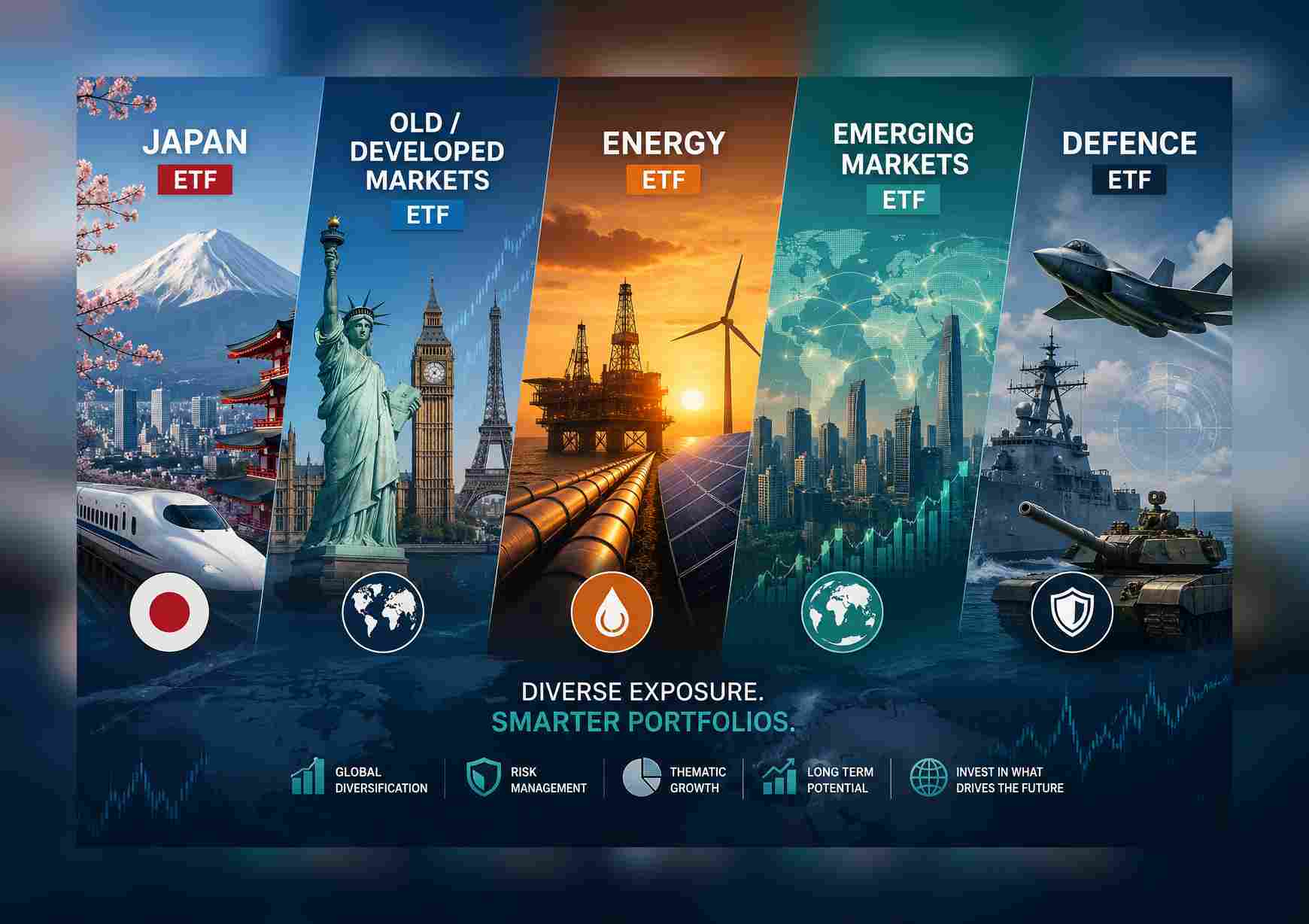
Artificial intelligence remains one of the dominant investment themes of 2026, but investors are increasingly looking beyond the obvious beneficiaries such as Nvidia (NASDAQ:NVDA), Broadcom (NASDAQ:AVGO), Microsoft (NASDAQ:MSFT) and the major semiconductor companies. The attraction is straightforward: diversify exposure to the AI boom while gaining access to sectors, assets and regions that could perform well if the technology trade cools.
The latest ETF flow data suggests, however, that this diversification is still selective. European investors have continued to favour broad global and US equity exposure rather than making a wholesale rotation away from growth. European-listed ETFs attracted €47.3 billion in July, taking year-to-date flows to almost €266 billion. Equity ETFs accounted for €34.2 billion of July inflows.
Where is the money going?
| Theme | Latest flow/performance evidence | Investment attraction |
| Japan | iShares MSCI Japan ETF attracted €1.57bn in July | Diversification from US mega-cap tech |
| Emerging markets | UBS Core MSCI EM ETF was among July’s most-bought ETFs | Faster-growing economies and different sector mix |
| Gold/commodities | Global gold ETFs attracted $3bn in July | Hedge against inflation, geopolitics and tech volatility |
| Energy | European energy ETFs attracted strong interest earlier in 2026; energy ETFs were July’s standout performers | Cash flow, inflation sensitivity and commodity exposure |
| Infrastructure | Infrastructure funds attracted €3.8bn in Q2 | AI data centres, grids and electricity demand |
| Defence | Defence funds suffered their first quarterly outflow in more than two years in Q2 | Long-term government spending theme, but increasingly crowded |
| Value | Global large-cap value ETFs lost €539m in July | Potential valuation diversification, although flows remain weak |
| Small caps | US small-cap ETFs lost €395m in July | Potential future rate-cut/economic recovery beneficiary |
Source: Morningstar, World Gold Council. Flow figures are not directly comparable because they cover different periods and fund universes.
1. Japan and emerging markets
Geographic diversification looks particularly interesting. The iShares MSCI Japan ETF (LON:IJPN) attracted €1.57 billion in July, while an emerging-markets ETF was also among Europe’s most heavily purchased strategies.
Japan offers exposure to industrials, financials and exporters rather than simply adding another collection of US technology stocks. Emerging markets offer an even broader mix, including Asian technology, financials, commodities and consumer businesses.
Nicola Takada Wood presents AVI Japan Opportunity Trust, Sharesify Webinar 24 June 2026
The risk is that geographical diversification can introduce currency volatility, political risk and weaker corporate governance. Emerging markets can also be extremely sensitive to the dollar and global liquidity.
Sharesify podcast with Emily Whiting of JPMorgan Emerging Markets Growth & Income
2. Gold and commodities
Gold has become one of the clearest potential counterweights to an AI-heavy portfolio. Global physically backed gold ETFs attracted $3 billion of net inflows in July, reversing two consecutive months of outflows. European-listed funds led the recovery. Year-to-date global inflows reached $11 billion.
For investors worried that AI valuations have become excessive, gold provides an asset with very different drivers. It can also offer protection against geopolitical shocks, currency concerns and persistent inflation.
But gold produces no earnings or dividends. Its valuation ultimately depends on investor demand, real interest rates, currencies and perceptions of risk.
Commodity exposure goes further. Oil, copper and other industrial commodities can benefit from AI’s enormous electricity, infrastructure and construction requirements. Energy ETFs were among the strongest-performing UK-listed ETFs in July, with the iShares MSCI Europe Energy Sector ETF (LON:ESIE) gaining ~17%.
The danger is buying after the rally. Energy and commodity prices are cyclical and can fall rapidly if geopolitical tensions ease, supply increases or economic growth weakens.
3. Infrastructure: perhaps the most interesting AI diversifier
Infrastructure may be one of the most compelling ways to diversify the AI trade without abandoning it.
European infrastructure funds attracted €3.8 billion during Q2 as investors focused on data-centre construction, electricity networks and the infrastructure required to support accelerating AI investment.
This creates exposure to the picks and shovels behind AI rather than the software and semiconductor companies themselves.
Think electricity grids, engineering, construction, cooling systems, power equipment, data centres and utilities.
AI power crunch: which stocks win the electricity boom?
The risk is valuation. Infrastructure companies have already benefited from the AI-capex narrative, while higher interest rates can make capital-intensive businesses less attractive.
4. Defence: powerful theme, but don’t confuse it with diversification
Defence has been one of Europe’s most popular thematic trades, driven by higher military spending and European rearmament.
Yet the latest data provides a warning. Defence funds recorded their first quarterly net outflow in more than two years in Q2. At the same time, European defence stocks have become volatile as investors question how quickly government spending commitments translate into corporate earnings.
The long-term investment case remains credible: governments appear committed to increasing defence budgets, while drone warfare, cybersecurity and missile defence create additional opportunities.
But investors should be wary of buying simply because defence spending is rising. Share prices can anticipate years of future earnings growth, creating disappointment if contracts are delayed or margins fall.
5. Value, mid-caps and small caps
Value and smaller companies are often presented as the obvious antidote to expensive AI mega-caps. The problem is that investors have not yet made a decisive move in that direction.
Global large-cap value ETFs recorded €539 million of outflows in July, while US small-cap ETFs lost €395 million.
That doesn’t mean value and small caps are unattractive. In fact, they could become more interesting if interest rates decline and economic growth broadens.
European value stocks have already demonstrated the potential: the Morningstar Developed Europe Value Index gained 4.7% in July, compared with a 2.2% decline for its growth counterpart. Value has also substantially outperformed growth during 2026 so far.
For UK investors, mid- and small-cap ETFs can therefore provide genuine diversification from a portfolio dominated by US mega-cap technology. But they generally carry greater economic sensitivity, volatility and liquidity risk.
Which themes suit which investor?
The cautious AI investor: consider a core global equity ETF complemented by a modest allocation to gold and defensive infrastructure. The objective is diversification rather than maximising AI upside.
The growth investor: Japan, emerging markets, infrastructure and selected small-cap exposure could broaden a technology-heavy portfolio while retaining substantial equity-market growth potential.
The inflation/geopolitical hedge investor: gold, energy and commodities offer the most direct diversification, although these should generally be treated as satellite positions rather than portfolio foundations.
The contrarian investor: value, European equities and small caps could offer greater upside if the market broadens beyond mega-cap technology. The trade-off is that these areas may remain out of favour for extended periods.
The income investor: energy, infrastructure, utilities and value-oriented equity ETFs may provide a better combination of dividends and diversification than pure AI funds, although yields and sector risks vary considerably.
Investor verdict
The key message from ETF flows is not that investors are abandoning AI. Quite the opposite. Global and US large-cap blend ETFs remained the dominant destinations for European capital in July, while technology-themed funds also rebounded during Q2.
Instead, sophisticated investors appear to be looking for adjacent opportunities: Japan and emerging markets for geographic diversification, infrastructure for AI’s physical requirements, energy and commodities for inflation and supply shocks, and gold as a portfolio hedge.
It’s about how you might diversify exposure to the AI boom while gaining access to sectors, assets and regions that could perform well if the technology trade cools.
For UK retail investors, that suggests a core-and-satellite approach may make more sense than trying to predict the next winning theme. Keep a diversified global ETF as the core, then use smaller thematic allocations to express views on infrastructure, gold, energy, defence, Japan, emerging markets or value.
Most importantly, ETF inflows are evidence of investor demand, not proof of future returns. Flow data can identify crowded trades as easily as attractive opportunities.
The best diversification is therefore not simply owning ten different thematic ETFs. It is owning assets whose earnings, valuations and economic drivers are genuinely different from the AI trade.
You might also like:
