


The message for investors is clear: Cisco Systems’ (NASDAQ:CSCO) AI transformation is becoming real but expectations are now much higher.
The networking giant delivered a strong Q4 FY2026, beating expectations on revenue and adjusted earnings and issuing FY2027 guidance comfortably ahead of Wall Street forecasts. Yet the shares fell ~6% after-hours on 12 August despite the beat, following a powerful ~60% year-to-date rally.
| Cisco Systems (NASDAQ:CSCO) | Price: $116.47 (~-6%) | Market cap: ~$459bn |
The long-term opportunity is attractive, particularly because Cisco can benefit from AI infrastructure spending without having to fund the enormous datacentre capital expenditure required by hyperscalers.
But at roughly 25x FY2027 adjusted earnings, Cisco is no longer a cheap mature technology stock.
Why Cisco sell-off could be a great opportunity for investors
Q4 results: a substantial beat
| $bn except EPS | Q4 FY26 | Q4 FY25 | YoY | Street | Verdict |
| Revenue | 17.25 | 14.67 | +18% | ~16.8 | ✔️ Beat |
| Adjusted EPS | $1.22 | $0.99 | +23% | $1.17 | ✔️ Beat |
| Product revenue | 13.46 | 10.89 | +24% | ~13.0 | ✔️ Beat |
| Adjusted gross margin | 66.3% | 68.4% | -210bp | ~66% | In line |
| Adjusted operating margin | 35.9% | 34.3% | +160bp | — | ✔️ Strong |
Revenue reached $17.25bn, up 18%, while adjusted EPS increased 23%. Product revenue was particularly strong.
The important detail is that Cisco managed to expand operating margins despite lower gross margins. Higher-cost AI products and components are putting pressure on gross margin, but operating discipline is providing an offset.
Why did the shares fall?
Cisco closed regular trading on 12 August higher but reversed sharply after the results. After-hours data shows a rough 6% decline despite the earnings beat and stronger-than-expected outlook.
This looks more like an expectations problem than an earnings problem.
Cisco had already rallied strongly into the results. Investors therefore needed evidence not merely that AI demand was strong, but that it would translate into accelerating revenue, sustainable margins and cash flow.
The results delivered the first two pieces. The market is still debating the third.
AI is transforming Cisco’s investment case
Cisco is not competing with Nvidia (NASDAQ:NVDA) for GPUs or any chips at all. Its opportunity is the infrastructure connecting those GPUs and AI servers.
AI clusters require increasingly high-speed networking to move enormous quantities of data between processors, storage and users.
Cisco’s networking revenue grew 28% in Q4, demonstrating that the AI build-out is benefiting its core business.
More importantly, Cisco booked approximately $4bn of AI infrastructure orders in Q4, taking FY2026 orders to $9.3bn.
That is a dramatic acceleration from the company’s earlier expectations.
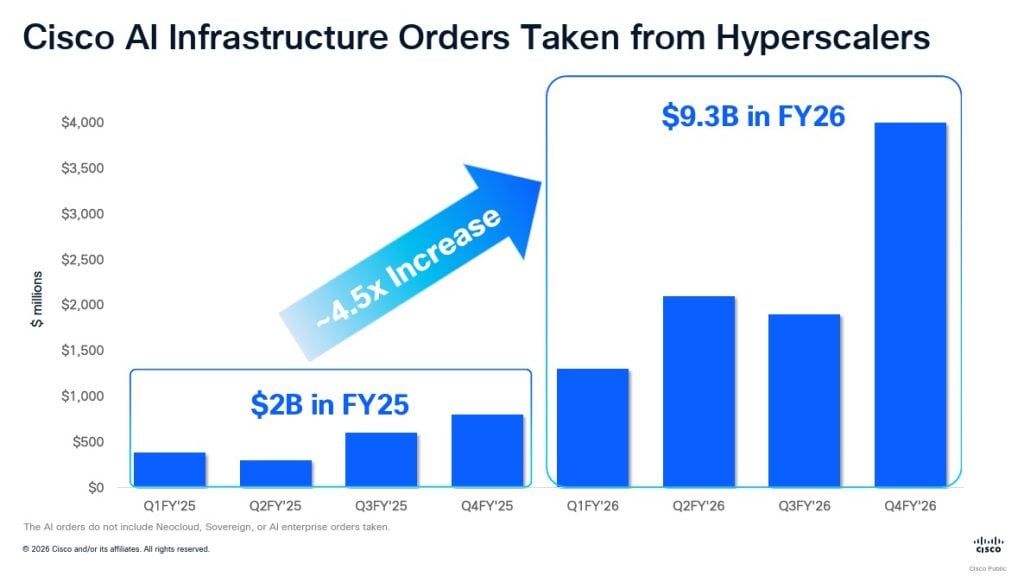
CEO Chuck Robbins has described the environment as an AI ‘super cycle’, while management expects AI hyperscaler revenue to increase substantially in FY2027.
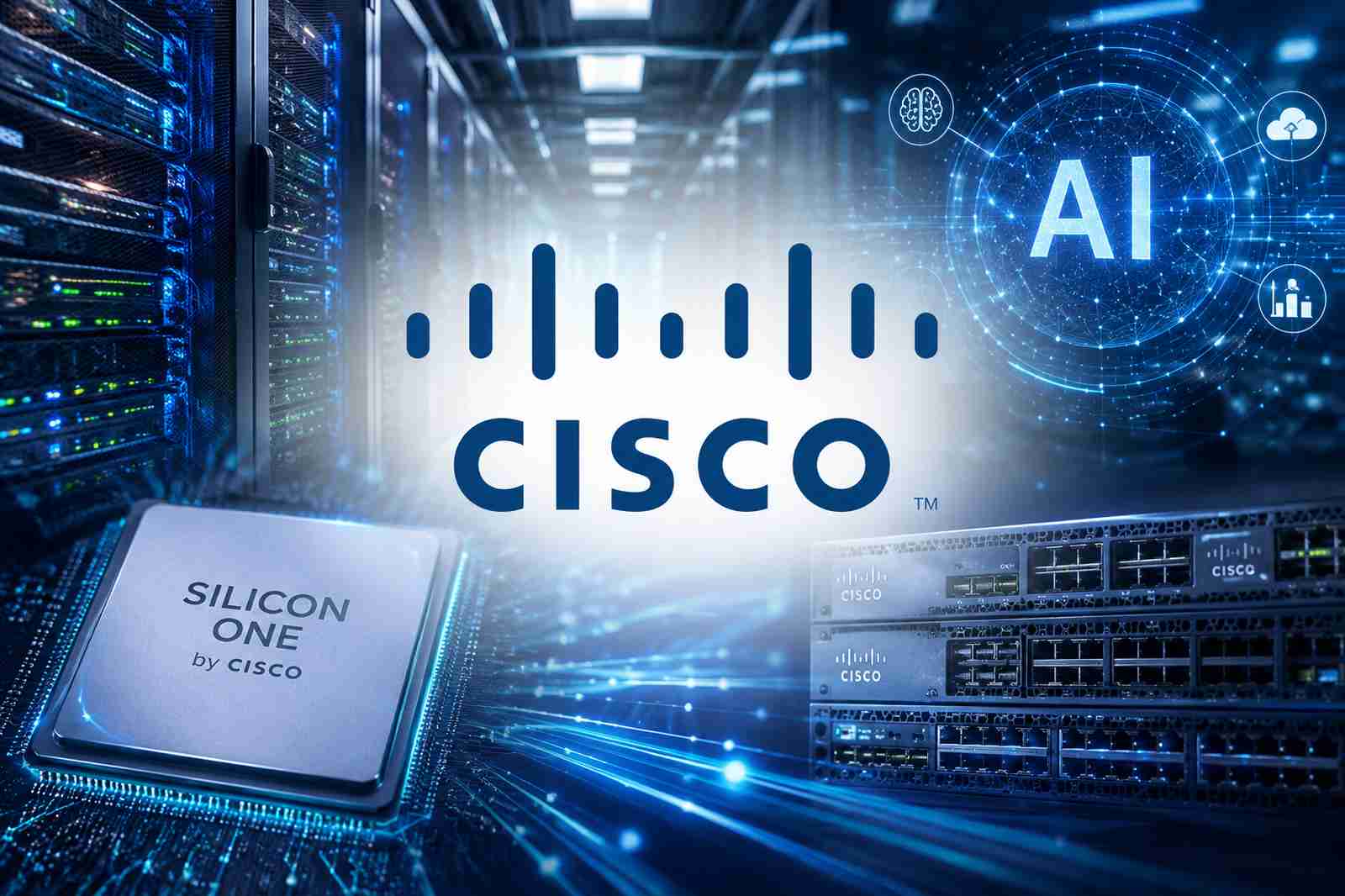
The company’s Silicon One networking silicon and optical technology are particularly important because they allow Cisco to participate further up the AI infrastructure stack.
FY2027 guidance raises the bar
Cisco’s guidance was significantly stronger than investors had expected.
| FY2027 | Cisco guidance | Approx. midpoint |
| Revenue | $72.2bn-$73.4bn | $72.8bn |
| Adjusted EPS | $5.05-$5.11 | $5.08 |
| Q1 revenue | $18.0bn-$18.2bn | $18.1bn |
| Q1 adjusted EPS | $1.32-$1.34 | $1.33 |
The full-year revenue midpoint implies roughly 15% growth, while the EPS midpoint implies approximately 17% growth.
That is a major change for a company historically associated with low-single-digit growth.
Management expects AI hyperscaler revenue of roughly $7.5bn in FY2027, compared with about $4bn in FY2026.
The crucial question is whether orders convert into revenue quickly enough.
Orders are encouraging. But shipments and cash flow are what ultimately matter.
Gross margins are the biggest concern
Cisco’s adjusted gross margin fell to 66.3% from 68.4%.
AI infrastructure products are more hardware-intensive, while higher memory and component costs are creating additional pressure.
How crazy could the memory chip shortage become – and what does it mean for UK investors?
Management expects Q1 FY2027 adjusted gross margin of around 65%-66%, suggesting investors should not expect an immediate return to previous margin levels.
This is particularly important because Cisco’s valuation has risen alongside the AI narrative.
If revenue grows 15% but margins continue falling, EPS growth could eventually disappoint.
Conversely, if Cisco can stabilise gross margins while AI revenue accelerates, the current valuation becomes easier to justify.
Cash flow is one of Cisco’s biggest advantages
Unlike many AI infrastructure companies, Cisco does not need to spend billions building AI data centres.
Its customers do that.
Cisco generated approximately $14.2bn of operating cash flow in FY2026 against roughly $1.4bn of capital expenditure, producing estimated free cash flow of around $12.8bn.
| FY2026 | $bn |
| Operating cash flow | 14.2 |
| Capital expenditure | 1.4 |
| Approx. free cash flow | 12.8 |
| FCF margin | ~20% |
This is a major strength.
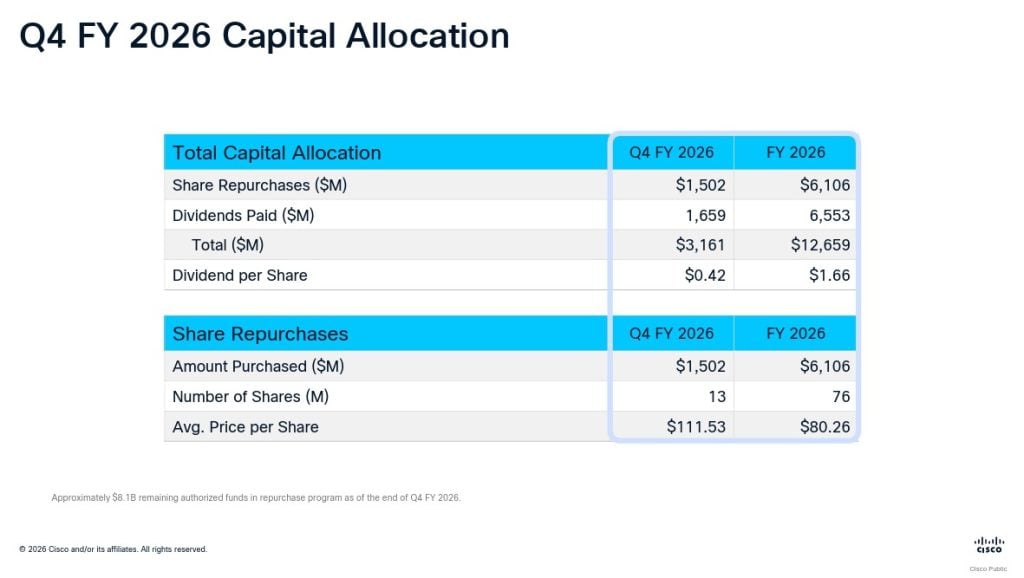
Cisco can fund R&D, acquisitions, dividends and share buybacks while still generating substantial excess cash.
It also returned billions of dollars to shareholders during the year.
For UK investors, that makes Cisco fundamentally different from capital-intensive AI infrastructure plays whose cash flows may remain negative while they build capacity.
Valuation: no longer a traditional Cisco
At approximately $115-$120 per share, Cisco is valued at roughly 24x FY2027 adjusted EPS using the midpoint of its guidance.
That is not excessive compared with some AI infrastructure companies, but it is well above the valuation investors historically associated with Cisco.
| Company | Approx. forward PE* | Investment profile |
| Cisco | ~26x | AI networking + security |
| Arista Networks | ~44x | High-growth AI networking |
| HPE | ~15x | Lower-growth infrastructure |
| Nokia | ~23x | Networking/optical |
*PE data based on Stockopedia rolling 12m basis, at 12 August 2026
Cisco therefore sits between traditional infrastructure companies and higher-growth AI networking specialists.
That looks reasonable if 15%-plus growth persists.
It looks expensive if AI growth fades back toward Cisco’s historical trajectory.
Analyst/investor debate
The key analyst questions increasingly concern AI revenue conversion and margins, rather than whether Cisco has an AI opportunity.
That distinction matters.
Cisco has already demonstrated substantial AI orders. The next test is converting those orders into recognised revenue without sacrificing profitability.
The market’s negative after-hours response despite a major earnings and guidance beat suggests investors were looking for an even bigger upside surprise after Cisco’s huge run-up.
In other words, good news was already priced in.
Bull vs bear case
| 🐂 Bull case | 🐻 Bear case |
| AI networking becomes a multi-year supercycle | AI spending eventually slows |
| AI revenue reaches/exceeds $7.5bn | Orders convert more slowly than expected |
| Silicon One wins more hyperscaler designs | Arista/Broadcom take market share |
| Networking growth remains double digit | Enterprise networking demand weakens |
| Security/Splunk accelerates | Services growth remains sluggish |
| Gross margins stabilise | Memory/component costs squeeze margins |
| ~$13bn FCF supports buybacks/dividends | Higher working capital absorbs cash |
| 25x earnings proves reasonable | Multiple contracts if growth disappoints |
Investor verdict
Cisco’s fundamentals are arguably stronger than they have been for years.
The combination of AI networking growth, Silicon One, security, strong free cash flow and a major installed base gives Cisco a credible role in the AI infrastructure boom.
The problem is the share price.
After a huge 2026 rally, investors are no longer buying Cisco as a sleepy dividend stock, although it still does return regular value to investors. They are paying for an AI-driven earnings re-rating.
That makes the next few quarters particularly important.
Watch four numbers:
AI revenue conversion → networking growth → gross margin → free cash flow.
If AI revenue reaches $7.5bn or more, networking remains strong and margins stabilise, Cisco could justify its premium valuation.
If AI orders remain impressive but revenue conversion or margins disappoint, the shares could face further multiple compression.
The AI transformation is becoming real but expectations are now much higher. The question for investors is how much of it is already priced in.
You might also like: