




Dell Technologies (NYSE:DELL) delivered one of the strongest quarterly reports of the 2026 earnings season, with fiscal Q1 2027 results dramatically ahead of Wall Street expectations as artificial intelligence infrastructure demand accelerated again.
Shares surged nearly 40% in after-hours trading after management raised full-year guidance and expanded its AI revenue outlook. Yes, you read that right… nearly 40%! That’s an extra ~$82bn added to its market cap at a stroke.
📊 Key Q1 FY2027 Results
| Metric | Reported | Wall Street Forecast | YoY Growth |
| Revenue | $43.84bn | $35.7bn | +88% |
| Adjusted EPS | $4.86 | $2.96 | +214% |
| Infrastructure Solutions Revenue | $29.0bn | — | +181% |
| Client Solutions Revenue | $14.6bn | — | +17% |
| AI Server Revenue | $16.1bn | — | +757% |
| AI Backlog | $51.3bn | — | +19% vs prior backlog |
🚀 Why Dell Stock Surged
The rally was driven by three major catalysts.
1. AI demand exploded again
Dell’s AI server business continues to scale far faster than investors expected. The company generated $16.1bn of AI server revenue in a single quarter, with enterprise and hyperscale customers still aggressively building AI datacentres. Management highlighted customers including CoreWeave (NASDAQ:CRWV), Samsung (LON:BC94) and Honeywell (NYSE:HON).
The most important figure for investors was backlog growth. Dell’s AI backlog rose to more than $51bn, giving unusually strong forward revenue visibility for the next several quarters.
2. Guidance was massively raised
Dell materially upgraded its outlook for both revenue and earnings.
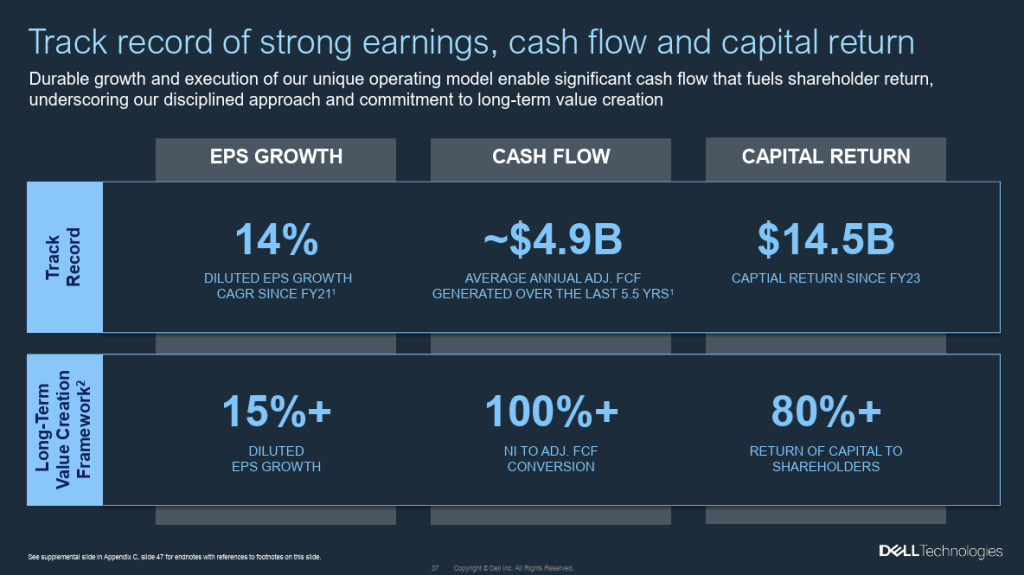
| Guidance Metric | Previous FY2027 Guidance | New FY2027 Guidance |
| Full-Year Revenue | $138bn-$142bn | $165bn-$169bn |
| Adjusted EPS | $12.90 | $17.90 |
| AI Revenue Target | $50bn | $60bn |
That scale of upward revision is rare for a company already generating more than $100bn annually in sales.
3. Investors now view Dell as an AI infrastructure winner
Historically, Dell traded like a mature PC and enterprise hardware company. That valuation framework is changing rapidly as AI servers become a larger percentage of profits.
The Infrastructure Solutions Group — now the key growth engine — grew revenue 181% year-over-year to $29bn.
Importantly, investors were worried AI servers would carry weak margins because of expensive Nvidia (NASDAQ:NVDA) GPU costs. Instead, Dell delivered strong operating leverage alongside revenue growth, easing fears that AI growth would only inflate low-margin sales.
🧠 The AI Opportunity Is Expanding
Dell increasingly resembles an “AI picks-and-shovels” business rather than a traditional PC maker.
The company now sits at the centre of several structural trends:
- Hyperscaler AI datacentre expansion
- Enterprise AI adoption
- Liquid-cooled rack deployments
- AI networking and storage upgrades
- Sovereign AI infrastructure spending
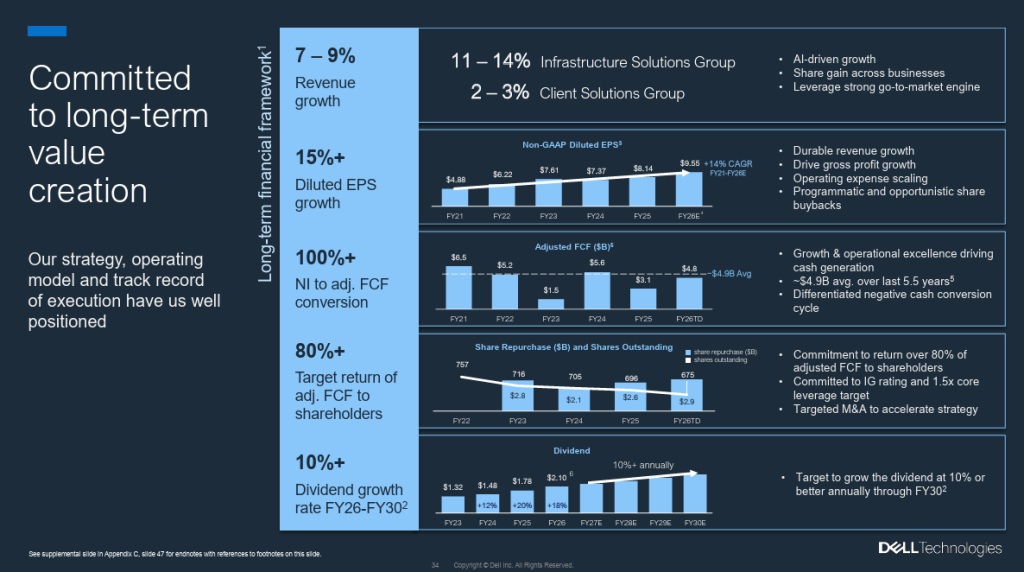
Dell also benefits from close relationships with Nvidia and enterprise customers needing turnkey AI systems rather than building infrastructure internally.
Management previously guided to roughly 100% annual AI server growth entering FY2027. That outlook has now strengthened further after Q1 demand materially exceeded expectations.
AI investing: Bubble or start of new economic supercycle?
🟢 Valuation Conclusion
Despite the rally, Dell’s valuation still looks relatively modest compared with many AI-linked companies.
| Company | Approx Forward P/E |
| → Dell | ~19x-21x |
| → Nvidia | ~35x+ |
| → Broadcom | ~30x+ |
| → AMD | ~40x+ |
The key investment debate is whether Dell deserves a structurally higher valuation multiple as AI becomes the dominant driver of earnings growth.
Bulls argue Dell now has:
- Exceptional revenue visibility
- A huge AI backlog
- Strong hyperscale demand
- Rapid EPS growth
- Improving margins
Bears will point out that hardware businesses remain cyclical, competitive and partially dependent on Nvidia supply dynamics.
For UK retail investors, these results were dramatically ahead of Wall Street expectations as artificial intelligence infrastructure demand accelerated again, making Dell increasingly look less like a legacy hardware company and more like a scaled AI infrastructure platform. After this quarter, the market is clearly beginning to reprice the stock accordingly.
You might also like:
