




IBM (IBM), Lam Research (LRCX) and Texas Instruments (TXN) reported earnings after-hours (22 April) and the overnight tape told a familiar—but increasingly nuanced—story. It is a tale of strong earnings tied to the enormous AI buildout being rewarded, yet not all ‘AI infrastructure’ names were treated equally.
The divergence wasn’t about whether companies are exposed to AI—it was about how directly, how visibly, and how credibly that exposure translates into near-term growth.
| IBM (IBM) | Price: $233.76 (-7%) | Market cap: $219.71bn |
| Lam Research (LRCX) | Price: $268.48 (+1%) | Market cap: $334.92bn |
| Texas Instruments (TXN) | Price: $264.55 (+12%) | Market cap: $240.70bn |
Act I: Clean beats, clear narratives — the market rewards certainty
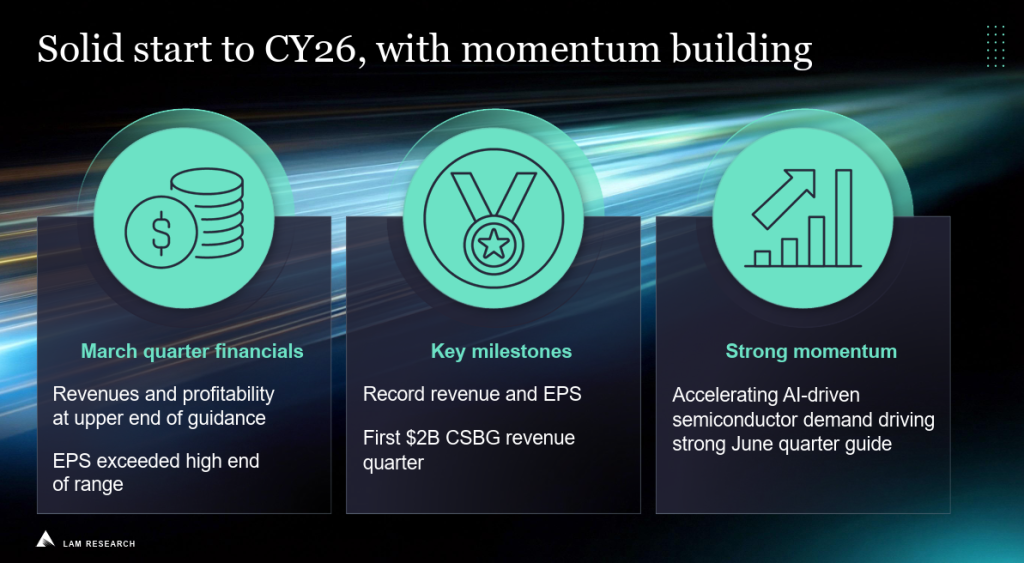
For Lam Research, the script was almost textbook. The $335 billion chip kit company delivered top-and-bottom-line beats, with revenue up sharply and guidance stepping ahead of expectations.
What mattered more than the numbers was the clarity of the story:
- AI-driven semiconductor demand is not theoretical—it’s already flowing through orders
- Customers (TSMC, Micron, etc) are actively expanding capacity
- Management signalled multi-year visibility, not just a cyclical bounce
Investors responded accordingly, pushing the stock higher in after-hours trading, albeit modestly, but bear in mind the stock’s 43%+ year-to-date rally.
A similar dynamic played out with Texas Instruments—though with a slightly different angle. Rather than leading-edge AI chips, TI is leveraged to analog and industrial demand feeding data centres.
- Revenue and EPS beat expectations
- Datacentre-related demand surged (c90% growth in that segment)
- Guidance came in decisively above consensus
The result: a sharp rally (+12%), signalling that investors are willing to reward ’second-derivative AI beneficiaries’—as long as the demand signal is strong and immediate.
Act II: Good numbers, bad reaction — the burden of proof in AI
Then comes IBM, the outlier that reveals the market’s deeper logic.
On paper, the quarter looked solid:
- Revenue and earnings beat expectations
- Growth across software, infrastructure, and consulting
- AI cited as a key driver of demand
And yet, the stock fell sharply after hours (-7%).
Why? Because the market wasn’t grading IBM on what it did—but on what it failed to prove:
- Software growth, while positive, didn’t exceed expectations meaningfully
- Consulting—central to IBM’s AI monetisation—remained muted
- Most critically, guidance didn’t move higher, leaving doubts about acceleration
In other words, IBM is talking AI, but investors are still waiting to see AI show up unmistakably in operating leverage and forward momentum.
Act III: The real divide — ‘AI proximity’ vs ‘AI monetisation’
What unfolded overnight wasn’t a contradiction—it was a sorting mechanism.
Winners (Lam Research, Texas Instruments):
- Directly tied to physical AI buildout (chips, fabs, equipment)
- Experiencing visible order growth now
- Offering strong forward guidance tied to AI demand
Lagging reaction (IBM):
- Positioned in AI services, software, and enterprise transformation
- Growth is real but less explosive and harder to attribute purely to AI
- Investors demand clearer proof of monetisation and acceleration
Final takeaway
The market is no longer rewarding ‘AI exposure’ as a blanket theme. It is pricing a hierarchy:
- Picks-and-shovels (equipment, semis): immediate, measurable demand → rewarded
- Enablers (analog, industrial chips): indirect but accelerating → rewarded
- Platform and services (enterprise AI): credible but slower → scrutinised
Overnight earnings didn’t just move stocks—they helped clarify the rules.
AI may be the rising tide, but for now, only the companies showing hard revenue tied directly to that tide are lifting cleanly with it.
You might also like:
