




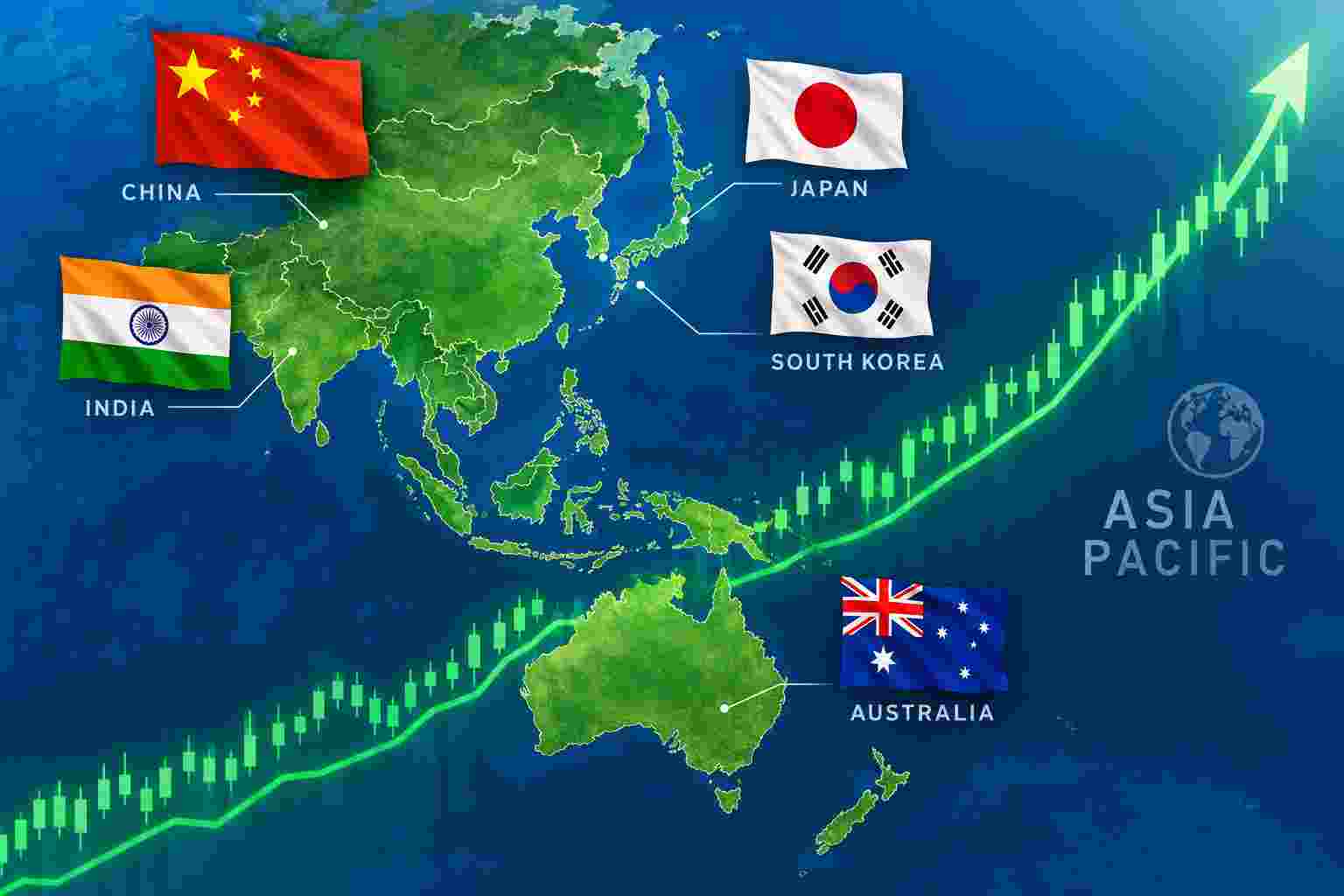
Growth-hungry investors cannot afford to ignore Asia Pacific, a region offering a diverse range of opportunities across major economies including China, India and Japan, as well as South Korea, Vietnam and Australia.
Asia leads the world by population and gross domestic product (GDP), yet UK investors allocate less than 10% of their portfolios to this dynamic and diverse region. This is a missed opportunity. Why? Well, powerful long-term trends are driving Asian growth and creating world-leading companies across Asia Pacific.
In this article, we explain why diversified portfolios should have an allocation to this vast and rapidly-growing region. And we highlight five funds focused on Asia Pacific that we think should appeal to patient portfolio builders.
Why invest in Asia Pacific?
Asia Pacific’s myriad attractions include its rapid economic growth, positive demographics and array of world-leading companies. The region encompasses Southeast and East Asia plus Oceania.
At the country level, it includes China, India, Japan, South Korea, Taiwan, Indonesia, Thailand, Singapore, Vietnam, Philippines, Malaysia, Hong Kong, New Zealand and Australia.
Investing in Asia offers portfolio builders the benefits of diversification, thanks to the heterogeneity across the region. Asia Pacific spans advanced economies such as Singapore and Australia, alongside high-growth emerging markets including Thailand, Indonesia and the Philippines.
Idiosyncratic growth drivers
As Kepler Trust Intelligence’s Jo Groves explains: ‘The region benefits from a range of idiosyncratic growth drivers, from export-oriented powerhouses such as Taiwan and South Korea to consumer-led economies in ASEAN countries.
‘Ongoing geopolitical tensions, including the “China +1” manufacturing strategy, have further benefitted countries such as India and Vietnam as an alternative to Chinese supply chains.’
Use funds for far-flung markets
In terms of size, the region is home to some heavyweight stock markets led by China, Japan and Hong Kong, followed by Korea, India and Taiwan. Smaller but still globally significant markets include Singapore, Thailand and Malaysia.
For private investors, investing directly in Asian equities can be tricky due to access limitations, higher costs and lower transparency. This why funds and investment trusts are the best way for UK-based investors to tap into Asia Pacific opportunities. They provide access to diversified portfolios of Asian equities, which reduces company-specific risk.
Funds have different mandates. Many exclude Japan entirely in the Asia Pacific ex-Japan sector, while others include non-Asian companies with significant revenues generated in the region. Investors can also purchase single-country funds focused on markets such as China, India and Japan.
Structural growth themes
When it comes to Asia, artificial intelligence (AI), semiconductors and the companies building the infrastructure behind them dominate the discussion. However, Asia Pacific is also the beneficiary of a number of long-term structural growth themes which receive far less attention than technology.
These range from rising consumer spending and increasing financial penetration, to the modernisation of retail, rising demand for travel, industrial innovation and investment in energy infrastructure.
China or India?
Robin Parbrook is co-manager of investment trust Schroder Asian Total Return (LON:ATR). ‘When it comes to investing in Asia, remember this: it’s about the companies, not the economy,’ he urges investors.
‘Stock markets here have never been well correlated to GDP growth, yet the great fallacy the industry sold investors for decades was that you could buy into the emerging middle classes, ride the growth story, and the stock market would follow.’
Parbrook continues: ‘China, for example, has lagged as a market since I first started investing in Asia in 1990, despite the economy going from bicycles to bullet trains over the course of one generation. Macro is a poor guide to where the bottom up opportunities are.’
Selective opportunities
Rob Secker, an emerging markets expert at T. Rowe Price, is currently seeing ‘selective opportunities’ in Chinese internet platforms.
Within this space, he says valuations have become ‘genuinely cheap, and a handful of names are showing early signs of benefiting from AI. For example, we recently initiated a position in Tencent (HKG:0700) for the first time – not because the macro is turning, but because the risk-reward at current levels has shifted.’
Secker also points out that China has a lot of companies benefitting from the Middle Kingdom’s rise in AI. However, ‘China’s AI stocks are very small components of the benchmark, so it is not capturing Western investors’ attention in the way Korea and Taiwan are.’
Finding forgotten stocks
The T. Rowe Price investment sage is watching India closely. ‘The dislocation has created the conditions for repositioning into higher quality domestic franchises, and we have been selectively adding to names where the long-term compounding thesis remains intact.
‘We are contrarian investors. We look for pockets that are being overlooked and hunt for stocks within them where we can identify prospects for fundamental improvements. That is how we find forgotten stocks. We are finding more ideas in China than India.’
Parbrook observes that China and India are the mirror image of each other. ‘China’s economic backdrop remains sluggish, still reeling from a property bust, which has suppressed consumption because most Chinese wealth is tied up in property rather than income-generating assets.
‘However, at a stock market level there is a corporate governance story, similar to what has emerged in Japan and South Korea yet has received far less coverage.’
Five key picks for your portfolio
Jupiter Asian Income Fund (BJJQ465)
Price: 387.3p
A compelling option for investors seeking exposure to Asia Pacific’s growth and income opportunities is Jupiter Asian Income (BJJQ465). The £3 billion fund is managed by the experienced Jason Pidcock alongside Sam Konrad. They invest in companies with strong management teams and a sustainable advantage enabling them to generate cash over a long period to fund dividends.
The fund aims to outperform the FTSE All World Asia Pacific ex Japan Index and is ranked first quartile in the IA Asia Pacific Excluding Japan sector. Pidcock and Konrad focus on generating long-term both income and capital growth. And the portfolio has generated an impressive 10-year annualised return of 12.7%, according to Morningstar.
| Asset allocation | As at 31 August 2026 |
| Australia | 29.6% |
| Taiwan (Republic of China) | 27% |
| South Korea | 17.5% |
| Singapore | 16.5% |
| India | 9.3% |
Source: Jupiter Asset Management
Jupiter Asian Income invests in five countries across developed Asia, culminating in a high concentration 25-stock portfolio. The fund targets a yield at least 20% more than its benchmark index and currently holds two of Asia Pacific’s big artificial intelligence (AI) plays, namely Taiwanese chipmaker TSMC (NYSE:TSM) and Korea’s Samsung Electronics (LON:SMSN).
Other top 10 positions include SK Hynix (NASDAQ:SKHY), Australia-listed mining giant BHP Group (ASX:BHP) and Melbourne-based banking group ANZ (ASX:ANZ).
Pacific Horizon Investment Trust (LON:PHI)
Share price: £14.46
Investors seeking a trust with a high-conviction growth approach should buy Pacific Horizon (LON:PHI), which invests in the Asia Pacific region excluding Japan, as well as the Indian sub-continent.
Pacific Horizon is the AIC Asia Pacific sector’s best one and 10-year share price total return performer. Managed by Baillie Gifford, the trust has the lowest ongoing charges in the sector at 0.75% and its shares offer value on a near-11% discount to NAV.
Steered by Roderick Snell and Ben Durrant, the fund generated a NAV total return of 65.1% for FY26 against 35.8% for the MSCI Asia ex-Japan index. A substantial amount of the excess return came from the managers’ bets on AI-related stocks and sectors.
| AIC Asia Pacific Sector | Discount/Premium (%) | 10-yr share price total return |
| Pacific Horizon | -10.7 | 445.6% |
| Schroder Asian Total Return | -6.1 | 249.4% |
| Schroder AsiaPacific Fund | -10.9 | 197.8% |
Source: The AIC/Morningstar
On an absolute basis, Pacific Horizon’s strong performance reflected big returns from two of its biggest tech holdings, Samsung Electronics and TSMC. But the portfolio’s largest individual contributor was SK Square (KRX:402340) with a 551% rise in the share price. The company provides economic exposure to SK Hynix and benefited from the exceptional improvement in memory pricing and earnings.
Pacific Horizon’s largest country allocations are to China, Korea and Taiwan and the managers remain positive on the outlook for Asia and Asian stocks. ‘Strong earnings growth across AI infrastructure, rising investment in energy security and electrification, and attractive valuations continue to provide a broad opportunity set,’ they insist.
Aberdeen Asia Focus (LON:AAS)
Price: 464p
Sharesify is a big fan of Aberdeen Asia Focus (LON:AAS), the standout performer in the AIC Asia Pacific Smaller Companies sector over one, five and 10 years. Managers Gabriel Sacks and Xin-Yao Ng pursue a bottom-up, stock selection driven approach to identifying the best quality smaller companies from across Asia.
And they are aided by Aberdeen’s sizeable on-the-ground presence, which helps them identify under-researched and attractively-priced opportunities.
Kepler Trust Intelligence argues Aberdeen Asia Focus makes a ‘very convincing case as a holding within a wider portfolio’. The asset class itself has outperformed its larger-cap equivalent over the long term, ‘whilst providing considerable diversification due to the large number of opportunities within the index, as well as historically having lower volatility’.
Furthermore, Kepler notes that the managers have ‘an impressive track record of producing alpha through stock selection across multiple time periods’.
| AIC Asia Pacific Smaller Cos | Discount/Premium (%) | 10-yr share price total return |
| Aberdeen Asia Focus | -9.8 | 205.3% |
| Fidelity Asian Values | -4.9 | 144.2% |
| Scottish Oriental Smaller Cos | -10 | 72.8% |
Source: The AIC/Morningstar
Top 10 holdings at last count included China-based Precision Tsugami (HKG:1651), India-listed Aegis Logistics (NSE:AEGISLOG) and MP Evans (LON:MPE), the sustainable Indonesian palm oil producer.
Aberdeen Asia Focus has a five-star rating from Morningstar and is also an ‘ISA millionaire’ investment trust. This means the company would have returned more than £1 million for ISA savers who invested their entire allowance every year from 1999 to 2025.
Invesco Asia Dragon Trust (LON:IAD)
Price: 509p
An 8% discount to NAV at Invesco Asia Dragon (LON:IAD) offers a compelling point of entry into the AIC Asia Pacific Equity Income sector’s second-best 10-year performer. The trust’s strong long-term performance has been driven by a winning contrarian approach. Furthermore, this trust carries the lowest charges in the sector at just 0.59% following a combination with Asia Dragon which bumped total assets up to more than £1 billion.
An enhanced dividend policy only adds to Invesco Asia Dragon’s appeal. The trust pays four equal quarterly dividends that total 4% of the previous financial year’s closing NAV. As such, Invesco Asia Dragon offers both income and capital potential, aiming to generate double-digit total returns per annum over a market cycle.
| AIC Asia Pacific Equity Income | Discount/Premium | 10-yr share price total return |
| JPMorgan Asia Growth & Income | -1.3% | 241.6% |
| Invesco Asia Dragon | -8% | 209% |
| Schroder Oriental Income | -5.4% | 205.9% |
| Aberdeen Asian Income Fund | -7.8% | 178.5% |
| Henderson Far East Income | +3% | 79.3% |
Source: The AIC/Morningstar
Over the past year, tech stocks have been the main driver of performance, but the managers have begun to take profits and recycle proceeds into more contrarian ideas. For instance, they have found opportunities in perceived AI losers where they believe the market reaction is overdone, such as NetEase (NASDAQ:NTES) and Tencent. And the fund also offers exposure to the likes of TSMC and life insurance giant AIA (HKG:1299).
Kepler analyst Ryan Lightfoot-Aminoff argues: ‘Whilst the trust is far from alone in offering an enhanced dividend, this combined with the contrarian approach continues to help the trust stand out in our view. In addition, the highly competitive fee structure, which has passed on the economies of scale as they have been achieved also appeals, even versus passive exposure.’
Vanguard FTSE Developed Asia Pacific ex-Japan ETF (LON:VDPG)
Price: 44.4p
Alternatively, investors might consider a low-cost, passive exchange-traded fund for their regional exposure. One solid option is Vanguard FTSE Developed Asia Pacific ex-Japan (LON:VDPG), which tracks the FTSE Developed Asia Pacific ex Japan Index.
In our view, this fund offers a cheap and highly-efficient way to gain exposure to the performance of Asia Pacific’s large and mid cap corporations. Prospective investors should note this is an accumulating ETF, which means that all dividends are reinvested.
Ongoing charges are low at just 0.15%, and the ETF uses full, physical replication to replicate the performance of the benchmark. This means it buys and holds all of the underlying names in the benchmark, which range from Samsung and SK Hynix to BHP and WestPac Banking (ASX:WBC).