




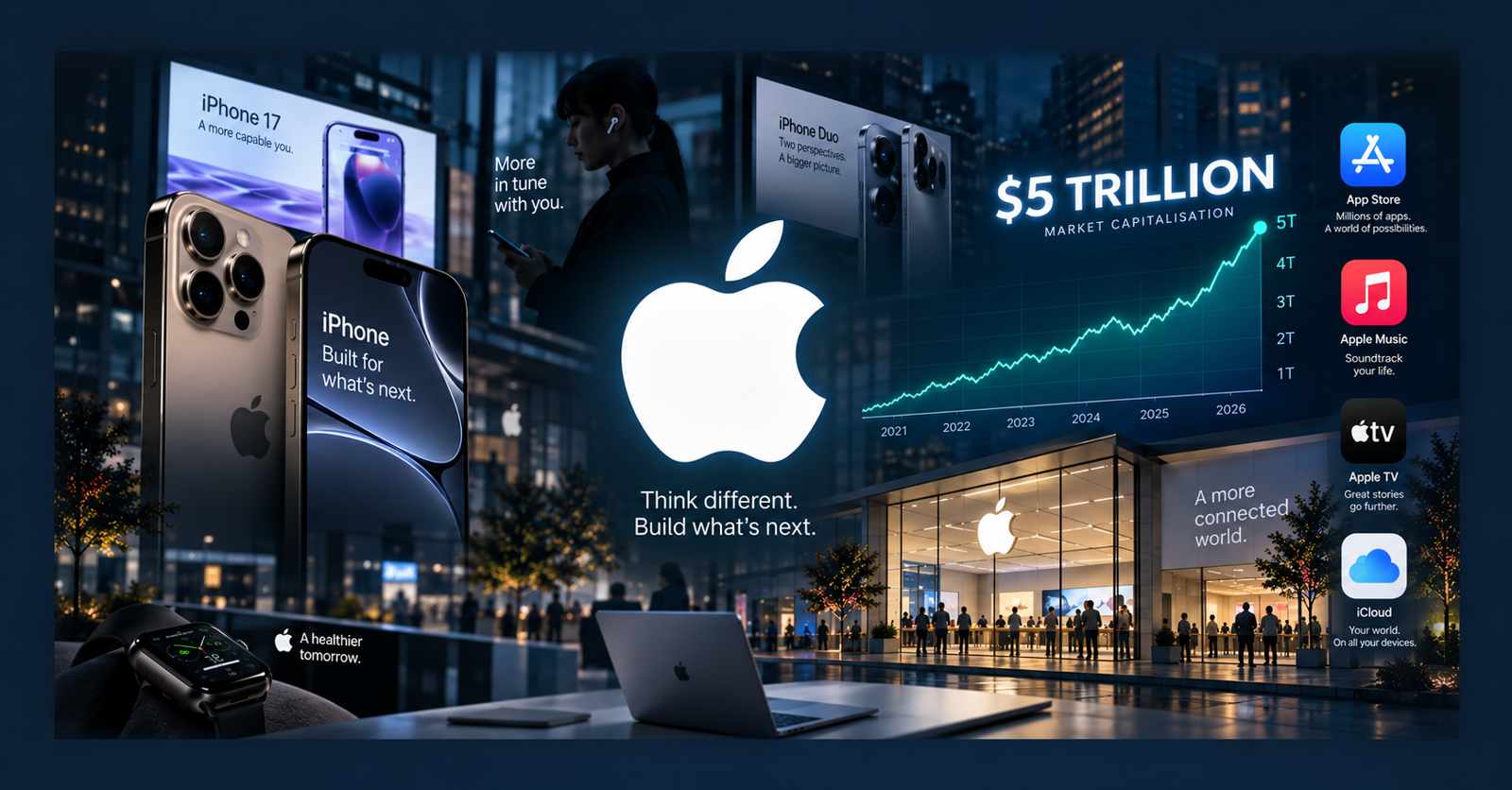
Apple (NASDAQ:AAPL) has joined an extraordinarily exclusive club: companies valued at $5 trillion or more. Or has it? There seems to be some confusion.
Having closed overnight at $337.75, Google Finance puts the market cap at £4.96tn, approximately 0.8% below the $5tn hurdle, although intra-day trading on Tuesday 22 September 2026 suggests that the market value did push beyond at one point.
Market capitalisation is calculated by multiplying a company’s share price by its outstanding shares. Apple’s enormous valuation does not automatically mean the business is overvalued—but it does mean relatively modest changes in investor expectations can translate into hundreds of billions of dollars in market value.
| Apple (NASDAQ:AAPL) | Price: $3339.75 (~+25% YTD) | Market cap: ~$4.96tn |
It first traded at $5tn intra-day in July, so we’re still waiting for the stocks first close above $5tn.
Regardless, it’s close enough to the milestone to raise the fundamental question for UK retail investors: can Apple continue creating shareholder value at a valuation that already reflects enormous future expectations, or has the market priced in too much success?
The answer depends on whether tech giant Apple can translate its vast installed customer base, premium brand and artificial intelligence opportunity into sustained earnings and cash-flow growth.
Apple’s $5tn market cap milestones
| $1tn | August 2018 |
| $2tn | August 2020 |
| $3tn | January 2022 intraday |
| $4tn | October 2025 |
| $5tn | First breached intraday July 2026 |
What’s driving Apple’s share price strength in 2026?
Apple’s gains have been supported by several factors rather than one single catalyst.
1. Foldable iPhone creates a new upgrade opportunity
The introduction of the foldable iPhone Duo, priced from approximately $1,999 and scheduled for launch on 23 October, has given investors a fresh product catalyst.
A successful premium device could increase Apple’s average selling price, encourage existing customers to upgrade and reinforce the company’s premium positioning.
The opportunity is significant because Apple does not necessarily need to sell foldable phones at mass-market volumes for the product to contribute meaningfully to revenue and margins.
However, the premium price also creates risk. Consumers may delay purchases or opt for cheaper alternatives if the perceived benefits do not justify the additional cost.
2. Artificial intelligence could support hardware upgrades
Apple’s AI strategy differs from companies attempting to dominate every layer of computing infrastructure.
The company is focused primarily on integrating AI into its devices and services, while using external technology partnerships where appropriate.
Improved Siri functionality and Apple Intelligence could encourage customers with older devices to upgrade, particularly where newer AI capabilities require more advanced hardware.
This creates a potentially attractive commercial model: Apple may monetise AI through higher hardware sales, stronger customer retention and increased services engagement rather than relying exclusively on selling AI software.
The challenge is demonstrating that AI features generate incremental revenue rather than simply improving the user experience.
3. Strong underlying business momentum
Apple’s recent financial performance has provided fundamental support for its valuation.
| Metric | Fiscal Q3 2026 |
| Revenue growth | 16% |
| iPhone revenue growth | 22% |
| Mac revenue growth | 29% |
| EPS | $2.02 |
| EPS growth | 29% |
These figures demonstrate that Apple continues to generate substantial growth despite its enormous scale.
Investors should nevertheless distinguish recurring performance from one-off benefits, including a reported tariff reimbursement that contributed approximately $0.11 to quarterly earnings per share.
Can Apple sustain a $5tn valuation?
The bull case rests on Apple’s ability to combine several growth drivers.
A successful foldable iPhone launch could support higher average selling prices, while AI-enabled upgrades could stimulate replacement demand. Services revenue provides recurring income, and continued share buybacks can support earnings per share growth by reducing the number of shares outstanding.
If Apple delivers sustained double-digit earnings growth, today’s valuation could become more reasonable over time.
However, the bear case deserves equal attention.
Apple’s valuation leaves limited room for disappointing execution. Foldable iPhone demand could fall short of expectations, AI monetisation may prove slower than anticipated, and competition in China could weigh on sales.
There is also the risk of valuation compression. Even if Apple remains highly profitable, investors may accept a lower price-to-earnings multiple if earnings growth slows.
What are investors paying at $5tn?
| Valuation metric | Estimate |
| 2027 forward PE | ~35.4x |
| 2028 forward PE | ~31.5x |
| 2027 sales growth | ~10.5% |
| 2028 sales growth | ~8% |
| 2027 EPS growth | ~9% |
| 2028 EPS growth | ~13% |
Source: Koyfin
A forward PE of 35.4x means investors are paying approximately $35.40 for every $1 of forecast annual earnings.
That valuation can be justified if Apple delivers strong, durable growth. But if earnings stagnate, investors could experience disappointing returns even if the underlying business remains exceptional.
To reach a $6tn valuation from $5tn, Apple would need to increase its market capitalisation by another 20%, assuming the share count remains broadly unchanged.
That could happen through earnings growth, a higher valuation multiple or a combination of both.
Implications for UK retail investors
Apple remains a major holding in global equity funds, S&P 500 trackers, Nasdaq-100 ETFs and technology-focused investment trusts and funds.
Many UK investors therefore already have exposure without owning the shares directly.
For those considering Apple through a Stocks and Shares ISA or SIPP, several factors matter:
- Currency risk: A gain in US dollars may translate into a smaller sterling return if the dollar weakens against the pound.
- Portfolio concentration: Investors should assess how much Apple exposure they already hold indirectly through funds.
- Income expectations: Apple’s low dividend yield means it is primarily a capital-growth investment rather than an income-generating holding.
- Valuation: Future returns will depend on earnings growth relative to the price paid today.
Sharesify investor verdict
Apple’s $5 trillion milestone reflects strong financial performance, optimism around its next iPhone cycle and confidence in its ability to monetise AI through its ecosystem.
The opportunity remains substantial. But at this valuation, investors must focus on earnings growth rather than headlines.
The key question is not simply whether Apple can become a $6tn company. It is whether future earnings and cash-flow growth justify the price being paid today—and how much Apple exposure belongs in a diversified UK investor’s ISA or SIPP.
You might also like: