


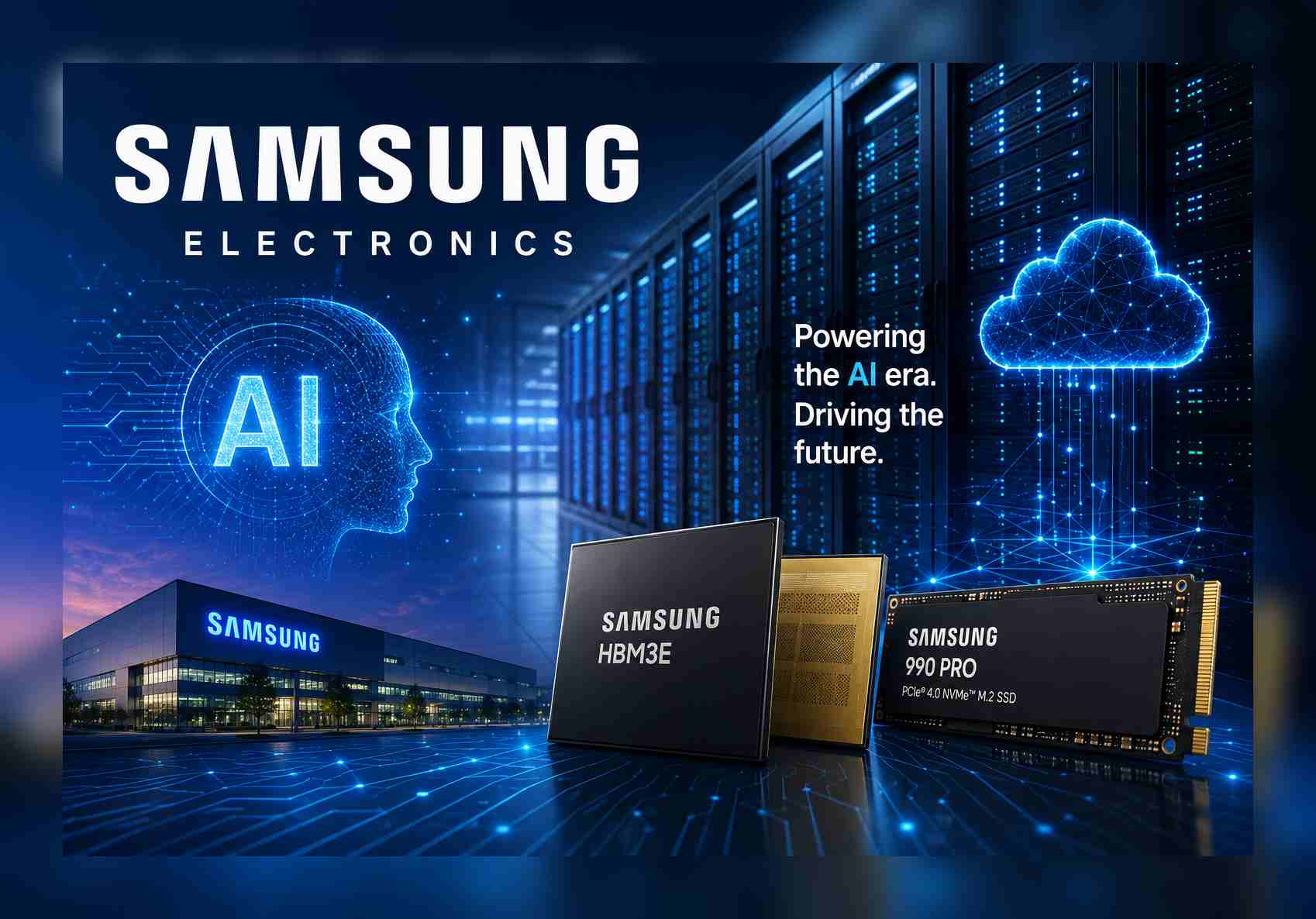
Samsung Electronics (KRX:005930) delivered another exceptional quarter as the AI infrastructure boom continued to drive demand for memory chips. However, despite record profitability, the shares fell sharply as investors questioned whether earnings have peaked and whether today’s AI spending can be sustained.
For UK retail investors, the results highlight an increasingly familiar theme in semiconductor investing: outstanding fundamentals do not always translate into a higher share price when expectations have become extremely ambitious.
| Samsung Electronics (KRX:005930) | Price: ₩287,000 (-10%) | Market cap: ₩1,832.64tn (~$1.2tn) |
Q2 2026: Reported vs expectations
| Metric | Reported | Consensus | Result |
| Revenue | ₩171.0tn | ₩171.4tn | Slight miss |
| Operating profit | ₩89.4tn | ₩85.1-86.0tn | Beat |
| Operating profit YoY | +1,800%+ (around 19x) | Strong growth expected | Ahead |
| Share price reaction | -10% | — | Negative |
Why the market reacted negatively
Normally, record profits would push a stock higher. Instead, Samsung lost almost 10% because investors were already pricing in near-perfect execution.
Key concerns included:
- revenue came in fractionally below expectations
- investors questioned whether hyperscale AI investment is approaching peak levels
- concerns are growing that Big Tech could slow AI infrastructure spending after an extraordinary investment cycle
- Samsung continues to spend heavily expanding manufacturing capacity, raising fears of future oversupply.
The reaction demonstrates how semiconductor stocks have become increasingly sensitive to expectations rather than simply reported earnings.
What management highlighted
Although Samsung only released preliminary earnings, management pointed to several themes:
- exceptionally strong demand for AI memory chips
- continued pricing strength across DRAM and NAND
- ongoing investment in advanced semiconductor manufacturing
- detailed divisional results will be released later this month.
Management also reiterated long-term investment plans into Korean semiconductor manufacturing, signalling confidence that AI demand remains a multi-year opportunity rather than a short-lived cycle.
How crazy could the memory chip shortage become – and what does it mean for UK investors?
Analyst commentary
Most analysts remain constructive despite the sell-off.
Positive points include:
- AI server demand remains extremely strong.
- High-bandwidth memory (HBM) continues to command premium pricing.
- Memory supply remains relatively constrained, supporting margins.
- Several analysts increased full-year operating profit forecasts following the results.
However, analysts also identified several risks:
- Samsung’s foundry business continues to lag market leader Taiwan Semiconductor Manufacturing Company.
- Logic chip operations remain loss-making.
- Employee bonus provisions reduced reported profits.
- Any slowdown in AI capital expenditure by major cloud providers could quickly weaken memory pricing.
Opportunities
For long-term investors, Samsung still offers several attractive investment themes.
AI memory leadership
Samsung remains one of the world’s largest producers of DRAM, NAND and HBM memory. These products sit at the heart of AI servers powering large language models.
Memory pricing cycle
Unlike previous downturns, memory supply remains relatively disciplined while AI demand continues to absorb production capacity.
Diversification
Unlike many semiconductor peers, Samsung combines semiconductors with smartphones, consumer electronics, displays and appliances, giving investors exposure across several technology markets.
Capital returns
Samsung continues to generate enormous free cash flow, supporting dividends and potential shareholder returns.
Risks
Investors should also recognise several important risks.
- AI infrastructure spending could normalise after two years of extraordinary investment.
- Memory remains one of technology’s most cyclical industries.
- Samsung still trails TSMC in leading-edge foundry manufacturing.
- Geopolitical tensions involving China, Taiwan and US export controls remain significant uncertainties.
- Massive capital expenditure could eventually create industry oversupply if demand slows.
Valuation
Even after its remarkable rally over the past year, Samsung’s valuation still appears reasonable relative to many AI beneficiaries.
| Metric | Assessment |
| Earnings outlook | Strongly positive |
| AI exposure | Very high |
| Balance sheet | Exceptionally strong |
| Dividend | Attractive by semiconductor standards |
| Valuation | Less demanding than many US AI stocks |
Unlike many US AI names trading at elevated earnings multiples, Samsung still offers investors exposure to the AI build-out at a comparatively modest valuation, reflecting both its cyclical memory business and weaker foundry position.
Despite massive stock appreciation across the memory sector, forward multiples remain low industry-wide because AI-driven memory demand has simultaneously boosted forecast earnings to record highs.
Peer valuation comparison
The global HBM and DRAM market is dominated by a three-company oligopoly. Here is how their forward PE valuations and overall standings compare:
- Samsung Electronics (Forward PE: 6.4x – 7.2x): Samsung trades at the lowest multiple of the three. This discount generally reflects its broader exposure to consumer electronics and mobile devices, which carry lower margins than pure-play memory and can drag down consolidated multiples.
- SK Hynix (Forward PE: 6.2x – 7.5x): As the global leader in HBM market share (holding roughly 58% of the market), SK Hynix trades at a comparable to slightly higher multiple than Samsung. Investors have priced SK Hynix at a premium due to its pure-play memory focus and direct alignment with the AI chip supercycle.
- Micron Technology (Forward PE: 7.6x – 13.3x): Micron generally trades at the highest forward multiple of the three. The higher premium reflects its US-based advantages, deep supply agreements with major datacentre players, and strong structural profitability during the memory upswing.
What UK investors should watch next
The detailed earnings release later this month will be more important than the preliminary headline numbers. Investors should focus on:
- HBM revenue growth
- Semiconductor operating margins
- Foundry profitability
- Capital expenditure guidance
- Management’s outlook for AI memory demand during the second half of 2026
Investor verdict
Samsung’s latest results underline just how powerful the AI infrastructure cycle has become. Operating profit comfortably exceeded expectations and reached another record, driven by booming demand for memory chips. Yet the negative share price reaction shows that investors are increasingly concerned about how long this exceptional earnings cycle can last.
The shares fell sharply as investors questioned whether earnings have peaked and whether today’s AI spending can be sustained but for long-term UK retail investors seeking exposure to artificial intelligence beyond the dominant US technology names, Samsung remains one of the world’s highest-quality semiconductor businesses. However, after such a dramatic run in AI-related earnings, future share price gains are likely to depend less on beating quarterly forecasts and more on convincing investors that today’s AI spending boom can be sustained for many years.
You might also like: