




Chip tech kit supplier Applied Materials (NASDAQ:AMAT) delivered a very strong fiscal Q3, with record revenue, margins and earnings. Yet the shares fell sharply after hours on 13 August. The message for investors is clear: the semiconductor-equipment business is performing extremely well, but expectations and valuation are now demanding.
The crucial question remains: Can it convert surging AI demand into high-margin earnings?
Applied Materials investor relations
| Applied Materials (NASDAQ:AMAT) | Price: ~$505 (~-5% after-hours) | Market cap: ~$403.2bn |
Q3: another record quarter
Applied Materials reported $9.12bn of revenue, up 25% year on year and ahead of consensus of about $8.99bn. Non-GAAP EPS was $3.50, up 41%, versus expectations of roughly $3.40.
| Q3 FY26 | Actual | Consensus |
| Revenue | $9.12bn | $8.99bn |
| Non-GAAP EPS | $3.50 | $3.40 |
| Non-GAAP gross margin | 50.4% | ~50.2% |
| Operating margin | 34.0% | — |
Semiconductor Systems revenue increased 27% to $7.04bn, while Applied Global Services rose 22% to $1.78bn. Gross margin reached 50.4%, extending AMAT’s run of year-on-year margin expansion.
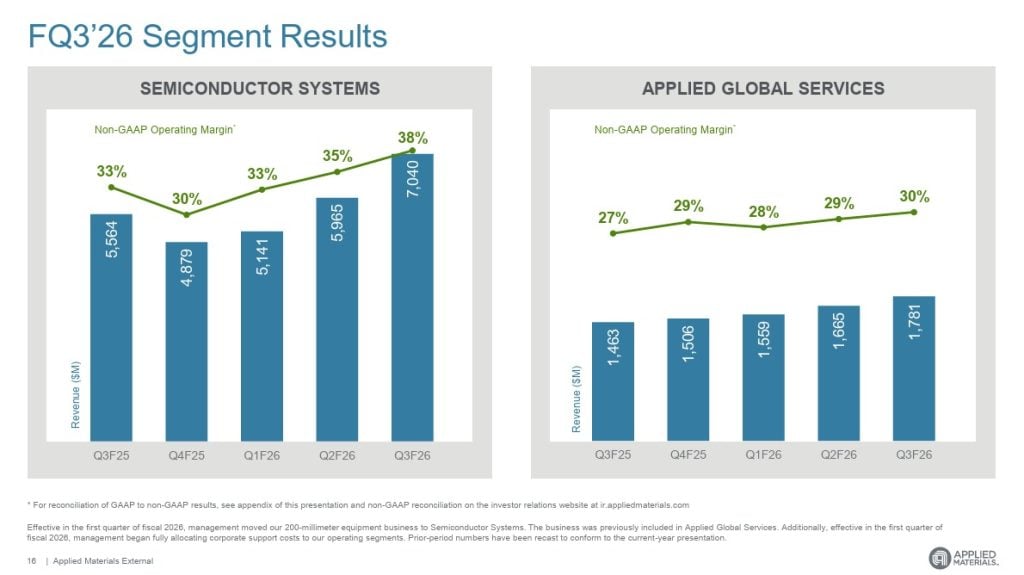
Memory is becoming increasingly important. DRAM represented 26% of Semiconductor Systems revenue, up from 22% a year earlier, reflecting spending on AI-related high-bandwidth memory (HBM) and advanced memory technologies.
Why did the shares fall?
AMAT closed 13 August at $534.54, down 2.5% in regular trading. The initial after-hours reaction took the shares to roughly $505, a fall of about 5%.
US after-hours and pre-market trading explained for UK investors
That looks surprising given the results. But the market appears to have been demanding an even bigger beat.
AMAT’s shares had already more than doubled during 2026, while rival semiconductor-equipment companies had also reported strong results.
CFRA analyst Brooks Idlet said the results were ‘not enough to impress the Street’, although he described the quarter as solid. He also said: ‘We think calendar year 2027 consensus estimates leave room for upside if recent strength continues.’
In other words, this looks more like an expectations problem than an operational problem.
Guidance was exceptionally strong
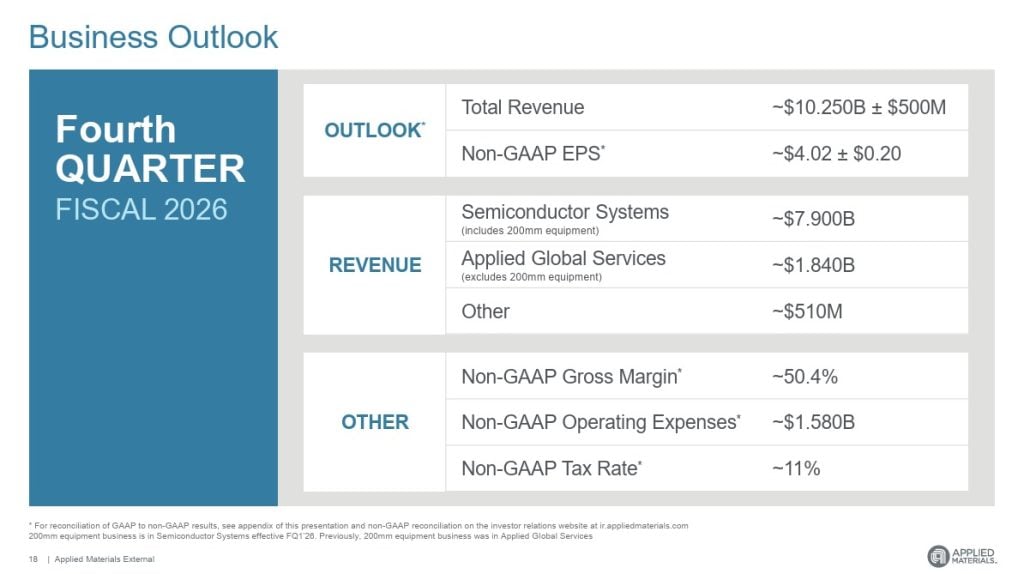
AMAT guided fiscal Q4 revenue to approximately $10.25bn ± $500m, with non-GAAP EPS of $4.02 ± $0.20.
That compares with consensus estimates of about $9.54bn and $3.69 respectively.
| Fiscal Q4 outlook | AMAT midpoint | Consensus | Implied beat |
| Revenue | $10.25bn | $9.54bn | +7.4% |
| Non-GAAP EPS | $4.02 | $3.69 | +8.9% |
AMAT also raised its 2026 Semiconductor Systems growth expectation from more than 20% to more than 30%. Advanced packaging revenue is now expected to grow more than 70%, versus a previous forecast of more than 50%. Process Diagnostics and Control is expected to grow more than 50%, while AMAT Global Services should grow more than 20%.
That is a remarkably bullish outlook.
Management sees a multi-year AI cycle
The investment case is increasingly about the duration of AI-related semiconductor spending.
CEO Gary Dickerson said the global build-out of AI infrastructure provides AMAT with an ‘exceptionally strong foundation for multi-year revenue and profit growth.’
CFO Brice Hill added: ‘Customers continue to give us longer visibility than we have ever had’, with some discussions extending to 2030.
AMAT is responding by expanding manufacturing capacity, with plans to approximately double quarterly semiconductor-systems output by 2028.
This is important because AMAT is not simply an indirect Nvidia (NASDAQ:NVDA) play. Its equipment is used across deposition, etch, CMP, materials engineering, metrology and inspection, supporting leading-edge logic, DRAM, HBM and advanced packaging.
AI therefore drives demand through several channels: more processors, greater manufacturing complexity, more HBM and increasingly sophisticated packaging.
Cash flow is a major strength
AMAT’s cash generation is another attraction.
It generated a record $3.04bn of operating cash flow in Q3 and approximately $2.33bn of free cash flow, after $707m of capital expenditure.
| Q3 FY26 cash flow | $bn |
| Operating cash flow | 3.04 |
| Capital expenditure | 0.71 |
| Free cash flow | 2.33 |
| Dividends | 0.42 |
| Share buybacks | 0.44 |
Capex absorbed only about 23% of operating cash flow. For the first nine months, operating cash flow was $5.57bn against $1.99bn of capex.
That makes AMAT particularly attractive compared with some AI infrastructure beneficiaries that require substantial capital investment before generating cash.
Valuation: quality, but not cheap
The biggest concern is valuation.
At around $535 before the results, AMAT was trading at roughly 50x trailing earnings. Forward multiples are more reasonable because earnings are rising rapidly.
| Company | CY26 PE* | CY27 PE* |
| Applied Materials | 43.4x | 31.3x |
| ASML | 41.9x | 30.5x |
| KLA | 38.1x | 31.5x |
| Lam Research | 35.8x | 29.5x |
*PE multiples based on $381.17 closing price, 13 August. Based on Stockopedia consensus data.
AMAT therefore does not look obviously expensive versus major global peers on forward earnings. But neither is it a bargain. The valuation increasingly depends on earnings estimates continuing to rise.
Opportunities
AI infrastructure: Continued spending by hyperscalers and chipmakers could sustain semiconductor-equipment demand for years.
HBM and memory: Growing AI accelerator requirements are driving greater DRAM and HBM investment.
Advanced packaging: Management’s upgraded >70% growth forecast highlights a rapidly expanding opportunity.
Pricing power: Gross margins above 50% suggest AMAT is capturing some of the value created by increasingly complex chip manufacturing.
Services: AMAT Global Services provides recurring revenue and benefits from the expanding installed equipment base.
Risks
Valuation: The biggest near-term risk is that earnings grow strongly but not fast enough to justify the share price.
AI capex: A slowdown in AI infrastructure spending would hit demand across the semiconductor-equipment industry.
Cyclicality: Semiconductor equipment remains cyclical despite the structural AI opportunity.
China: China represented 26% of Semiconductor Systems and AGS revenue in Q3, leaving AMAT exposed to export controls and geopolitical tensions.
Capacity execution: Doubling production by 2028 creates execution risk and could result in excess capacity if demand weakens.
Bull vs bear case
| 🐂 Bull case | 🐻 Bear case |
| AI capex remains elevated through 2030 | AI spending peaks sooner than expected |
| HBM/DRAM investment accelerates | Memory overcapacity develops |
| Advanced packaging grows rapidly | Packaging growth normalises |
| Margins remain above 50% | Capacity investment pressures margins |
| Customer visibility supports 2027-30 growth | Orders are delayed or cancelled |
| Earnings estimates continue rising | Valuation multiple contracts |
Investor verdict
Applied Materials delivered a very strong quarter; the shares simply demanded something extraordinary.
For long-term UK retail investors seeking exposure to the semiconductor-equipment side of the AI boom, the fundamentals remain compelling: record revenue, 50%-plus gross margins, powerful free cash flow, increasing memory exposure and unusually long customer visibility.
But the after-hours sell-off is a warning. With the shares already reflecting substantial AI-driven growth, ‘good’ may no longer be good enough.
Is Applied Materials really the best AI stock ahead of Q3 earnings?
The key question for the next 12–24 months is not whether AI demand is real. It is can it convert surging AI demand into high-margin earnings quickly enough to support its valuation.
For investors using a Stocks & Shares ISA or SIPP, AMAT offers high-quality AI exposure, but it should be treated as a growth stock with meaningful valuation and cyclical risk, rather than a defensive technology holding.
You might also like: