



🟢 Key Points
- SpaceX has officially filed for a US stock market listing under the ticker SPCX
- The company reported $18.67 billion (£13.9bn) in annual revenue
- First-quarter operating losses came in at $1.94 billion
- Founder Elon Musk will retain overwhelming voting control after the IPO
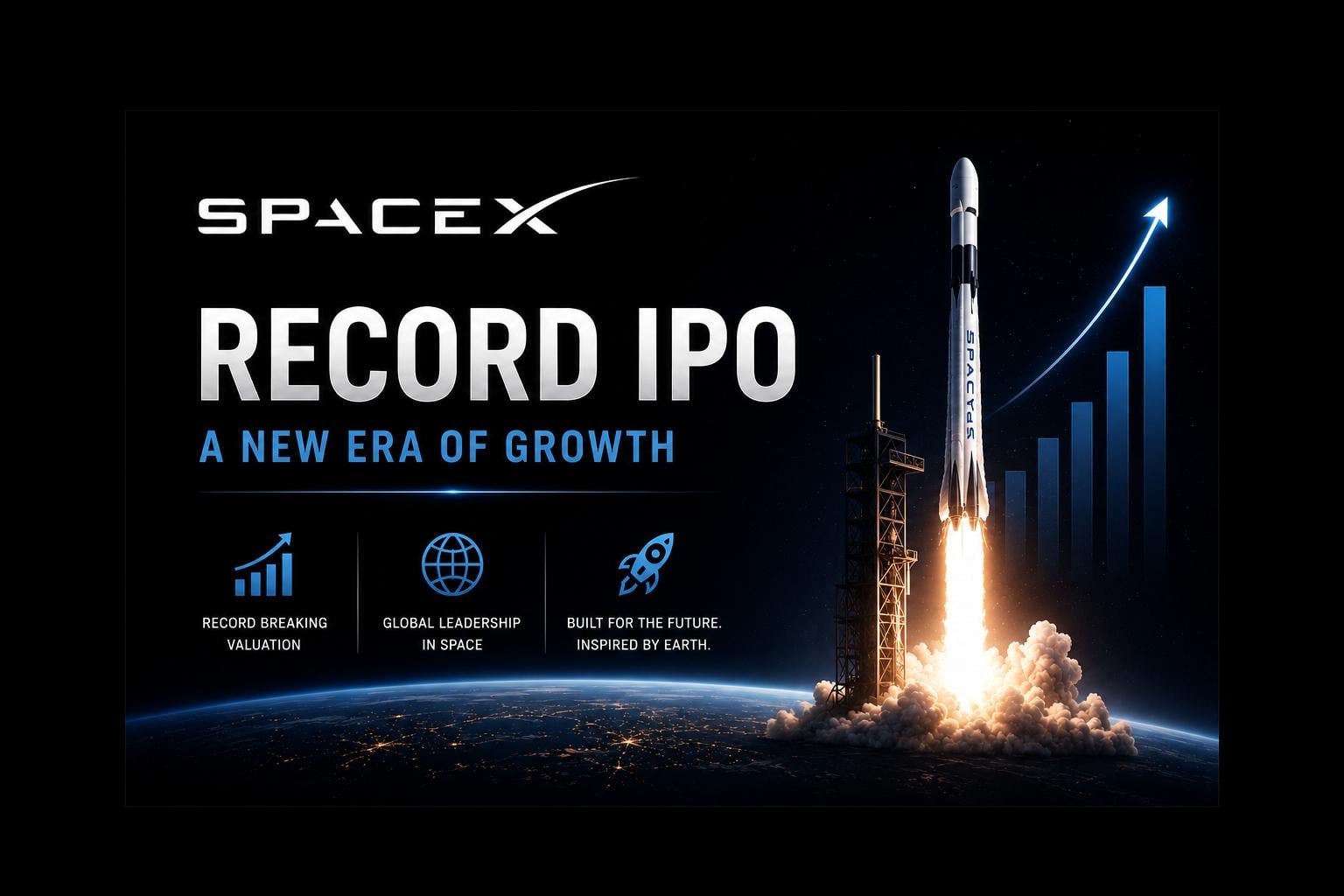
- The flotation could value SpaceX at up to $1.75 trillion (£1.3tn), potentially making it the largest IPO in history
- Retail investors are expected to receive a meaningful allocation of shares
- The business is expanding beyond rockets into AI, finance and satellite internet
🚀 What Is SpaceX?
Founded in 2002, SpaceX has become the dominant private space company globally, largely through:
- Reusable rockets
- Government launch contracts
- Its Starlink satellite internet network
- Long-term ambitions around lunar and Mars missions
The company has transformed launch economics by repeatedly landing and reusing rockets, dramatically reducing costs compared with traditional aerospace operators.
📊 Financial Snapshot
SpaceX Reported Revenue
| Segment | Q1 Revenue | Share of Revenue |
| Starlink & Connectivity | $3.26bn | 69.5% |
| Space Operations | $619m | 13.2% |
| AI Division | $818m | 17.4% |
| Total Q1 Revenue | $4.69bn | 100% |
Annual Revenue
| Metric | Amount |
| Full-Year Revenue | $18.67bn |
| Q1 Operating Loss | ($1.94bn) |
👉 What This Means for Investors
Although SpaceX is generating enormous revenue, the business is still heavily loss-making at the operating level. That is common among high-growth technology and infrastructure firms, especially those investing aggressively in expansion.
The biggest revenue driver is now Starlink rather than rocket launches.
🔗 Why Starlink Matters More Than Rockets
Estimated Business Mix
| Business Area | Importance to Valuation |
| Starlink Internet | Very High |
| Rocket Launches | High |
| Defence & Government Contracts | High |
| AI & Compute Services | Emerging |
| Financial Services | Speculative |
| Asteroid Mining | Extremely Speculative |
Many analysts are likely to view SpaceX less as a traditional aerospace business and more as a hybrid of:
- Telecoms
- AI infrastructure
- Defence technology
- Space logistics
That broader positioning helps explain the enormous valuation expectations.
💰 IPO Could Break Global Records
Largest IPO Comparisons
| Company | IPO Valuation |
| Saudi Aramco (2019) | ~$1.7tn |
| Ali Baba (2014) | ~$140bn |
| Agricultural Bank of China (2010) | ~$130bn |
| NTT Mobile (1998) | ~76bn |
| SoftBank (2018) | ~$64bn |
| SpaceX (2026 expected) | Up to ~$1.75tn |
SpaceX is about to rip up IPO playbook and investors can’t get enough, here’s why
If SpaceX achieves the upper end of expectations, it would become:
- The biggest US IPO ever
- Potentially the largest market debut globally
🧭 Elon Musk Will Keep Tight Control
Post-IPO Voting Structure
| Share Class | Musk Ownership |
| Class A (1 vote) | 12.3% |
| Class B (10 votes) | 93.6% |
| Combined Voting Power | 85.1% |
The dual-class structure means ordinary shareholders will have limited influence over corporate decisions. SpaceX will also qualify as a ‘controlled company’, meaning it can avoid some corporate governance requirements normally expected of listed firms.
For UK retail investors, this is similar to governance structures seen at:
- Meta Platforms
- Alphabet
- Berkshire Hathaway
- Snap
❌ No Dividend Expected
SpaceX said it does not plan to pay dividends ‘for the foreseeable future’. That makes the stock more suitable for:
- Growth-focused investors
- Long-term capital appreciation strategies
It may be less attractive for:
- Income investors
- Dividend-focused portfolios
- Pension income strategies
📈 The Bigger Growth Story
The filing outlines several ambitious future projects.
Planned Expansion Areas
| Initiative | Description |
| Orbital AI Compute | AI processing infrastructure in orbit |
| AI Software Services | Selling compute capacity |
| Financial Services | Payments and banking products |
| Terafab Project | Collaboration with Tesla and Intel |
| Cursor Acquisition | Proposed $60bn stock deal |
| Asteroid Mining | Long-term resource extraction plans |
| Mars & Lunar Missions | Deep-space exploration |
Some of these initiatives could open entirely new markets.
Others may be viewed by investors as highly speculative and years away from meaningful profitability.
🚫 Key Risks for Retail Investors
| Risk | Why It Matters |
| Extremely High Valuation | Expectations may already price in decades of growth |
| Heavy Losses | Profitability remains uncertain |
| Musk Control | Limited shareholder influence |
| Regulatory Risk | Space and telecoms regulation is complex |
| Execution Risk | Ambitious projects may fail or face delays |
| Volatility | IPO hype can create sharp price swings |
Large technology IPOs often experience significant volatility in the first year after listing.
✔️ Why Retail Investors May Be Interested
SpaceX combines several themes that are currently popular with markets:
- Artificial intelligence
- Space technology
- Defence infrastructure
- Satellite communications
- Long-duration growth investing
The company also benefits from the global profile of Elon Musk, whose ventures already include:
- Tesla
- xAI
The filing suggests retail participation will be encouraged, with around 1,500 retail investors invited to a post-roadshow event.
🔁 What UK Investors Should Watch Next
Key Upcoming Catalysts
| Event | Why It Matters |
| IPO Pricing Range | Will determine valuation expectations |
| Nasdaq Debut | Initial market demand |
| Starlink Growth Data | Main driver of future revenue |
| Profitability Trends | Key concern for institutions |
| Rocket Launch Cadence | Operational scale indicator |
| AI Monetisation | Potential future growth engine |
UK investors buying the shares would likely need access to US markets through:
- Stocks & Shares ISAs (where eligible)
- SIPPs
- International trading accounts
Currency movements between sterling and the US dollar could also affect returns.
👉 Bottom Line
SpaceX’s IPO is shaping up to be one of the most closely watched stock market events in decades.
The company combines:
→ Massive revenue growth
→ Dominance in commercial space launches
→ Expanding satellite internet operations
→ Ambitious AI and infrastructure plans
However, investors are also being asked to accept:
→ Large ongoing losses
→ Significant execution risk
→ An extremely high valuation
→ A governance structure dominated by Elon Musk
👉For retail investors, the IPO may ultimately be viewed less as a traditional aerospace listing and more as a long-term bet on a future ecosystem spanning communications, AI infrastructure and space commerce.
You might also like: