




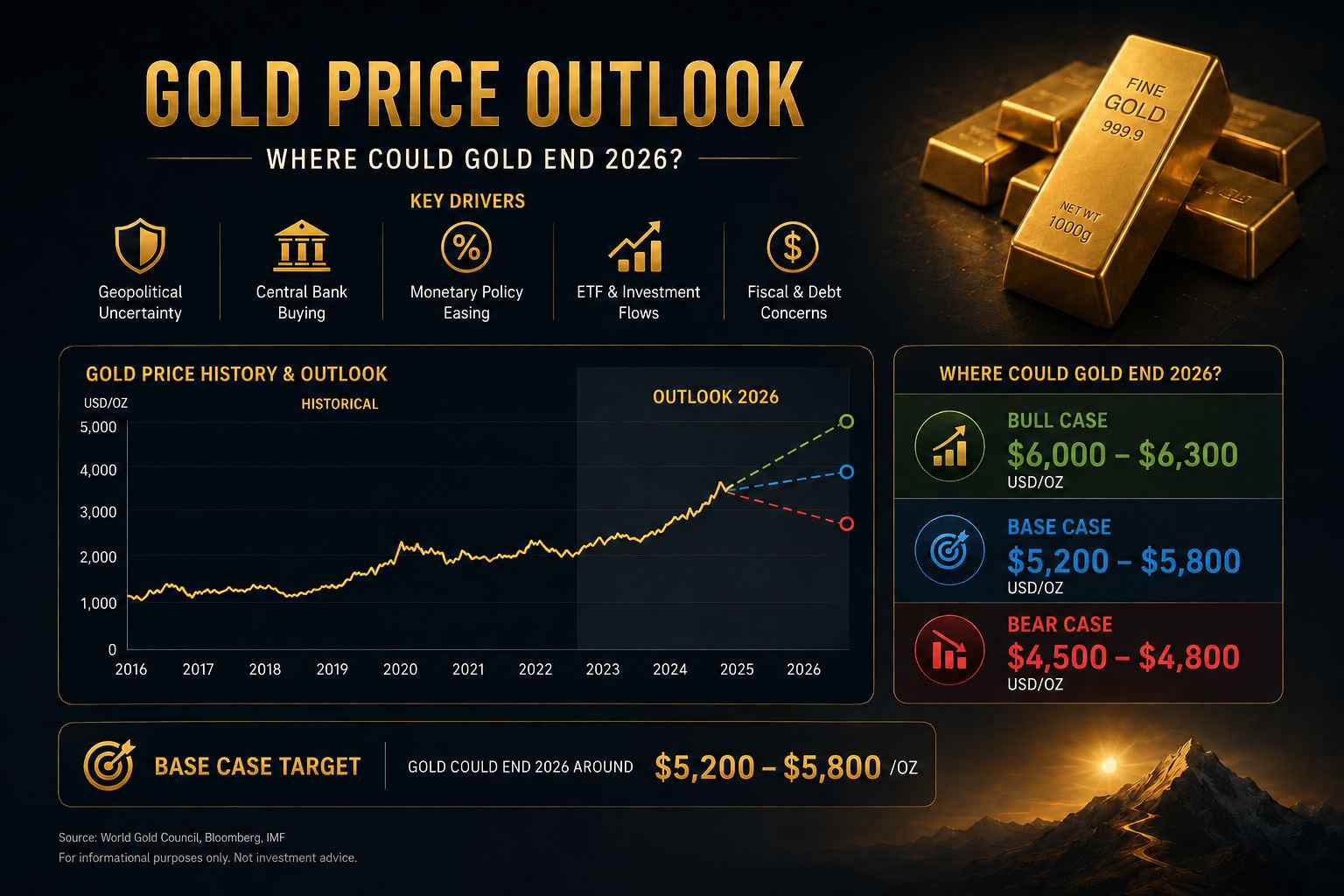
Gold has already delivered exceptional returns over the past several years, reaching record highs during 2025 and early 2026. The key question for UK investors is whether the rally has further to run or whether much of the upside has already been captured.
The consensus among analysts remains broadly positive, although expectations vary considerably. Most analysts continue to see structural support from central-bank buying, geopolitical uncertainty, fiscal concerns in the US, and the prospect of lower interest rates. However, after such a strong run, volatility and corrections should be expected.
Summary
Base Case (Most Likely)
Gold trades broadly sideways to modestly higher through the remainder of 2026, finishing between $5,200 and $5,800 per ounce. This would imply continued support from central-bank demand and investor diversification, but less dramatic gains than seen during 2025.
Bull Case
A global slowdown, faster-than-expected interest-rate cuts, worsening geopolitical tensions, or renewed concerns about government debt could push gold towards $6,000–$6,300/oz.
Bear Case
If inflation remains sticky, bond yields rise, the US dollar strengthens significantly, and risk appetite improves, gold could fall back towards $4,500–$4,800/oz.
Why Gold Has Been So Strong
Several structural factors have supported gold’s rise:
| Driver | Impact on Gold |
| Central bank buying | Strongly positive |
| Geopolitical tensions | Positive |
| US fiscal concerns | Positive |
| Lower real interest rates | Positive |
| Weakening US dollar | Positive |
| ETF inflows | Positive |
Central banks continue to accumulate gold as a reserve asset, and gold recently overtook US Treasuries as the largest reserve holding by value among central banks worldwide.
The World Gold Council also notes that both institutional investors and central banks have increased allocations to gold as a diversification tool amid ongoing economic uncertainty.
Gold has lost nearly $1,000/oz in a month, here’s why
Analyst Forecasts for End-2026 Gold Prices
The range of forecasts remains unusually wide.
| Institution | End-2026 Forecast ($/oz) |
| JPMorgan | $6,300 |
| Wells Fargo | $6,100–$6,300 |
| Bank of America | $6,000 |
| UBS | ~$5,600–$5,900 |
| RBC Capital Markets | ~$5,723 |
| Goldman Sachs | $5,400 |
| Morgan Stanley | ~$5,200 |
| Citi (base case) | ~$5,000 |
| LBMA Analyst Survey Average | ~$4,742 |
Notable Analyst Comments
Goldman Sachs
- Continues to cite central-bank demand and relatively low investor ownership of gold as supportive factors.
- Maintains a positive outlook despite volatility.
UBS
- Remains bullish but warns that ‘easy money’ has likely already been made.
- Expects gains to continue but at a slower pace.
- Suggests gold could remain range-bound if consensus economic expectations play out.
- Notes that unexpected economic weakness could create additional upside.
Pros of Investing in Gold Today
1. Portfolio Diversification
Gold historically behaves differently from equities and bonds, often performing well during periods of market stress.
2. Protection Against Geopolitical Risk
Wars, trade disputes, and political instability continue to support demand for safe-haven assets.
3. Central Bank Demand
Official-sector purchases remain one of the strongest pillars supporting the market.
4. Potential Benefit from Lower Rates
If central banks cut rates further, the opportunity cost of holding non-yielding assets such as gold falls.
Cons of Investing in Gold Today
1. Valuation Risk
Gold has already risen substantially. Future returns may be lower than those seen during the previous five years.
2. No Income
Unlike dividend-paying shares or bonds, gold generates no cash flow.
3. Volatility
Although perceived as “safe,” gold can experience sharp corrections.
4. Storage and Costs
Physical gold incurs storage, insurance and dealing costs. Even ETFs carry annual charges. The ECB notes gold remains costly to store and does not generate income.
Popular UK Gold ETFs and ETCs
Most UK investors access gold through exchange-traded commodities (ETCs) rather than holding bullion directly.
| Fund | Ticker | Annual Cost |
| iShares Physical Gold ETC | SGLN | 0.12% |
| Invesco Physical Gold ETC | SGLD | 0.12% |
| WisdomTree Physical Gold | PHAU | 0.39% |
| Xtrackers Physical Gold ETC | XGLD | 0.11% |
Performance of a Typical UK Gold ETC
The largest UK-listed product is the iShares Physical Gold ETC (SGLN).
| Period | Return |
| 1 Year | ~34% |
| 5 Years | ~47% |
| 10 Years | ~144% cumulative (approximately 14.4% annualised) |
What £10,000 Invested 10 Years Ago Would Be Worth
Using the 10-year cumulative return of approximately 144%:
| Initial Investment | Value Today |
| £10,000 | ~£24,400 |
How Much Gold Should Investors Hold?
Many professional asset allocators suggest:
| Investor Type | Typical Gold Allocation |
| Conservative | 5–10% |
| Balanced | 3–7% |
| Growth-focused | 0–5% |
Gold generally works best as a portfolio diversifier rather than a dominant holding.
Gold: Verdict
For UK retail investors, the key question is whether the rally has further to run or whether much of the upside has already been captured. The most likely outcome is that gold remains supported through the rest of 2026, but with returns that are far more modest than those achieved during the previous bull run. The combination of central-bank buying, geopolitical uncertainty and potential rate cuts provides a solid foundation, while high valuations and the lack of income generation argue against excessive exposure.
A reasonable expectation is for gold to finish 2026 somewhere between $5,200 and $5,800 per ounce, with upside towards $6,300 if economic or geopolitical risks intensify. For most UK investors, gold remains attractive as a portfolio insurance asset, rather than as a vehicle for aggressive capital growth.
Disclaimer: The author Steven Frazer has a personal interest in iShares Physical Gold.
You might also like:
