


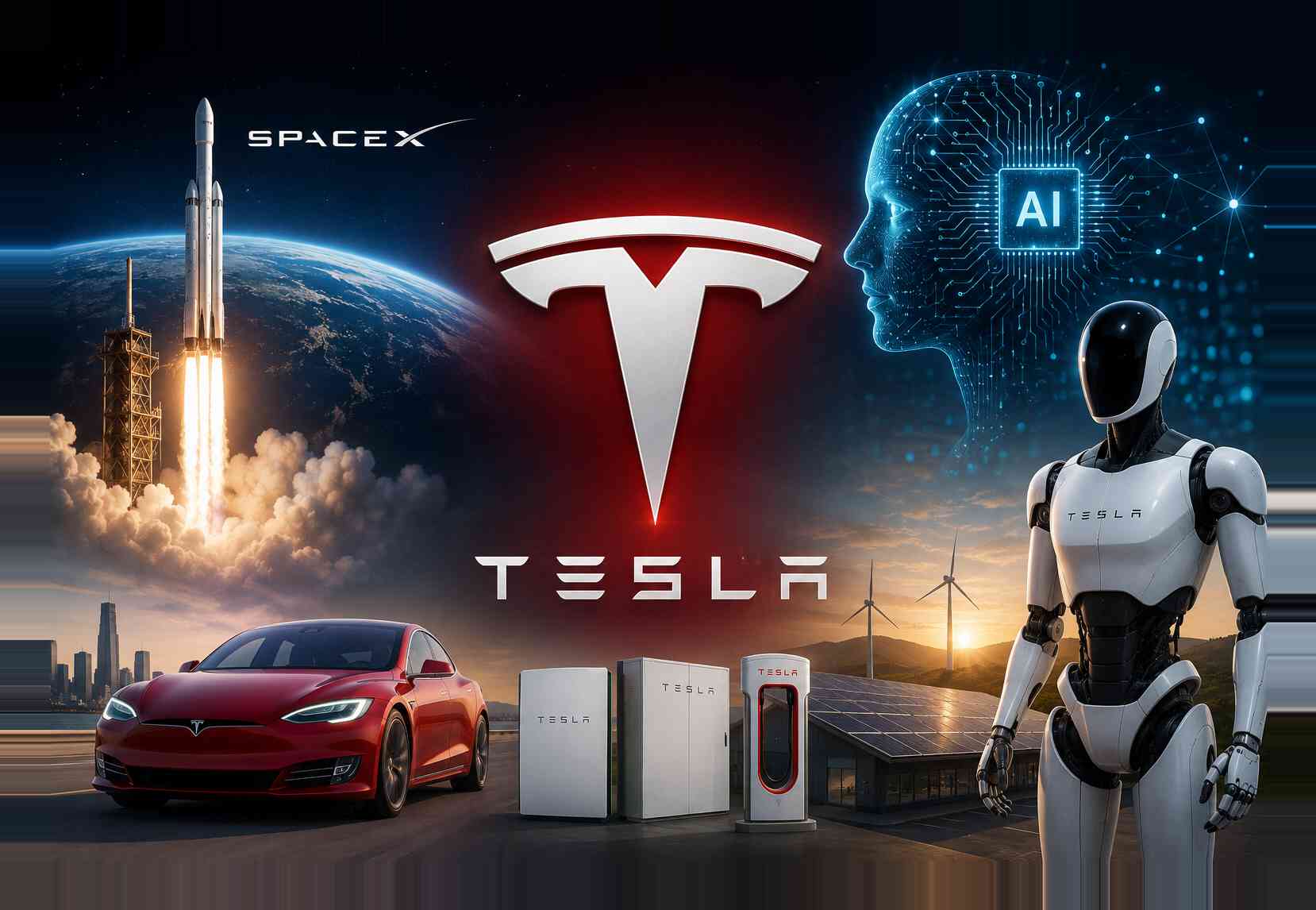
Tesla’s (NASDAQ:TSLA) second-quarter earnings call gave investors plenty to debate beyond electric cars. Attention centred on Elon Musk’s expanding business empire — spanning Tesla, SpaceX (NASDAQ:SPCX), AI, robotics and autonomous driving — and the possibility that some of these interests could eventually be brought closer together, although investors chief worry appears to be that Tesla is becoming increasingly capital intensive.
Musk did not announce a Tesla-SpaceX merger, nor did management suggest a transaction was imminent. But the discussion kept alive the possibility of greater consolidation across Musk-controlled businesses.
| Tesla (NASDAQ:TSLA) | Price: $353.02 (-5.6% after-hours) | Market cap: $1.10tn |
More questions than answers
For Tesla investors, that adds another dimension to an already difficult valuation question. Should Tesla still be valued primarily as an electric vehicle and energy company, or as part of a potentially much larger AI, robotics and space technology ecosystem?
Meanwhile, the Q2 numbers delivered a mixed message. Tesla generated record quarterly revenue of $28.24 billion, comfortably beating expectations, but profits disappointed, operating margins came under pressure and free cash flow turned negative.
Tesla Q2 2026: key numbers
| Metric | Q2 2026 | Investor takeaway |
| Revenue | $28.24bn | Record quarter; ahead of expectations |
| Revenue consensus | ~$25.55bn | Significant top-line beat |
| Adjusted EPS | $0.33 | Below roughly $0.49 expected |
| Operating profit | Down ~57% YoY | Costs weighed heavily on profitability |
| Free cash flow | Negative | First negative quarter in more than two years |
| Capital spending | Rising sharply | AI, robotics and manufacturing absorbing cash |
| Initial after-hours reaction | Down ~4% | Investors focused on profits and cash burn |
The contradiction is clear: Tesla is growing strongly at the top line but converting that growth into profits and cash is becoming more difficult.
What did Musk say about Tesla and SpaceX?
The key distinction is between closer strategic ties and an actual corporate merger.
Tesla and SpaceX are increasingly interconnected through Musk’s wider technology ambitions. The businesses have overlapping interests in artificial intelligence, computing infrastructure, robotics, advanced manufacturing, energy and semiconductors.
Musk did not provide a timetable, structure or commitment for combining Tesla and SpaceX. Investors should therefore treat a merger as strategic optionality rather than a base-case investment assumption.
Operational logic
There is, however, a plausible industrial logic for closer cooperation.
Tesla is increasingly positioning itself as an AI, robotics, energy and manufacturing company rather than simply an EV producer. SpaceX, meanwhile, has enormous requirements for computing, communications, energy, advanced electronics and manufacturing.
Potential areas of collaboration range from AI infrastructure and robotics to batteries, Starlink connectivity and potentially space-based computing.
The bull argument is that combining resources across Musk’s businesses could create an unusually powerful vertically integrated technology ecosystem.
The counterargument is governance. Tesla shareholders would need to ask whether any merger genuinely created value for them — or simply reorganised Musk’s empire while introducing dilution, conflicts of interest and additional complexity.
SpaceX is already influencing Tesla’s numbers
Tesla already has direct financial exposure to SpaceX.
Its SpaceX investment generated a roughly $1 billion mark-to-market benefit during the quarter, according to comments on the earnings call.
That is important because Tesla’s reported earnings can increasingly be influenced by changes in the value of investments rather than purely the operating performance of cars, energy, Robotaxi or Optimus.
Investors should therefore pay particularly close attention to operating profit, operating cash flow, capital expenditure and free cash flow when assessing underlying performance.
Cash burn may be the bigger story
Arguably the most important Q2 issue was not SpaceX speculation but Tesla’s rapidly increasing capital requirements.
The company is simultaneously investing in autonomous driving and Robotaxi, Optimus humanoid robots, AI computing infrastructure, manufacturing capacity, energy storage and potentially semiconductor production.
These are potentially enormous markets — but pursuing all of them is expensive.
| Growth platform | Opportunity | Execution risk |
| EVs | Global transport | Medium/high |
| Robotaxi | Autonomous mobility | Very high |
| Optimus | Humanoid robotics | Very high |
| AI infrastructure | Autonomous systems | High |
| Energy storage | Grid/electricity growth | Medium |
| Semiconductors | Vertical AI integration | Very high |
| SpaceX integration | Wider Musk ecosystem | Very high |
This helps explain why Tesla shares initially fell despite the huge revenue beat.
Investors are questioning how much capital will be required before Robotaxi, Optimus and other emerging businesses begin generating meaningful returns.
Margins remain the financial battleground
For years, Tesla’s premium valuation partly rested on its ability to generate stronger margins than conventional car manufacturers.
That argument has weakened.
Competition, pricing pressure and huge spending on AI and new businesses have squeezed profitability. Q2 illustrated the problem particularly clearly: revenue reached record levels while operating profit fell sharply year-on-year.
The bullish interpretation is that Tesla is deliberately sacrificing current profits to build potentially dominant positions in autonomous transport, robotics and AI.
The risk is that investors are paying today for highly profitable future businesses that take much longer than expected to materialise — or never achieve the scale currently implied by Tesla’s valuation.
Why did Tesla shares fall?
Tesla shares initially dropped roughly 6% in after-hours trading, despite revenue significantly beating Wall Street forecasts.
Three issues appeared to concern investors.
- Earnings quality was weaker than the headline revenue figure suggested, with adjusted EPS missing expectations and operating profit falling sharply.
- Free cash flow turned negative just as Tesla is embarking on an exceptionally ambitious capital-investment programme.
- Tesla’s valuation leaves little room for disappointment.
Traditional automotive earnings alone cannot justify a market valuation above $1 trillion. Investors are effectively paying for future success from Robotaxi, Optimus, AI and energy — with potential SpaceX-related optionality adding another speculative element.
Analysts remain deeply divided
Tesla remains one of Wall Street’s most polarising major stocks.
Analyst valuations range from deeply bearish to extremely bullish because forecasts depend heavily on what investors believe Tesla eventually becomes.
| View | Investment argument |
| Bull | Tesla becomes a dominant AI, autonomous-driving, robotics and energy platform |
| Middle | EV recovery plus valuable Robotaxi/Optimus optionality, but much success is priced in |
| Bear | Tesla remains economically dominated by autos while spending heavily on speculative projects |
| Merger bull | SpaceX integration creates a unique AI, robotics and space technology platform |
| Merger bear | Governance, dilution and conflicts destroy shareholder value |
Ahead of earnings, Barclays raised its Tesla price target to around $370 while retaining an Equal Weight stance. Across Wall Street, Tesla targets have ranged from roughly $123 to $600, illustrating the extraordinary disagreement over its intrinsic value.
The reason is simple: relatively small changes in assumptions about Robotaxi or Optimus can produce dramatically different valuations.
Would a SpaceX merger be good for Tesla shareholders?
It would depend entirely on the terms. Potential benefits could include shared AI infrastructure, Starlink connectivity, manufacturing expertise, robotics technology and access to SpaceX’s wider technology ecosystem.
But risks would be substantial. Tesla shareholders could face dilution, increased capital requirements, governance conflicts and the danger of Tesla paying too much for related assets.
Any transaction involving Musk-controlled businesses would require intense scrutiny of valuation, ownership, voting rights and governance.
Investors should not assume that ‘Tesla + SpaceX’ automatically means greater shareholder value.
Investor verdict
Tesla’s Q2 results strengthened the bull and bear cases simultaneously.
Bulls can point to record revenue and enormous opportunities across autonomous transport, robotics, energy and AI, with closer SpaceX ties potentially adding another strategic dimension.
Bears can point to weak earnings conversion, falling operating profit, negative free cash flow and an extremely demanding valuation.
| Factor | Assessment |
| Revenue momentum | 🟢 Strong |
| Robotaxi opportunity | 🟢 Huge potential |
| Optimus opportunity | 🟢 Huge but speculative |
| Margins | 🔴 Under pressure |
| Free cash flow | 🔴 Key concern |
| Capital intensity | 🔴 Extremely high |
| SpaceX optionality | 🟢/🟠 Potentially valuable but uncertain |
| Governance | 🟠 Elevated risk |
| Valuation | 🔴 Demanding |
For UK retail investors, the SpaceX connection is fascinating but should remain an option rather than the core investment thesis.
The bigger Q2 message is that Tesla is becoming increasingly capital intensive just as investors expect it to transform from an EV manufacturer into an AI, robotics and autonomous-transport giant.
At today’s valuation, investors are not simply betting that Tesla will sell more cars. They are betting that at least some of Musk’s biggest technological ambitions will become enormously profitable businesses at scale.
That remains both the attraction — and the fundamental risk — of owning Tesla shares.
You might also like:
