



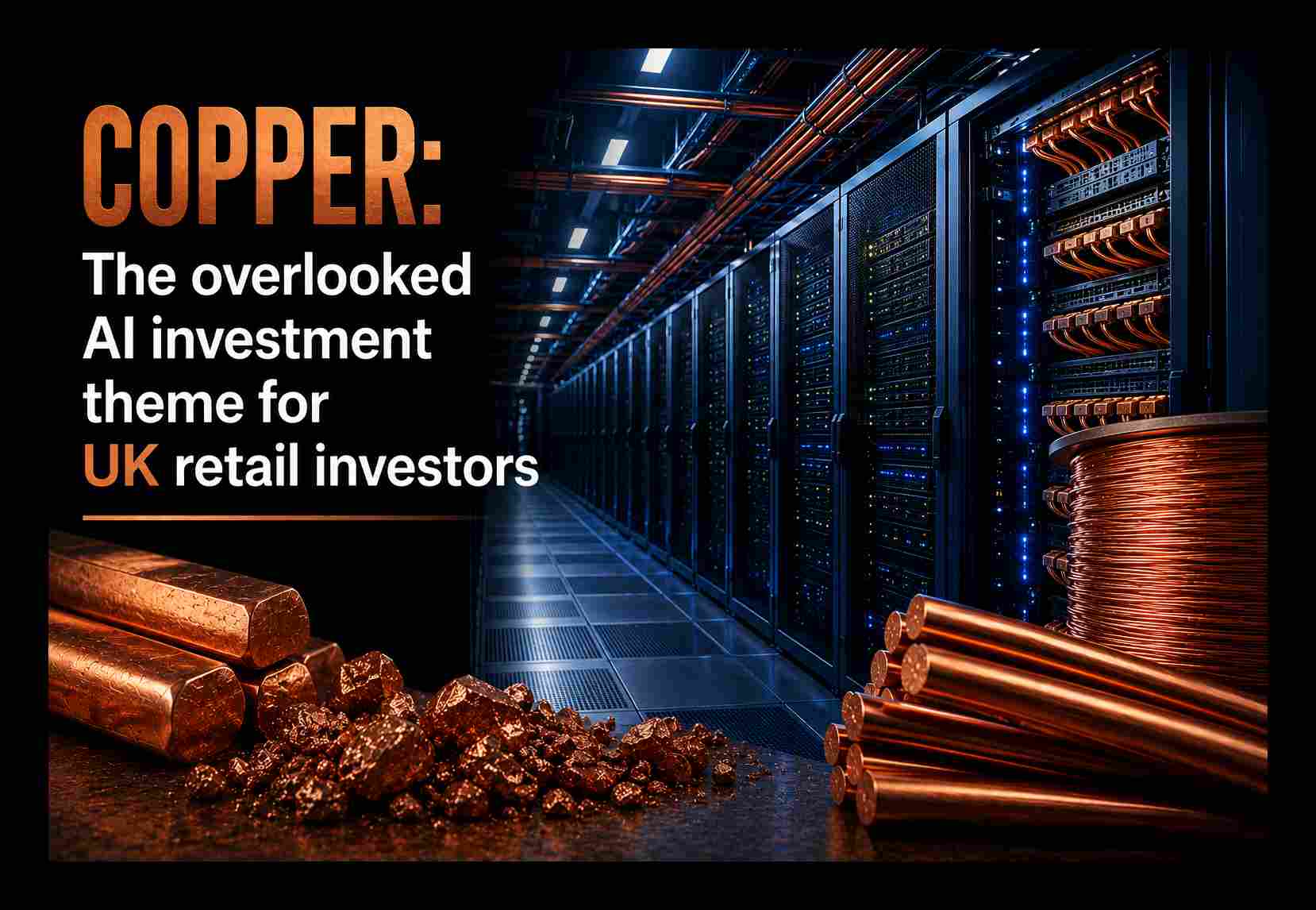
Every AI model ultimately runs inside a power-hungry datacentre, and every datacentre requires vast quantities of copper. So while investors thinking about artificial intelligence will usually focus on chipmakers, such as Nvidia (NASDAQ:NVDA), Broadcom (NASDAQ:AVGO), Micron Technology (NASDAQ:MU), or cloud hyperscale providers, like Microsoft (NASDAQ:MSFT), Amazon (NASDAQ:AMZN) or Alphabet (NASDAQ:GOOG), copper seldom gets a look in.
Yet increasingly numbers of analysts view copper as the ‘physical backbone’ of the AI revolution. While software captures headlines, copper powers the servers, cooling systems, substations, transformers and transmission networks needed to make AI work.
Micron earnings crush expectations as AI memory boom accelerates
Why copper matters for AI
Copper is one of the world’s best conductors of electricity and heat.
In AI infrastructure it is used in:
- Power cables
- Transformers
- Switchgear
- Server wiring
- Cooling systems
- Grid connections
- Renewable energy projects supplying datacentres
Research suggests copper accounts for roughly 83% of the total mineral mass required for AI datacentre infrastructure, with power infrastructure representing the largest source of demand.
Copper’s role in the AI stack
| Infrastructure component | Copper intensity |
| Datacentre electrical systems | Very High |
| Grid upgrades | Very High |
| Transformers & substations | Very High |
| Cooling systems | High |
| Server racks & power distribution | High |
| Fibre-optic networks | Moderate |
AI is becoming a major new source of copper demand
The International Energy Agency expects data-centre electricity consumption to more than double by 2030, with AI the biggest driver of growth.
Meanwhile, industry estimates suggest:
| AI/Copper demand metric | Estimate |
| Copper needed per MW of AI data-centre capacity | 27-47 tonnes |
| Copper required for large hyperscale campuses | Up to 50,000 tonnes |
| Annual copper demand from datacentres by 2030 | ~1.1 million tonnes |
| Share of global copper demand by 2030 | ~3% |
This demand arrives on top of existing growth from:
- Electric vehicles
- Renewable energy
- Grid modernisation
- Electrification of industry
The supply problem
The bullish copper investment case depends on a simple fact: mines take years to build.
The IEA warns that currently announced mining projects may only meet around 70% of projected copper demand by 2035.
Copper prices have hit record highs, but smelters face mounting strategic pressures
Meanwhile, analysts expect the copper market to remain in deficit as demand grows faster than new supply.
Copper market outlook
| Metric | Current estimate |
| Global copper demand (2024) | 26.7m tonnes |
| Global copper demand (2030) | 31.3m tonnes |
| Increase | +17% |
| Announced supply likely to meet demand? | No |
| Market balance outlook | Structural deficits |
Analyst commentary
BHP
UK-listed mining group BHP (LON:BHP) argues AI datacentres represent an entirely new source of copper demand alongside electrification and renewable energy. The company highlights copper’s use throughout power delivery and cooling systems.
Wood Mackenzie
Wood Mackenzie’s copper research team believes datacentres are becoming an increasingly important part of the broader electrification story and should provide a long-term tailwind for copper demand.
Reuters analysis
Some analysts caution investors against assuming every announced AI project will be built. Grid constraints, labour shortages and planning delays could slow demand growth. Nevertheless, even more conservative forecasts point to substantial long-term increases in copper consumption.
5 Global copper mining stocks to watch
1. Freeport-McMoRan (NYSE:FCX)
| Metric | Details |
| Primary exposure | Copper |
| Key assets | Grasberg, Indonesia; Americas operations |
| Investment case | One of the purest large-cap copper plays |
2. Southern Copper (NYSE:SCCO)
| Metric | Details |
| Primary exposure | Copper |
| Key regions | Peru & Mexico |
| Investment case | High production growth and attractive margins |
3. Antofagasta (LON:ANTO)
| Metric | Details |
| Listing | London |
| Primary exposure | Chilean copper |
| Investment case | Direct FTSE 100 copper exposure |
4. BHP (LON:BHP)
| Metric | Details |
| Listing | London & Australia |
| Primary exposure | Diversified miner |
| Investment case | Significant copper growth pipeline |
5. Rio Tinto (LON:RIO)
| Metric | Details |
| Listing | London |
| Primary exposure | Diversified mining |
| Investment case | Expanding copper portfolio |
UK-Listed Copper ETFs & ETCs
For most retail investors, ETFs and ETCs offer a simpler route than owning individual miners.
| Fund | Exposure | Structure |
| WisdomTree Copper | Spot copper price | ETC |
| WisdomTree Copper 2x Daily Leveraged | Leveraged copper | ETC |
| Global X Copper Miners UCITS ETF | Mining equities | ETF |
| Sprott Copper Miners ESG-Screened UCITS ETF | Copper producers | ETF |
| HANetf Electric Vehicle Metals UCITS ETF | Broader metals theme | ETF |
Alternative Ways to Invest in Copper
1. Mining royalty companies
Companies such as Wheaton Precious Metals (LON:WPM) and Franco-Nevada (TSE:FNV) offer indirect exposure through royalties and streams.
2. Diversified miners
FTSE investors can access copper through:
- Rio Tinto
- BHP
- Glencore
3. Commodity funds
Broad commodity ETFs often include copper alongside energy and industrial metals.
4. Electrification funds
Many clean-energy and infrastructure ETFs hold companies benefiting from copper demand growth.
Investor verdict
The AI investment narrative is gradually expanding beyond chips and software.
Every AI model ultimately runs inside a power-hungry datacentre, and every datacentre requires vast quantities of copper. The combination of AI, electrification, renewable energy and grid upgrades is creating what many analysts view as a multi-decade demand story. At the same time, new mine supply remains constrained, raising the prospect of recurring deficits and higher prices.
For UK retail investors, the most accessible routes are likely to be FTSE-listed miners, such as Antofagasta and diversified giants such as BHP, alongside specialist copper ETCs and copper-miner ETFs. The key question is whether AI becomes merely another source of demand—or the catalyst that finally pushes the copper market into a prolonged supply squeeze.
Disclaimer: The author Steven Frazer has a personal interest in Nvidia and Broadcom.
You might also like: