




Wall Street’s favourite memory stock Sandisk (NASDAQ:SNDK) delivered another excellent operational quarter including a headline beat, comfortably exceeding Wall Street forecasts for both revenue and earnings as AI-driven demand for NAND flash memory remained exceptionally strong.
However, after a ~750% 2026 rally that had driven the share price to record $2,335 (in June) levels, investors were looking for another significant guidance upgrade rather than merely strong results.
| Sandisk (NASDAQ:SNDK) | Price: $1,230.01 (-9% after-hours) | Market cap: ~$182.2bn |
The market instead focused on Q1 FY2027 guidance that was broadly in line with expectations, together with slightly softer profit guidance than some of the most optimistic forecasts.
The stock remains ~+390% YTD.
Q4 FY2026 at a glance
| Metric | Reported | Consensus | Beat/(Miss) |
| Revenue | $8.97bn | ~$8.48bn | ✔️Beat |
| Adjusted EPS | $39.25 | ~$34.96 | ✔️Beat |
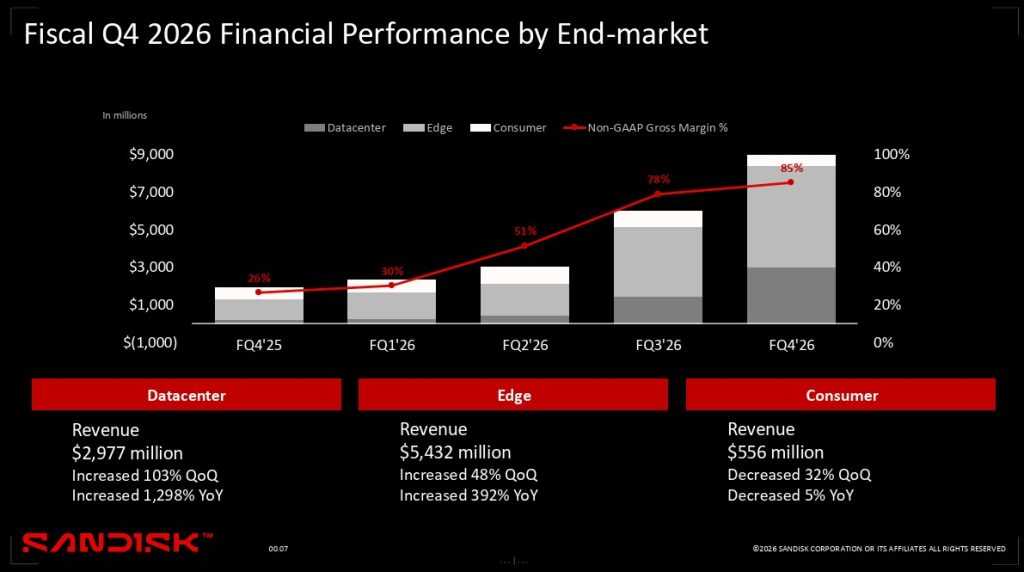
| Gross margin | 84.6% | Above expectations | ✔️Beat |
| Data Centre revenue | $2.97bn | n/a | +103% YoY |
| Consumer revenue | $556m | ~$874m expected | ❌Miss |
Source: Company results, consensus estimates.
Guidance
Guidance still implies another exceptional quarter.
The problem was that investors had been pricing in another substantial raise, not simply continued growth.
That distinction explains why the shares fell despite what would normally be considered an outstanding earnings report.
| Metric | Company guidance | Market expectation |
| Q1 FY2027 revenue | $10.3bn-$10.8bn | ~$10.8bn midpoint |
| Adjusted EPS | $44-$46 | ~$44.7 |
Why the market sold the shares
Three issues dominated the after-hours reaction.
1. Expectations had become almost impossible to satisfy
Sandisk entered earnings after one of the strongest rallies anywhere in global technology.
Following gains ~390% this year, investors were already assuming:
- continued NAND price increases
- additional AI hyperscaler contracts
- another sizeable guidance increase
- higher margins
Instead, management largely reaffirmed the current trajectory.
2. Profit guidance disappointed some investors
Revenue guidance exceeded many forecasts.
However, earnings guidance landed slightly below the most bullish estimates because Sandisk continues investing heavily in production, technology and long-term customer agreements.
3. Consumer business remains weak
AI is booming.
Traditional consumer SSDs, USB drives and memory cards remain relatively subdued.
That matters less strategically than data centres, but investors noticed the consumer miss.
What management said
CEO David Goeckeler focused less on quarterly results and more on changing the economics of the memory industry.
One of the most important comments was:
‘We’re prioritizing long-term contracts over quarterly sales.’
Reuters reported Sandisk has now signed eight major agreements with six customers worth approximately $94 billion, with average durations around four years. Management expects around half of production to be covered by these agreements during FY2027, rising to roughly two-thirds in FY2028.
The significance is enormous.
Historically NAND has been among the most cyclical industries in semiconductors.
Long-term agreements potentially reduce pricing collapses during downturns.
Management also reiterated its objective of building:
‘durable free cash flow’
rather than maximising short-term shipments.
AI investing: Bubble or start of new economic supercycle?
What analysts said
Matt Bryson (Wedbush)
Bryson believes earnings momentum should continue through FY2027-28 because industry supply remains constrained while long-term customer contracts improve visibility.
He highlighted:
‘limited new chip capacity’
combined with Sandisk’s multiyear agreements as supporting sustained profitability.
Reuters analysis
Reuters concluded investors remain concerned that even excellent operational execution may struggle to justify Sandisk’s extraordinary valuation after this year’s rally.
Sandisk’s position in memory chips
Unlike Nvidia (NASDAQ:NVDA), AMD (NASDAQ:AMD), or Broadcom (NASDAQ:AVGO), Sandisk specialises primarily in NAND flash memory.
Products include:
- AI SSDs
- enterprise storage
- hyperscale storage systems
- embedded flash
- automotive storage
- consumer SSDs
As AI models become larger, memory becomes almost as important as computing power.
GPUs cannot function efficiently without huge amounts of high-performance storage feeding them data.
That places Sandisk alongside:
- Micron
- Kioxia
- Samsung
- SK Hynix
as one of the world’s critical AI memory suppliers.
AI bottlenecks creating demand
Current AI infrastructure constraints increasingly involve storage rather than GPUs alone.
Major bottlenecks include:
| Bottleneck | Why it matters |
| GPU memory bandwidth | Models require enormous datasets |
| AI storage throughput | Faster SSDs reduce GPU idle time |
| AI inference caching | Requires high-performance NAND |
| Enterprise data lakes | Growing rapidly with generative AI |
| Power availability | Slows new data-centre deployments |
Many hyperscalers are now investing simultaneously in:
- GPUs
- networking
- storage
- power
- cooling
rather than treating GPUs as the only bottleneck.
Opportunities
AI infrastructure
Enterprise AI storage remains in the early stages.
Inference workloads should become an increasingly important demand driver.
Multi-year pricing agreements
These contracts could fundamentally reduce NAND cyclicality.
If successful, earnings become more predictable than previous memory cycles.
Limited industry supply
Unlike previous booms, manufacturers have shown unusual production discipline.
That has helped maintain pricing.
Enterprise SSD growth
Cloud providers increasingly require higher-capacity drives as AI datasets expand.
Risks
Memory remains cyclical
Every previous NAND supercycle eventually reversed.
AI capex slowdown
If hyperscaler spending slows, pricing could weaken rapidly.
Valuation
Much optimism is already reflected in the share price.
Consumer weakness
Traditional consumer flash demand remains subdued.
Cash flow versus capex
| Metric | FY2026 |
| Adjusted free cash flow | ~$8.7bn |
| Q4 adjusted free cash flow | ~$5bn |
| Cash balance | ~$4.8bn |
The company continues investing heavily in manufacturing technology while still generating exceptional free cash flow.
That combination is relatively unusual within the memory industry and reflects the current pricing environment.
Valuation versus peers
| Company | Primary focus | AI exposure | Valuation observations (PE)* |
| Sandisk | NAND flash | Very High | Premium after 2026 rally (PE ~6.9x) |
| Micron | DRAM + NAND | Very High | More diversified memory (~5.9x) |
| SK Hynix | HBM + DRAM | Extremely High | HBM leader (~5.1x) |
| Samsung Electronics | Broad semiconductor | High | More diversified (~4.2x) |
| Kioxia | NAND | High | Private/less liquid (~5.1x) |
*PE valuations based on rolling 12-month forward Stockopedia, Gurufocus estimates.
Sandisk now trades much higher multiples than traditional semiconductor valuations.
That leaves much less room for disappointment.
Why memory chip stocks usually trade on lower PE multiples
Unlike software companies or semiconductor designers with recurring revenue, memory manufacturers have historically been among the most cyclical businesses in the technology sector.
Demand for DRAM and NAND can swing sharply as spending on PCs, smartphones, servers and data centres rises and falls, while supply often expands in waves as new fabrication capacity comes online. During downturns, excess inventory can lead to rapid price declines, causing profits to evaporate or even turn into losses.
Because earnings are viewed as volatile and difficult to sustain through a full cycle, investors have typically assigned lower price-to-earnings (PE) multiples to memory stocks than to less cyclical semiconductor companies such as Nvidia, Broadcom or ASML (AMS:AMSL). The current AI investment boom is challenging that long-held view, however.
If companies such as Sandisk can lock in multi-year customer agreements and maintain greater supply discipline across the industry, investors may become more willing to pay higher valuation multiples than in previous memory cycles.
Even so, most analysts remain cautious about assuming today’s elevated profitability represents a permanent structural change rather than another exceptionally strong phase of the cycle.
Bull vs bear case
| 🐂 Bull case | 🐻 Bear case |
| AI storage demand is only beginning | Valuation already discounts years of growth |
| Multi-year contracts reduce cyclicality | Memory remains historically volatile |
| Enterprise SSD growth remains exceptional | Consumer business remains weak |
| Supply discipline supports pricing | New capacity could pressure prices |
| Free cash flow continues accelerating | AI capex could normalise after current boom |
Investor verdict
Sandisk produced another excellent operational quarter. Revenue, earnings, margins and cash generation all exceeded expectations, while management continued executing a strategy designed to make the traditionally volatile NAND industry more predictable through multi-year supply agreements.
For UK retail investors, the key takeaway is that the share price reaction reflects expectations rather than business quality. After a ~390% rally, investors demanded an even larger guidance upgrade than management delivered. If AI infrastructure spending remains robust and long-term contracts continue to expand, Sandisk’s structural earnings power could keep improving.
However, with the stock already valued at a substantial premium and memory markets historically prone to sharp cycles, execution must remain close to flawless to justify current valuations. Long-term investors may still find the AI storage theme compelling, but future returns are likely to depend more on sustained earnings growth than on further multiple expansion.
You might also like: