




Artificial intelligence is transforming industries worldwide, creating opportunities for investors but also raising questions about valuations, competition and financial sustainability.
For UK beginners, understanding how the AI ecosystem works — and which companies may capture its economic benefits — is essential before investing.
This guide explores AI’s impact, the different investment opportunities available and the risks investors should consider in September 2026 before investing in a Stock.
Artificial intelligence has become one of the biggest themes in mainstream media, dominating headlines, business coverage and investment discussions. Yet despite its growing influence, surprisingly few people truly understand what AI is, how it works or where it is being used. The reality is that many of us are already using AI, often without realising it.
AI matters now because it is moving from a largely experimental technology into everyday products, business operations and investment decisions. The shift is happening unusually quickly, with AI increasingly able to perform tasks that previously required human judgement, from writing and coding to analysing data, recognising images and automating customer service.
Three developments make AI important
- AI is becoming mainstream. Generative AI tools can now create text, images, software, audio and video, making the technology accessible to millions of people rather than just specialist users.
- Businesses are investing heavily. Companies across technology, healthcare, finance, manufacturing and retail are spending billions on AI infrastructure, software and applications in an attempt to improve productivity and create new revenue streams.
- AI is changing the investment landscape. Nvidia, Microsoft, Alphabet, Amazon, Meta and other companies are committing enormous sums to data centres, chips and AI models, creating opportunities throughout the semiconductor, cloud-computing, networking and software industries.
- The technology is increasingly embedded in products people already use. Search engines, smartphones, social media, streaming services, email, online shopping and cybersecurity increasingly use AI behind the scenes.
The important point for investors is that AI is not simply one industry or a single technology. It is becoming a layer of computing that can affect almost every sector of the economy.
That creates both opportunity and risk. Companies capable of using AI to reduce costs, increase productivity or develop new products could benefit significantly. But huge expectations are already reflected in some share prices, while the scale of spending required to build AI infrastructure raises questions about returns, competition and whether today’s investment boom can ultimately generate sufficient profits.
What is artificial intelligence?
Artificial intelligence enables computers to perform tasks traditionally associated with human intelligence, including:
- Understanding and generating language.
- Recognising images, speech and patterns.
- Making predictions and recommendations.
- Analysing large quantities of data.
- Automating decisions and workflows.
What is generative AI?
Generative AI creates new content, including text, images, audio, video and software code.
Examples include ChatGPT, Google’s Gemini, Microsoft Copilot, Claude and other image-generation tools.
Unlike traditional software, modern AI models identify patterns in vast datasets and generate responses based on what they have learned.
Small Language Models: AI winners beyond the data centre?
For investors, this matters because generative AI requires substantial computing power, specialised chips, cloud infrastructure and software — creating opportunities throughout the technology supply chain.
How AI is changing industries globally
AI’s economic impact extends far beyond technology companies.
| Industry | How AI is being used | Potential investment impact |
| Technology | AI assistants, cloud computing and software development | Demand for chips, infrastructure and enterprise software |
| Healthcare | Drug discovery, medical imaging and administrative automation | Productivity gains and potential new treatments |
| Financial services | Fraud detection, risk assessment and customer service | Lower costs and faster decision-making |
| Manufacturing | Robotics, predictive maintenance and quality control | Greater automation and efficiency |
| Retail | Personalised recommendations, demand forecasting and logistics | Improved margins and customer experiences |
| Automotive | Driver assistance and autonomous driving | New software and mobility revenue |
| Energy | Grid optimisation and demand forecasting | Smarter infrastructure and rising electricity demand |
| Professional services | Research, coding, document analysis and workflow automation | Changes to knowledge-worker productivity |
Investor takeaway: AI could benefit both technology providers and businesses deploying it effectively. However, not every company using AI in its marketing will generate meaningful financial returns from it.
The AI ecosystem: Five layers investors need to understand
AI stocks are not interchangeable. The ecosystem contains several layers with different economics, growth drivers and risks.
The AI investment value chain
1. Applications & AI software
Enterprise tools, automation and industry-specific applications
Palantir · Salesforce · Adobe
2. Foundation models & cloud platforms
Large language models, cloud computing and AI deployment
Microsoft · Alphabet · Amazon · Oracle
3. Networking, memory & advanced chips
GPUs, CPUs, networking, high-bandwidth memory and semiconductor manufacturing
Nvidia · AMD · Broadcom · SK Hynix · TSMC
4. Data centres & physical infrastructure
Servers, cooling, electricity, buildings and specialist infrastructure
Vertiv · Eaton · Digital Realty · Equinix
5. End-user industries
Healthcare, finance, manufacturing, transport and retail
Businesses adopting AI to improve productivity
Illustrative AI ecosystem
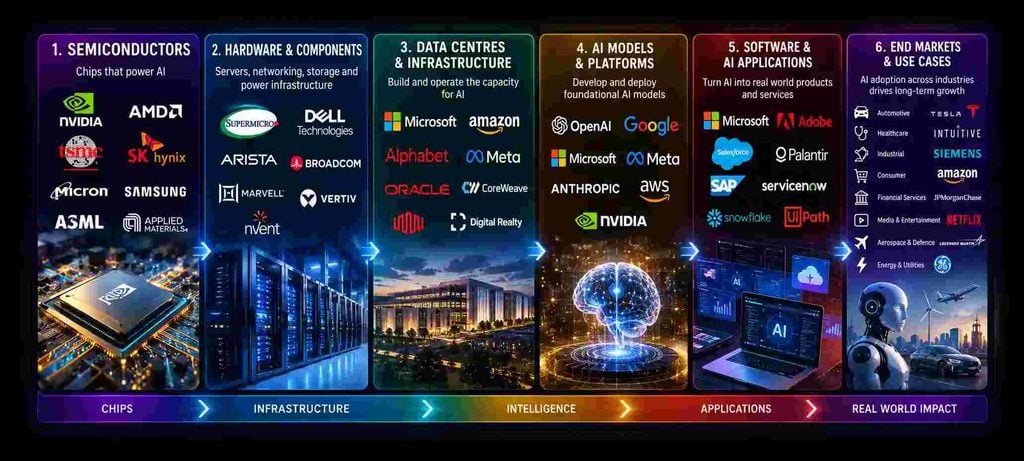
*Companies may operate across multiple layers
AI chips and semiconductor manufacturing
AI models require enormous computing power, particularly during training and inference.
| Company | AI investment exposure |
| Nvidia | GPUs, accelerated computing, networking and AI software |
| AMD | Data centre GPUs and CPUs |
| Broadcom | Custom AI accelerators and networking |
| TSMC | Manufactures advanced chips designed by other companies |
| SK Hynix | High-bandwidth memory used in AI systems |
| ASML | Advanced lithography equipment for leading-edge chips |
Investment consideration: Semiconductor companies can benefit from AI spending but remain exposed to cyclicality, capital intensity and customer concentration.
Cloud computing and AI platforms
Training and running AI models requires data centres and cloud infrastructure.
Major companies include Microsoft, Alphabet, Amazon, Oracle and Meta Platforms.
These businesses offer AI exposure alongside diversified operations. However, the infrastructure race is expensive.
Barclays Private Bank reported that Microsoft, Alphabet, Amazon and Meta spent a combined $165 billion on capital expenditure in Q2 2026, up 87% year-on-year. Their combined free cash flow after capital expenditure was approximately $6.7 billion.
Reuters Breakingviews reported in July 2026 that technology giants were collectively committing approximately $700 billion to data centres, raising questions about whether AI products would generate sufficient returns.
AI software and applications
AI software companies help businesses deploy the technology directly.
| Company | AI application |
| Palantir Technologies | Enterprise and government data analysis and AI deployment |
| Salesforce | AI-assisted customer relationship management |
| Adobe | Generative AI for creative and marketing workflows |
| ServiceNow | AI-enabled enterprise automation |
| SAP | AI integrated into business software |
Software businesses could generate recurring revenue from AI features without bearing the entire cost of hyperscale infrastructure.
However, competition may commoditise AI capabilities and pressure pricing.
Popular AI stocks for UK investors to research in 2026
These companies represent different routes to AI exposure. They are research candidates, not personal recommendations or a ranked list.
| Company | Investment case | Key risks |
| Nvidia | Leading AI computing, GPUs, networking and software ecosystem | High expectations, competition and slower infrastructure spending |
| Microsoft | Azure, enterprise software and AI productivity tools | Infrastructure costs and uncertain AI monetisation |
| Alphabet | Gemini, Google Cloud and AI research alongside Search | Search disruption, regulation and capital expenditure |
| Amazon | AWS exposure to AI computing and services | Capital requirements and competitive pressure |
| Broadcom | Custom AI chips and networking | Customer concentration and sustainability of AI orders |
| Palantir | Enterprise AI deployment and data analytics | Valuation, contract concentration and competition |
What investors should examine: Revenue growth, profitability, valuation, competitive advantages, customer concentration and the proportion of financial performance attributable to AI.
AI investment trusts and funds for UK ISAs and SIPPs
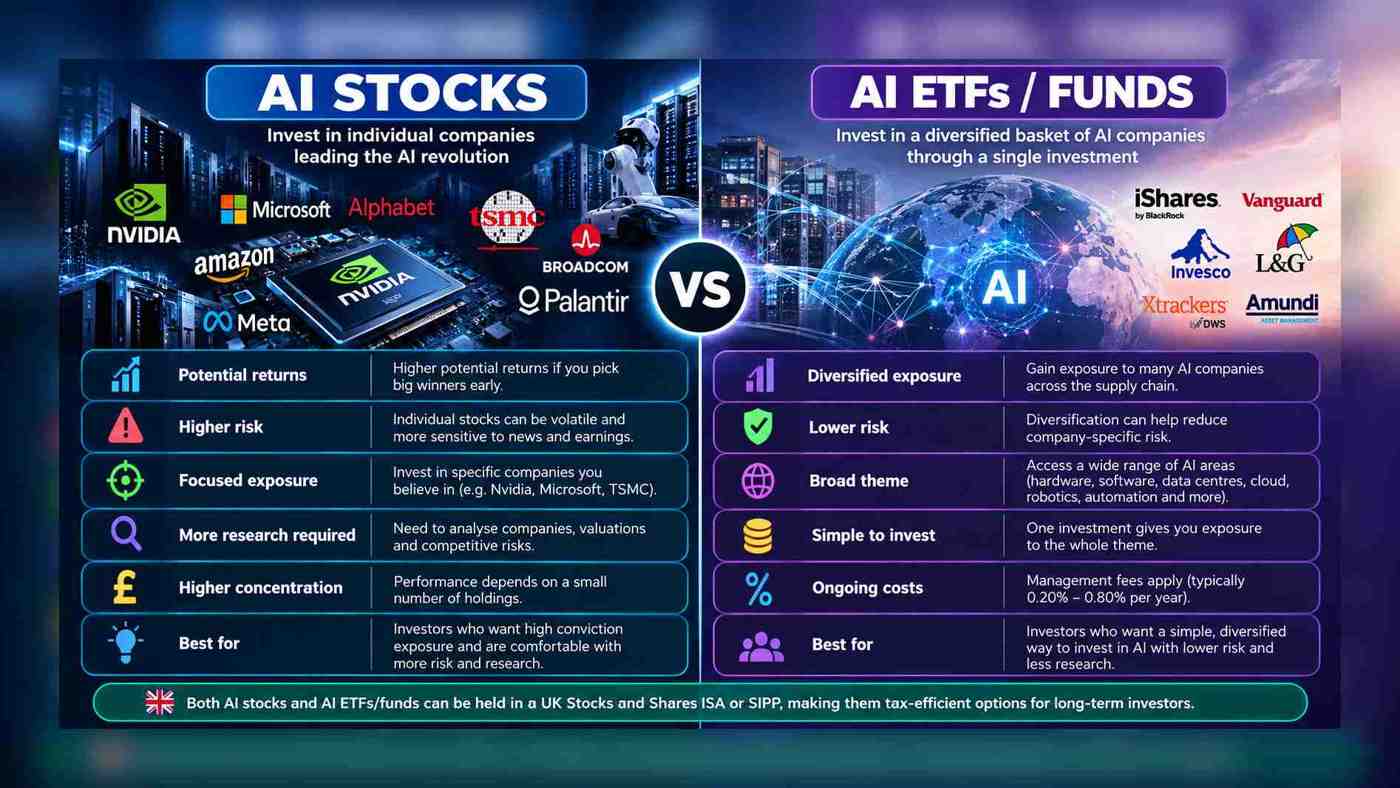
Funds can provide diversification across multiple AI beneficiaries rather than relying on one company, making them an attractive choice for Stocks & Shares ISAs and SIPPs.
Technology-focused investment trusts
| Investment trust | Potential AI exposure | What to investigate |
| Scottish Mortgage Investment Trust | Global technology and growth companies | Portfolio concentration, valuation and discount/premium |
| Polar Capital Technology Trust | Global technology businesses across the AI supply chain | Semiconductor exposure, gearing and discount |
| Allianz Technology Trust | Global technology and innovation companies | Portfolio construction, fees and valuation |
Investment trusts offer professional management but can trade at discounts or premiums to the value of their underlying assets.
Check current holdings, charges and ISA/SIPP eligibility before investing.
AI and technology ETFs
| ETF category | Exposure | Considerations |
| Artificial intelligence ETFs | Companies linked to AI development and adoption | Definitions vary |
| Automation and robotics ETFs | Robotics and industrial automation | Broader industrial exposure |
| Semiconductor ETFs | Chip designers, manufacturers and equipment companies | Cyclical and potentially concentrated |
| Technology sector ETFs | Broad technology businesses | Less dependent on one theme |
| Nasdaq-100 ETFs | Large US growth and technology companies | AI exposure may be substantial but indirect |
Examples to research include:
- WisdomTree Artificial Intelligence UCITS ETF.
- L&G Artificial Intelligence UCITS ETF.
- iShares Automation & Robotics UCITS ETF.
Look for UCITS ETFs available to UK investors and verify ISA or SIPP eligibility with the ETF provider or your broker.
Global technology funds
Actively managed global technology funds may invest across software, semiconductors, cloud computing and other technology businesses.
Advantages include professional stock selection and the ability to adjust exposure.
Disadvantages include higher fees, manager risk and potential underperformance against passive indices.
How to invest in AI stocks through a UK Stocks & Shares ISA
For the 2026/27 tax year, the overall ISA allowance is £20,000.
A Stocks & Shares ISA can hold eligible investments in a tax-efficient wrapper, with no UK income tax or capital gains tax on returns within the ISA.
Step-by-step
- Choose a regulated investment platform: Compare dealing fees, FX charges, fund fees and investment availability.
- Open or use a Stocks & Shares ISA: Check the provider’s terms and annual allowance.
- Choose individual shares or funds: Individual stocks offer targeted exposure; funds provide diversification.
- Research before investing: Review valuation, revenue growth, profitability, debt and AI-related financial exposure.
- Consider investing gradually: Regular contributions may reduce the risk of committing everything at one market level.
- Review your portfolio: Ensure AI exposure has not become excessive relative to your wider investments.
What about a SIPP?
A Self-Invested Personal Pension offers another tax-efficient route to investing in AI stocks and funds.
However, pensions are designed for retirement and generally restrict access until the applicable minimum pension age, subject to exceptions.
The decision is not necessarily ISA or SIPP. Investors may use both for different long-term objectives.
Bull case vs bear case: Investing in AI in 2026
🐂 Bull case
- Enterprise adoption accelerates.
- AI delivers measurable productivity gains.
- Cloud and chip demand continues growing.
- Software companies monetise AI features.
- AI creates new markets and services.
🐻 Bear case
- AI infrastructure becomes overbuilt.
- Businesses struggle to monetise adoption.
- Cheaper models pressure pricing.
- Competition reduces profit margins.
- High valuations amplify share-price falls.
The Bank of England’s July 2026 Financial Stability Report highlighted rising financial risks associated with AI infrastructure investment.
Bloomberg consensus estimates for hyperscaler capital expenditure in 2028 increased from below $600 billion in December 2025 to more than $1 trillion by July 2026. The Bank warned that greater reliance on debt could create vulnerabilities if AI earnings disappoint or infrastructure becomes obsolete faster than expected.
The lesson is clear: technological progress does not automatically translate into attractive investment returns.
What data should AI investors monitor?
| Metric | Why it matters |
| AI-related revenue growth | Shows whether demand translates into sales |
| Gross and operating margins | Indicates pricing power and profitability |
| Capital expenditure | Reveals infrastructure investment |
| Free cash flow | Assesses financial sustainability |
| Data centre demand | Indicates infrastructure requirements |
| AI customer spending | Measures enterprise adoption |
| Valuation multiples | Shows expectations reflected in share prices |
| Competitive position | Indicates whether advantages may endure |
AI stock research checklist
Before buying an AI stock
- Understand how the company makes money from AI.
- Review revenue growth and profitability.
- Check valuation against earnings expectations.
- Assess competition and technological disruption.
- Understand debt, capital expenditure and cash flow.
- Consider portfolio concentration and investment horizon.
Sharesify investor verdict
Artificial intelligence is transforming industries worldwide and offers exposure to one of the most significant technological developments of the modern economy. The opportunity extends beyond Nvidia and chipmakers to cloud providers, semiconductor manufacturers, software companies, data centre operators and businesses adopting AI.
However, the distinction between a great technology and a great investment is crucial. High valuations, competition and uncertain monetisation can create substantial volatility.
For beginners, a diversified technology fund or broad-market investment may provide a more balanced starting point than concentrating heavily in a handful of AI shares.
Investors choosing individual companies should understand their business models, financial performance, competitive advantages and valuations.
Disclaimer: The author Steven Frazer has a personal interest in Allianz Technology, Polar Capital Technology, Scottish Mortgage, Nvidia, Broadcom and Palantir.
You might also like: