





Law Debenture (LON:LWDB) is an unusual proposition for UK retail investors, but a popular one, nonetheless. It combines a predominantly UK equity portfolio, managed by Janus Henderson, with an operating business providing professional services to pension schemes, bond issuers and other companies.
That combination has helped it deliver a strong long-term record of capital growth and rising dividends. In its H1 2026 results published in July, Law Debenture reported an 11.4% NAV total return, against 7.2% for its FTSE All-Share benchmark. Its share price total return was 16.2%.
It’s an important distinction: investor returns are underpinned by net assets outperformance, not simply by more investors becoming more enthusiastic towards the shares.
The next question is whether its distinctive model can continue to deliver — particularly as long-serving co-manager James Henderson prepares to retire, and Laura Foll takes on lead responsibility for the investment portfolio.
1. At a glance: what investors are buying
| Ticker LWDB London Stock Exchange | Dividend yield ~3.1% Based on indicative 37.625p and £12.20 |
| Ongoing charges 0.56% At 28 Aug 2026 | Net gearing ~7% At 28 Aug 2026 |
Source: Law Debenture, AIC
Objective: long-term capital growth in real terms and steadily increasing income. Benchmark: FTSE Actuaries All-Share Index Total Return. Figures sourced from company reports and its 24 August 2026 NAV announcement.
Law Debenture is not simply a UK equity income fund. Shareholders gain exposure to two distinct sources of value: a listed-equity portfolio and a wholly owned Independent Professional Services (IPS) business.
The attraction is diversification. The investment portfolio offers exposure to rising company profits, dividends and share prices, while IPS generates revenue from professional services. The drawbacks are equally important: investors are exposed to UK equity market risk, the operating risks of a services business, borrowing and the possibility that the share price falls behind its underlying net asset value (NAV).
2. The two sides of the operating model
A. The investment trust portfolio
Growth + income
Law Debenture invests in a diversified selection of listed businesses, predominantly in the UK. Managers James Henderson and Laura Foll have historically favoured bottom-up stock selection, valuation discipline and companies they believe are misunderstood or undervalued.
The portfolio spans large, medium and smaller companies. It can include businesses with modest dividends, or none at all, when their growth prospects and valuations are attractive.
B. Independent Professional Services (IPS)
Operating earnings
IPS provides pension trustee services, corporate trust services for capital markets and outsourced corporate services. Its work includes helping clients meet complex financial, legal and governance obligations.
This is an operating business, not a passive fund holding. It earns fees from clients, incurs its own costs and has opportunities to expand through technology, client relationships and international markets.
The financial contribution of IPS is substantial relative to its size. At the end of 2025, it represented approximately 16% of NAV, while the investment portfolio represented about 84%. Yet IPS has funded roughly one-third of the dividends paid over the preceding decade.
That is the key distinction. A conventional equity income trust depends heavily on dividends paid by its portfolio companies. Law Debenture has a second source of earnings and cash generation, giving managers greater freedom to own attractive companies that reinvest profits rather than pay high dividends.
The operating business is not risk-free, however. Its revenue depends on retaining clients, maintaining professional standards and managing regulatory and operational obligations. Nor is it entirely independent of economic conditions: financial market activity, corporate issuance and demand for professional services can fluctuate.
3. Portfolio mix and investment philosophy
The portfolio’s UK focus is deliberate, rather than a commitment to invest exclusively in domestic earners. At 30 June 2026, 91% of the investment portfolio was UK-weighted. Many UK-listed holdings nevertheless generate substantial revenue overseas.
The managers’ approach is broadly value-conscious and selective. They look for good businesses at prices they believe underestimate long-term prospects, while combining income-producing holdings with companies offering stronger potential for capital growth.
Recent examples illustrate the method. In its August 2026 factsheet, manager Laura Foll noted excellent long-term performance of construction firms Balfour Beatty (LON:BBY) and Kier (LON:KIER) – leading to top slicing profits. For the same reason, the trust also reduced several bank holdings including Lloyds (LON:LLOY), HSBC (LON:HSBA) and Barclays (LON:BARC).
Proceeds were partially rotated into existing holdings that the trust believes remain modestly valued, including pharmaceutical companies GSK (LON:GSK) and Sanofi (EPA:SAN), one of its overseas listings.
Such portfolio management give a good indication of the broad asset base from which it draws investment ideas, being neither exclusive growth or high yield, but a strategy that combines the best of both when opportunities arise. It is a diversified UK equity approach in which valuation, business quality and total return matter more than maximising the portfolio’s headline yield.
The IPS business adds a further source of diversification, but shareholders should not mistake this for a defensive asset allocation. Most of the trust’s NAV remains linked to listed equities, and gearing can magnify losses as well as gains.
4. Performance: has Law Debenture beaten the market?
The trust’s long-term performance is one of its strongest selling points. Its benchmark is the FTSE All-Share Total Return Index, which includes reinvested dividends. The comparison below uses the company’s published figures for the period ending 30 June 2026. All returns are cumulative total returns, not annualised figures.
Total returns to 28 August 2026
| Period | Share price | NAV, IPS and debt at fair value | FTSE All-Share |
| 1 year | 30.4% | 25.7% | 20.9% |
| 3 years | 77.7% | 79.5% | 62.4% |
| 5 years | 87.8% | 89.6% | 69.4% |
| 10 years | 272.2% | 223.1% | 130.6% |
Source: Law Debenture, 28 August factsheet. NAV figures use the company’s fair-value methodology, including the IPS business and long-term borrowings.
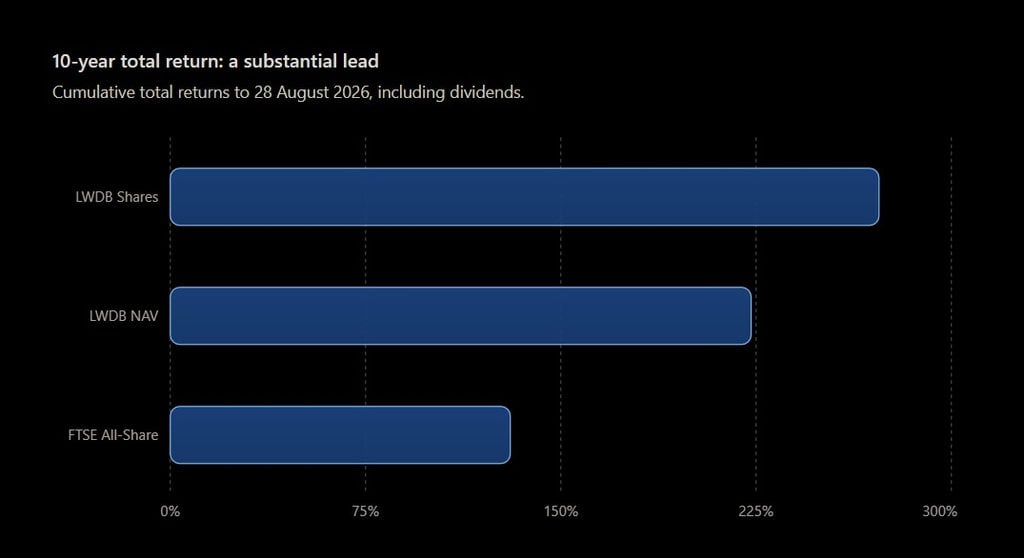
The 10-year record is striking: the share price total return of 272% is more than double the benchmark’s 130.6%. Put another way, £10,000 invested at the beginning of the period would have grown to approximately £37,220, against £23,060 for an equivalent investment tracking the benchmark, assuming reinvestment of income and ignoring charges and tax.
Over three and five years, both the share price and fair-value NAV have also beaten the benchmark. This suggests the result is not solely a consequence of investors becoming more enthusiastic about the shares: underlying NAV growth has contributed materially.
There are two qualifications. First, share price returns and NAV returns are different measures. Shares can trade above or below NAV, affecting shareholder returns independently of portfolio performance. Second, the comparison is backward-looking. A strong record does not guarantee future outperformance, especially if the trust’s value-oriented holdings fall out of favour or UK equities lag global markets.
5. Dividends: a long record, but a modest yield
Law Debenture has a particularly strong income history. It reported 47 consecutive years of increasing or maintaining its dividend in its 2025 annual results. Its dividend rose from 29p in 2021 to 35.5p in 2025.
| Financial year | Annual dividend | Annual growth |
| 2021 | 29.0p | 5.5% |
| 2022 | 30.5p | 5.2% |
| 2023 | 32.0p | 4.9% |
| 2024 | 33.5p | 4.7% |
| 2025 | 35.5p | 6.0% |
| 2026* | ~37.625p implied | ~6% implied |
*2026 figure is an indicative annual amount, not a confirmed full-year dividend. The board declared a second interim dividend of 8.875p on 22 September 2026, payable on 23 October. The final dividend is expected to be announced in March 2027.
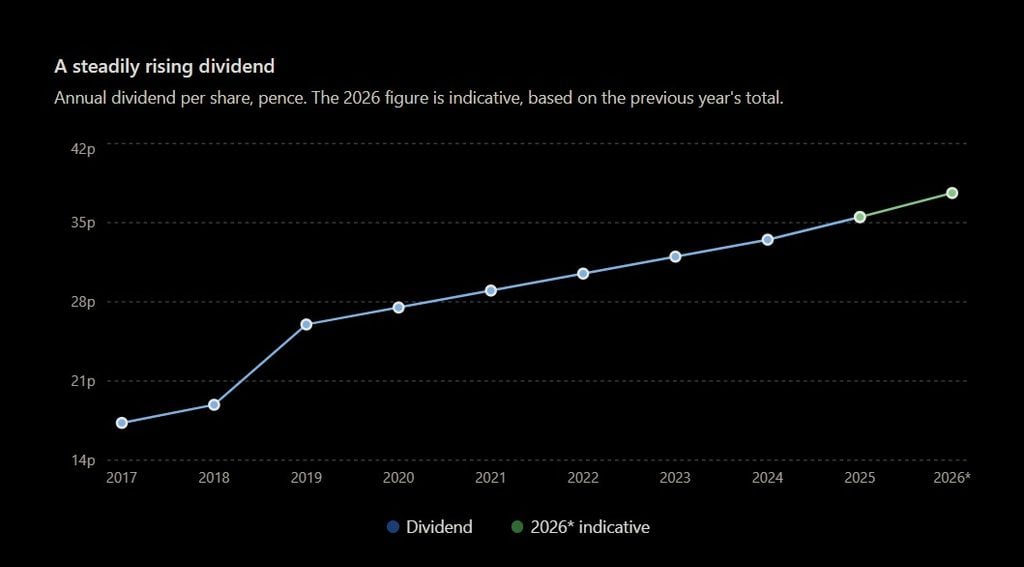
At a share price of £12.20 — the closing price reported on 14 October 2026 — a 37.625p annual dividend implies a yield of approximately 3.1%. This is an indicative calculation, not a live market quote or guaranteed yield.
That yield is not especially high for an income-focused investor. The appeal is the combination of income growth and capital appreciation rather than maximising today’s cash payout.
There is also evidence of dividend cover. For 2025, group revenue return was 37.26p per share against a 35.5p dividend, equivalent to cover of approximately 1.05x. That provides a modest buffer, but not an unlimited one. Future dividends still depend on portfolio income, IPS profitability, costs and board policy.
For UK investors using a Stocks and Shares ISA or SIPP, dividends can be reinvested or taken as income within the account’s applicable tax rules. The account wrapper does not remove the underlying investment risk.
6. Management changes: what happens when James Henderson leaves?
Laura Foll becomes lead portfolio manager – Transition planned for June 2027
Laura Foll, who has co-managed Law Debenture since 2019 and worked on the portfolio since 2011, will take responsibility for the investment portfolio following James Henderson’s retirement from Janus Henderson in June 2027.
Henderson’s departure marks the end of a remarkable period. The company reported that NAV total return since he took over lead management responsibilities in 2003 reached 1,288%, compared with 546% for the FTSE All-Share over the same period.
The succession is less disruptive than it might initially appear. Foll has extensive knowledge of the portfolio and will retain the support of Janus Henderson’s Global Equity Income team. The board has explicitly stated that there will be no change to the investment objective or strategy.
What might change? Foll will inevitably make her own judgements on individual holdings, valuations and portfolio construction. Over time, the balance between value opportunities, income generation and growth could evolve. Investors should monitor changes in sector exposure, turnover and the treatment of companies facing structural disruption, including AI.
What is unlikely to change immediately? The fundamental framework: predominantly UK equities, bottom-up stock selection, valuation discipline, a long-term approach and the flexibility provided by IPS. The transition is therefore better viewed as a change in leadership within an established process than an announced strategic overhaul.
The key test will be whether Foll can preserve the discipline that underpinned the historic record while identifying the next generation of attractive investments. Past performance under Henderson is evidence of the strategy’s potential, not proof of future success under any manager.
7. Which retail investors might suit Law Debenture?
Long-term total-return investors
✔️ Good fit
Investors seeking a blend of capital growth and rising income, with a time horizon of at least five to ten years, may find the combination attractive. Its long-term benchmark record is a meaningful advantage, although not a promise of future outperformance.
Dividend-growth investors
✔️ Good fit
Those who value a history of maintaining or increasing distributions may prefer LWDB to a fund focused solely on the highest current yield. The trade-off is a relatively modest yield of around 2.8% on the indicative figures used here.
Investors seeking UK diversification
⚖️ Potential fit
LWDB can provide a differentiated UK equity allocation through its combination of listed shares and IPS. However, investors who already have substantial UK exposure through work pensions, funds or individual holdings should consider the risk of further concentration.
Investors needing high immediate income or capital security
🚫 Less suitable
A yield below 3% may disappoint those seeking a high income today. Investors who cannot tolerate equity-market falls, gearing or fluctuations in the share price should also look elsewhere for their core capital-security needs.
Sharesify investor verdict
Law Debenture offers an unusually compelling combination of a strong long-term equity track record, a growing dividend and an operating business that helps support income and broadens its sources of earnings.
Its strongest argument is not the current yield, but the potential for long-term total returns. The IPS business gives it a structural point of difference from conventional investment trusts, while its value-conscious investment style can offer opportunities when UK shares are out of favour.
The main risks are that UK equities underperform, the operating business encounters difficulties, gearing magnifies losses or the manager transition changes investment decisions for the worse. A strong historic record should not be mistaken for a low-risk investment.
For a retail investor building a diversified ISA or SIPP portfolio, LWDB is very much worth considering as a long-term UK equity holding with an income-growth bias. It is less compelling for someone whose overriding priority is a high starting yield or global diversification in a single holding.
Disclaimer: The author Steven Frazer has a personal interest in Law Debenture.
You might also like:
