



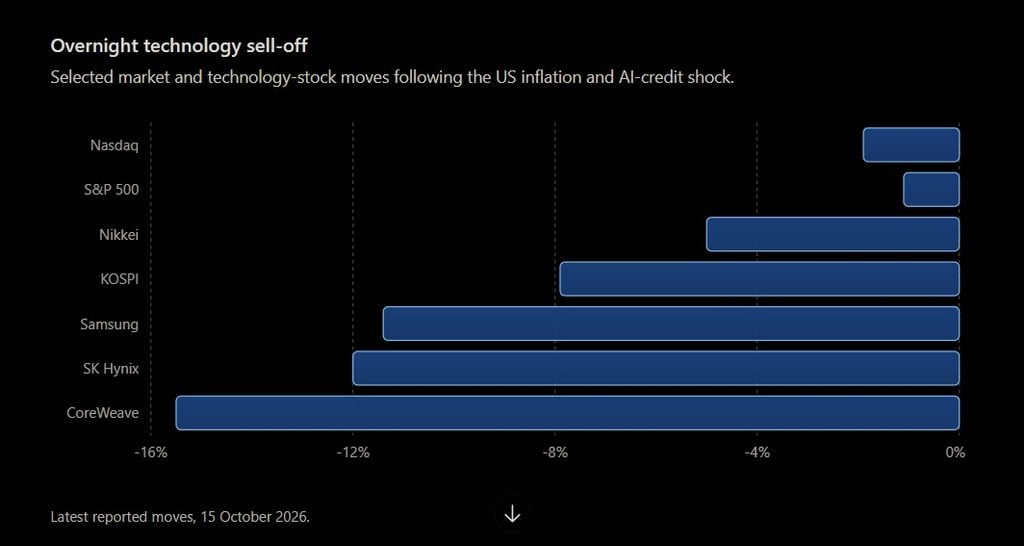
The overnight sell-off in US and Asian technology stocks is less about investors suddenly losing faith in AI demand and more about the cost of financing the AI boom.
The trigger was a combination of a hotter-than-expected US inflation report and a sharp deterioration in sentiment towards CoreWeave’s (NASDAQ:CRWV) debt-heavy business model. That matters because the AI infrastructure boom is being financed with enormous amounts of corporate debt.
The sell-off in numbers
| Market/stock | Latest move |
| Nasdaq Composite | -1.9% |
| S&P 500 | -1.1% |
| South Korea KOSPI | -7.9% |
| Japan Nikkei 225 | -5.0% |
| Samsung Electronics | -11.4% |
| SK Hynix | -12.0% |
| CoreWeave | -15%+ |
| ASML | -5%+ in Europe |
Asian markets extended the US sell-off, with semiconductor-heavy South Korea particularly badly hit.
CoreWeave: the bond market is sending the warning
CoreWeave has become the focal point because its equity and corporate bonds have sold off together.
Its 9.625% 2032 bonds have recently traded at yields around 14.8%-15%, versus their 9.625% coupon. The company’s shares fell more than 15% on Wednesday. CoreWeave has accumulated roughly $50bn-plus of debt and lease obligations, making its funding costs crucial to the investment case. Quartz
CEO Mike Intrator attempted to reassure employees, describing the market reaction as ‘irrational’ and arguing that CoreWeave’s roughly $104bn backlog is sufficient to support its debt obligations.
But that reassurance may highlight the central issue for investors: a huge backlog is not the same thing as high returns on capital. AI infrastructure requires enormous upfront spending on GPUs, data centres and power. If the cost of debt rises faster than revenues and cash generation, equity returns can deteriorate even while demand remains strong.
Why the bond market matters to shareholders
The relationship is straightforward:
Higher bond yields → higher corporate borrowing costs → lower future cash flows → lower valuations for equities.
That relationship is particularly powerful for companies such as CoreWeave, Oracle (NYSE:ORCL), data centre operators and other AI infrastructure businesses because they require substantial external financing.
It is also why investors are watching other corporate bonds, rather than simply CoreWeave shares.
Oracle, for example, saw its shares fall sharply while the yield on its 6.25% 2032 bonds rose to about 7.24%. Nebius (NASDASQ:NBIS), Dell (NYSE:DELL) and other AI infrastructure-related companies were also hit.
The concern isn’t that these companies are all about to default. Rather, investors are asking whether the return on incremental AI investment will justify increasingly expensive capital.
Then came the CPI shock
US September CPI rose 3.7% year-on-year, well above the Federal Reserve’s 2% target. Core CPI rose 2.6%, also slightly above expectations. The Fed had already lifted rates to 3.75%-4.00% in September.
The inflation surprise increased expectations that another hike could be required, with markets moving towards roughly even odds of an October increase and growing expectations of a December hike.
This creates a particularly uncomfortable environment for expensive-growth technology:
| Driver | Investor implication |
| Hotter CPI | Higher-for-longer rates |
| Higher rates | More expensive corporate debt |
| Rising credit spreads | Greater refinancing risk |
| AI capex | More funding required |
| Higher discount rate | Lower value placed on future profits |
| CoreWeave bond sell-off | Warning about debt-funded AI models |
AI corporate bond watchlist — 15 October 2026
| Company | Representative bond | Coupon | Maturity | Approx. current yield | Credit-risk signal |
| CoreWeave | 9.625% senior notes | 9.625% | 2032 | ~14.8–15.1% | 🔴 Distressed |
| CoreWeave | 9.75% senior notes | 9.75% | 2031 | ~14.9% | 🔴 Distressed |
| Nebius | 0.50% convertible notes | 0.50% | 2030 | Convertible | 🟠 High growth/funding risk |
| Nebius | 4.50% convertible notes | 4.50% | 2034 | Convertible | 🟠 High growth/funding risk |
| Oracle | Senior corporate debt | — | Various | ~6–7% range | 🟠 Rising risk |
| Meta | Long-dated corporate debt | 4.65% | 2062 | ~7.3% | 🟡 Investment grade, but AI funding pressure |
| Alphabet | 4.50% corporate bond | 4.50% | 2035 | ~5.7% | 🟢 Strong balance sheet |
| Microsoft | 5.20% corporate bond | 5.20% | 2039 | Market yield around 5–6% | 🟢 Strong balance sheet |
| Amazon | 3.875% corporate bond | 3.875% | 2037 | Market yield around 5–6% | 🟢 Strong balance sheet |
| Nvidia | Investment-grade corporate debt | — | Various | ~5–6% range | 🟢 Strong balance sheet |
Important: yields move continuously with bond prices, so these should be treated as indicative market levels rather than executable quotes. The CoreWeave figures are the clearest current datapoints: its 2032 notes have traded at yields close to 15%, while its 2031 notes have been around 15%.
Nebius is slightly different. Its August $5bn convertible issue comprised $3bn of 0.5% 2030 notes and $2bn of 4.5% 2034 notes. Because these are convertibles, their pricing cannot be interpreted in the same way as conventional corporate bonds.
For comparison, Alphabet’s 2035 bond is currently quoted around 5.7%, while Meta’s very long-dated 2062 bond is around 7.3%.
The number that really matters
The most revealing comparison is CoreWeave versus the hyperscalers:
| Issuer | Approx. bond yield | Interpretation |
| Microsoft | ~5–6% | Funding remains relatively cheap |
| Alphabet | ~5.7% | Strong credit despite huge AI capex |
| Amazon | ~5–6% | Higher funding cost, but investment-grade |
| Meta | ~7.3% on ultra-long debt | Investors demand more for duration/capex |
| Oracle | ~6–7%+ | Increasing scrutiny of AI capex and leverage |
| CoreWeave | ~15% | Credit market is pricing substantial risk |
That ~15% versus ~5–7% gap is arguably more useful to UK retail investors than simply looking at the share price sell-off.
CoreWeave’s bonds have moved into territory normally associated with distressed credit, with its CDS costs also surging. Reuters reports CoreWeave’s CDS spread above 1,000 basis points, while Oracle’s reached a record 288bp.
Meanwhile, the broader AI financing boom is enormous: Alphabet (NASDAQ:GOOG), Amazon (NASDAQ:AMZN), Meta (NASDAQ:META) and Oracle alone had issued more than $228bn of bonds by 13 October, according to LSEG data cited by Reuters.
Important distinction
Don’t interpret CoreWeave’s 15% yield as meaning Microsoft (NASDAQ:MSFT), Alphabet or Nvidia (NASDAQ:NVVDA) face the same financial risk. They don’t.
The more interesting question is whether CoreWeave represents the high-risk end of a much bigger AI credit cycle.
If bond yields continue rising, watch:
CoreWeave → Oracle → Meta/Amazon → investment-grade hyperscalers → AI equipment suppliers
The further that stress moves up this chain, the more seriously equity investors should question whether AI capex is generating sufficient returns.
And that is why corporate bond yields may currently be one of the best early-warning indicators for the AI trade.
What this means for UK retail investors
The important distinction is between AI demand and AI financing.
TSMC (NYSE:TSM) and ASML (AMS:AMSL) can continue reporting powerful AI demand while investors simultaneously become more sceptical about companies financing expansion with heavy debt. Indeed, ASML’s latest results pointed to strong demand extending towards 2030.
ASML Earnings: AI demand surges, but has valuation peaked?
So, this looks less like an immediate collapse in the AI investment theme and more like a repricing of its risk.
For UK investors, the lesson is to look beyond revenue growth. When assessing AI beneficiaries, examine net debt, interest expense, free cash flow, capex and the cost of refinancing.
Sharesify investor verdict
The overnight sell-off is a warning that the next phase of the AI trade may be determined not simply by who has the best technology, but by who can finance the enormous AI build-out at attractive returns. CoreWeave’s bonds are currently providing one of the clearest signals of where that risk lies.
Disclaimer: The author Steven Frazer has a personal interest in Nvidia.
You might also like:
