



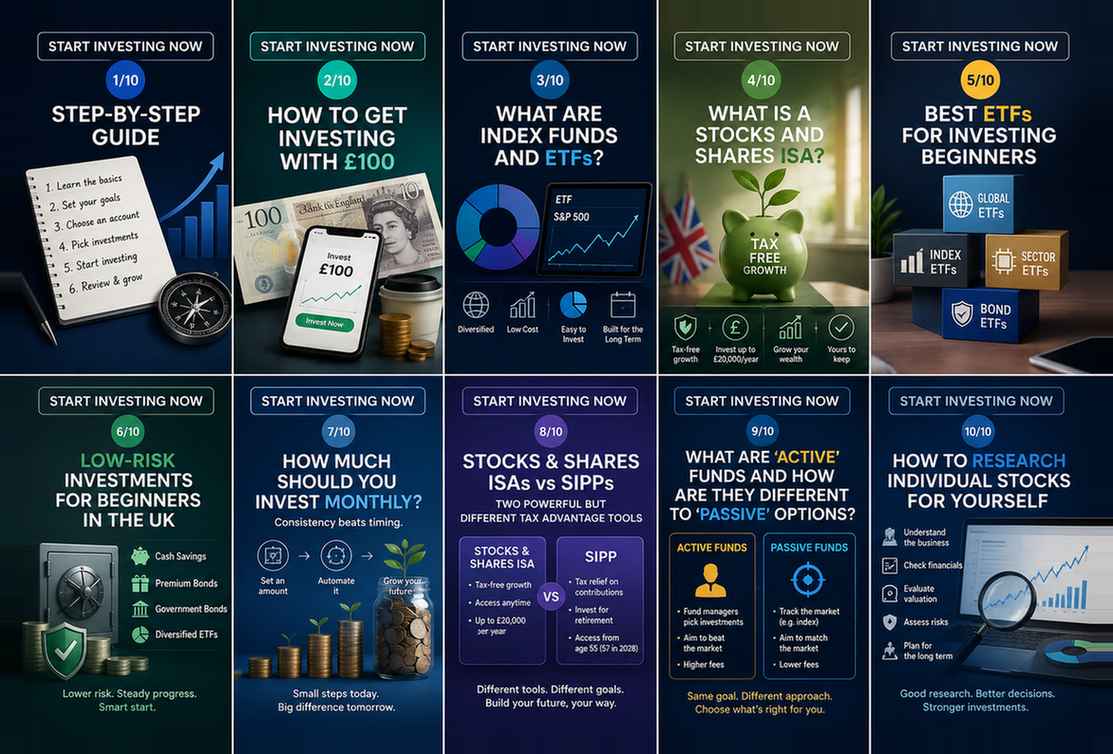
In the UK, individuals are encouraged to save and invest for the future through a range of tax‑advantaged schemes. Two of the most important and widely used are the Stocks and Shares Individual Savings Account (ISA) and the Self‑Invested Personal Pension (SIPP).
Both allow you to invest in assets such as shares, funds, and bonds, and both offer significant tax benefits. However, they are designed for different purposes, have different rules, and suit different time horizons.
This article explains what a Stocks and Shares ISA is, what a SIPP is, and how they differ, so you can understand how each fits into long‑term financial planning.
💡What is a Stocks and Shares ISA?
A Stocks and Shares ISA is a type of Individual Savings Account that allows you to invest money in financial markets in a tax‑efficient way. ISAs were introduced by the UK government to encourage saving and investing by offering favourable tax treatment.
🧩 How it works
When you invest through a Stocks and Shares ISA, your money can be placed into assets such as:
- Individual company shares
- Investment funds (e.g. unit trusts, OEICs, ETFs)
- Investment trusts
- Corporate and government bonds
👉 The key feature of an ISA is that all returns are tax‑free. This means:
- No income tax on dividends
- No capital gains tax when investments are sold
- No tax on interest earned
🧠 Annual allowance
Each tax year, you can contribute up to a set ISA allowance (currently shared across all ISA types, such as Cash ISAs and Stocks and Shares ISAs). You can invest the full allowance in a Stocks and Shares ISA if you wish or split it across different ISAs.
Importantly, contributions are made from after‑tax income—you do not receive any initial tax relief when you put money in.
🧩 Access to money
One of the biggest advantages of a Stocks and Shares ISA is flexibility. You can usually access your money at any time without paying tax or penalties, although the value of investments can go down as well as up.
👉 This makes ISAs suitable for:
- Medium‑ to long‑term investing
- Saving for goals before retirement (e.g. a house deposit, school fees)
- Building wealth alongside other savings
🚫Risk and time horizon
Because Stocks and Shares ISAs invest in markets, they carry risk. As a result, they are generally more suitable for money you can leave invested for at least five years, giving markets time to recover from short‑term volatility.
💡What is a SIPP?
A Self‑Invested Personal Pension (SIPP) is a type of personal pension that gives you greater control over how your retirement savings are invested. Like other pensions, its primary purpose is to provide income in later life, rather than flexible access at any time.
🧩 How it works
With a SIPP, you can invest in a broad range of assets like those available in a Stocks and Shares ISA, including:
- Shares
- Funds and ETFs
- Bonds
- Commercial property (in some SIPPs)
👉 What distinguishes a SIPP is how it is taxed, both when you contribute and when you withdraw.
💰 Tax relief on contributions
Contributions into a SIPP benefit from pension tax relief:
- If you are a basic‑rate taxpayer, for every £80 you contribute, the government adds £20
- Higher‑ and additional‑rate taxpayers may be able to claim extra relief through their tax return
👉 This means pensions are effectively funded using pre‑tax income, making them extremely tax‑efficient for long‑term saving.
📈 Growth within the SIPP
Like ISAs, investments inside a SIPP grow largely free of UK tax:
- No capital gains tax
- No UK income tax on most investment growth
🧩 Access to money
A major difference from ISAs is restricted access. You normally cannot access a SIPP until you reach the minimum pension access age (currently 55, rising to 57 in 2028). This provides you with built-in wealth creation discipline, because SIPP money is tied up for the long-term, so it forces you to resist any temptation to dip in to the cash in the short-term.
When you do access it:
- Up to 25% of your pension is usually available tax‑free
- The remaining amount is typically taxed as income when withdrawn
👉 Because withdrawals may be taxed, pensions are often more tax‑efficient during accumulation than during retirement, depending on your circumstances.
🧠 Role in retirement planning
A SIPP is primarily used to:
- Build income for retirement
- Reduce income tax while working
- Benefit from long‑term compounding with tax advantages
⚖️ Key Differences Between a Stocks and Shares ISA and a SIPP
While ISAs and SIPPs may look similar on the surface, they differ in several fundamental ways.
🧭 Purpose
- Stocks and Shares ISA: General longer-term investing and saving, flexible goals
- SIPP: Specifically designed for retirement income
🔁 Access
- ISA funds can usually be accessed at any time
- SIPP funds are locked away until retirement age
💰 Tax treatment on contributions
- ISA contributions receive no tax relief
- SIPP contributions receive tax relief at your marginal rate
🏦 Tax treatment on withdrawals
- ISA withdrawals are entirely tax‑free
- SIPP withdrawals (beyond the tax‑free portion) are usually taxable as income
💰 Contribution limits
- ISAs have a single annual allowance shared across ISA types
- SIPPs have their own annual pension allowance and additional lifetime limits (depending on current legislation)
⚖️ Suitability
- ISAs suit flexibility and shorter‑term access
- SIPPs suit long‑term, discipline‑based retirement saving
🔁 How People Often Use Them Together
Many UK investors use both a Stocks and Shares ISA and a SIPP as part of a broader strategy:
- A SIPP for retirement, benefiting from tax relief while working
- An ISA for bridging income before pension age or for flexible spending
- ISAs can also be used in retirement to provide tax‑free income alongside pensions
👉 This combination allows investors to manage tax efficiency, flexibility, and timing more effectively.
🧠 Conclusion
A Stocks and Shares ISA and a SIPP are both powerful tools for UK investors, but they are designed for different purposes. A Stocks and Shares ISA offers flexibility and tax‑free growth with access at any time, making it suitable for medium‑ and long‑term goals. A SIPP is a highly tax‑efficient way to save for retirement, offering generous tax relief in exchange for locking money away until later life.
👉 Understanding how they work—and how they differ—helps individuals make informed decisions about saving, investing, and planning for the future.
Want to learn more? Read the next part of Sharesify’s 10-part ‘Start investing now’ simple guide… ‘ – What are ‘active’ funds and how are they different to passive options?’…
Revisit part 7: How much should you invest monthly?
You might also like: