


The optical networking market has become one of the most interesting sub-sector beneficiaries of the AI boom, transforming rapidly as a result. As hyperscalers build increasingly large AI clusters, the amount of data moving between GPUs is exploding. Copper connections increasingly struggle with the speed, distance and power requirements, pushing data centres towards optical transceivers, lasers and photonic components.
The market recently hit the headlines when US private equity firm Arlington Capital Partners agreed to buy British photonics firm Gooch & Housego in a £345.6m deal in July 2026.
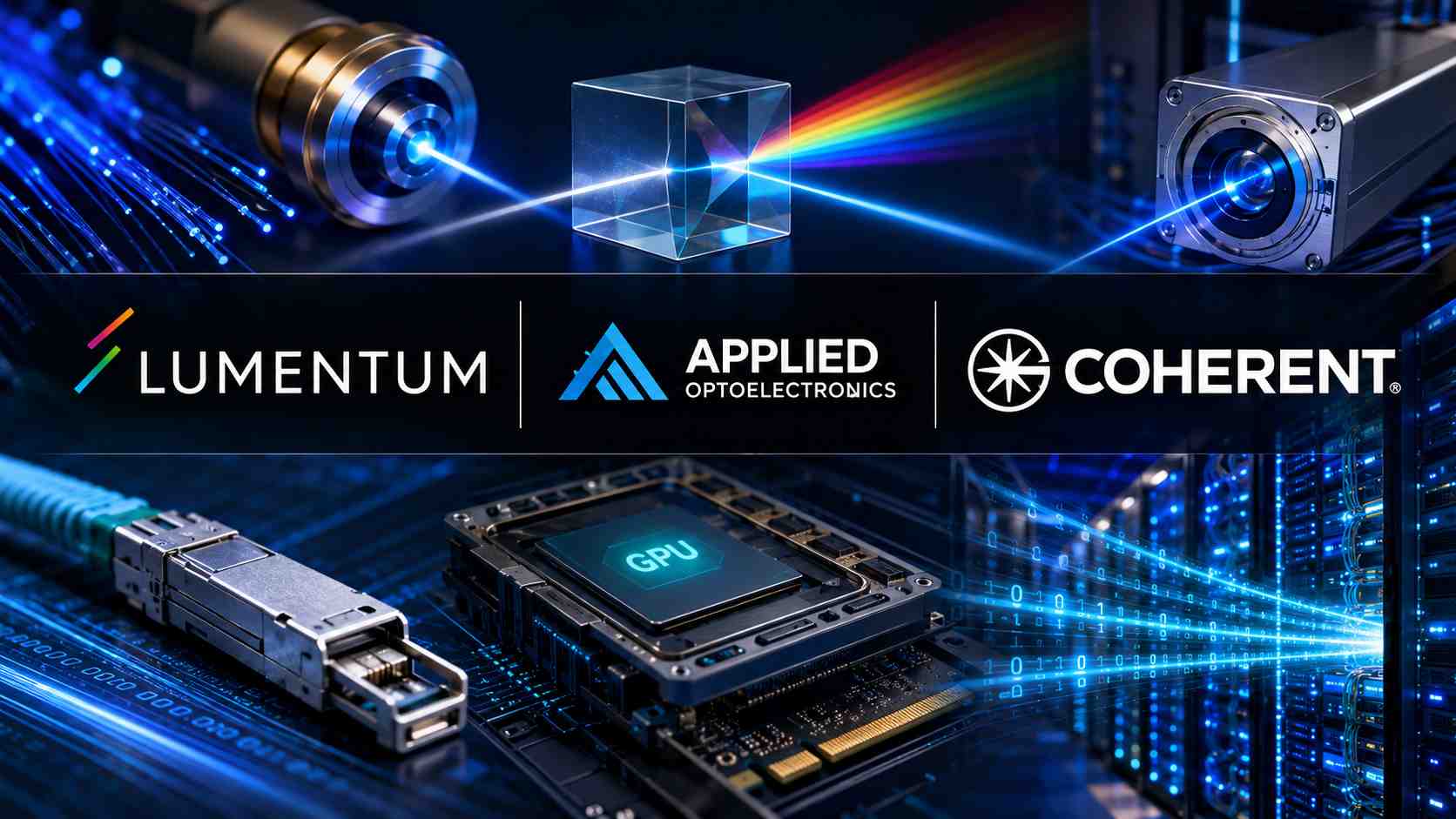
This creates a powerful investment theme for US-listed giants Lumentum (NASDAQ:LITE), Applied Optoelectronics (NASDAQ:AAOI) and Coherent (NYSE:COHR). But they offer very different risk/reward profiles.
Applied Optoelectronics investor relations
A simple ranking analysis for a UK retail investor today is:
- Coherent — best overall risk/reward
- Lumentum — best pure AI/optics momentum
- Applied Optoelectronics — highest-risk/highest-upside option
The investment case in one table
| Lumentum | Applied Optoelectronics | Coherent | |
| Ticker | LITE | AAOI | COHR |
| Core exposure | Lasers, optical components, transceivers | Optical transceivers/modules | Photonics, lasers, transceivers, materials |
| AI/data-centre exposure | Very high | Very high | Very high |
| Latest quarterly revenue growth | +109% | +86% | +34% |
| Latest revenue | $1.01bn | $191.9m | $2.05bn |
| Latest adjusted EPS | $3.23 | $0.06 | $1.74 |
| Latest adjusted gross margin | 50.4% | Lower/early-stage profitability | ~40% |
| Recent share price | ~$951 | ~$154 | ~$344 |
| Approx. equity value | ~$60bn | ~$9.2bn | ~$48bn |
| Forward valuation* | ~43.5x | ~48x | ~33x |
| Balance-sheet/scale | Strong | More leveraged to expansion | Stronger/diversified |
| Risk | High | Very high | High |
*Based on Stockopedia rolling 12 months forward basis.
The key point is that Lumentum is growing fastest, but Coherent gives investors considerably more scale and diversification for a still-demanding valuation.
1. Lumentum: the strongest AI optics momentum
Lumentum currently has the most spectacular financial trajectory of the three.
Fiscal Q4 revenue jumped 109% year-on-year to $1.01bn, while adjusted EPS rose 267% to $3.23. Adjusted gross margin reached 50.4% and adjusted operating margin was 36.6%. Management then guided to fiscal Q1 2027 revenue of $1.225bn-$1.275bn and adjusted EPS of $4.05-$4.35.
That is extraordinary growth for a company of Lumentum’s size.
The attraction is its exposure to several of the fastest-growing parts of optical infrastructure:
- 800G and 1.6T optical transceivers
- high-power lasers
- near-packaged optics (NPO)
- emerging co-packaged optics (CPO)
- AI data-centre connectivity
- cloud and hyperscaler networks
The company also has a major strategic relationship with Nvidia, which invested $2bn in Lumentum earlier this year.
That gives Lumentum an important credibility advantage with investors: it is not simply benefiting indirectly from AI spending; Nvidia is effectively helping to support its optical technology ecosystem.
The problem: expectations are enormous
Lumentum shares have risen close on 700% over the past year, according to recent market reports.
That means investors are already pricing in an extraordinary continuation of growth.
At roughly $944, simply annualising the midpoint of the latest $4.05-$4.35 quarterly EPS guidance produces approximately $16.80 annualised EPS — implying a valuation around 52x annualised earnings.
That is not necessarily excessive if earnings genuinely triple over the next few years. But it leaves little room for disappointment.
UBS has warned about supply-chain constraints, while Needham has argued that Lumentum has significant opportunities not yet incorporated into forecasts.
Verdict: outstanding business momentum, but arguably the hardest stock of the three to buy after such a dramatic re-rating.
2. Applied Optoelectronics: the high-octane option
Applied Optoelectronics is the most speculative of the three.
Its attraction is straightforward: it is becoming a much more focused supplier of optical transceivers for AI data centres.
Q2 revenue jumped 86% to $191.9m, with data-centre revenue reaching $107.7m, or 56% of total sales. The company also returned to adjusted profitability, reporting EPS of $0.06.
The really interesting part is the product ramp.
Management is seeing strong demand for 800G and 1.6T transceivers, with 800G revenue more than doubling sequentially in Q2.
The company also has relationships with major hyperscalers including Amazon and Microsoft.
This creates a potentially explosive earnings trajectory if AI infrastructure spending continues.
Why the valuation looked deceptively cheap
AAOI has recently traded at on a PE below 30x projected earnings, substantially below Lumentum and Coherent.
But that all changed this month, after the stock’s 100%+ August 2026 rally. Investors should be careful.
Applied Optoelectronics is spending enormous amounts to build capacity. In the first half of 2026 it spent roughly $335m on property, plant and equipment, while operating cash flow was negative $74m.
That is a major difference from simply buying a high-growth software company.
The company is effectively betting that today’s AI demand justifies building tomorrow’s manufacturing capacity.
If it works, margins and earnings could rise dramatically.
If AI capex slows, customers delay deployments or the new capacity is underutilised, cash burn could become a major problem.
There is also greater customer concentration and considerably less financial scale than Lumentum or Coherent.
Verdict: potentially the biggest winner, but also the easiest to get badly wrong.
3. Coherent: the best all-rounder
Coherent is the most diversified company of the three and, arguably, offers the best risk-adjusted exposure to the optics boom.
Its latest fiscal Q4 produced $2.05bn of revenue, up 34%, while adjusted EPS rose to $1.74 from $1.00 a year earlier. Management expects approximately $2.3bn of revenue in the next quarter, with adjusted EPS of $1.85-$2.05.
The numbers are less spectacular than Lumentum’s, but the business is considerably larger in projected full year revenue terms.
Coherent supplies:
- optical communications
- lasers
- photonic components
- materials
- datacentre connectivity
- industrial applications
- communications infrastructure
That diversification matters.
It means an investor is not making quite such a binary bet on AI transceivers.
Coherent also has a major strategic relationship with Nvidia, while its manufacturing scale and broad photonics portfolio give it advantages when customers want multiple components from a single supplier.
Management says demand visibility is strong and the company is expanding capacity to meet AI infrastructure requirements.
The weakness: margins and capex
The downside is that Coherent has historically had lower profitability than a pure-play optics company.
Its Q3 fiscal 2026 adjusted gross margin was 39.6%, compared with Lumentum’s latest 50.4%.
And the company is investing heavily to expand production.
That creates a classic AI-infrastructure dilemma: revenue can grow rapidly while free cash flow remains under pressure because the company has to build capacity ahead of demand.
Nevertheless, the scale and diversification make Coherent easier to own through a volatile AI cycle.
Recent analyst estimates put fiscal 2027 adjusted EPS at roughly $9.20, implying a forward PE in the mid-30s at current share prices. Consensus estimates also point towards very strong earnings growth.
Verdict: not the fastest horse, but arguably the best combination of growth, technology breadth, scale and valuation.
Valuation: don’t confuse ‘cheaper’ with ‘cheap’
| Metric | Lumentum | Applied Optoelectronics | Coherent |
| Approx. recent price | ~$951 | ~$154 | ~$344 |
| Approx. forward PE* | ~43.5x | ~48x | ~33x |
| Revenue growth | +109% | +86% | +34% |
| Profitability | Strong and improving | Emerging | Improving |
| Cash-flow risk | Medium | High | Medium/high |
| AI optionality | Very high | Very high | Very high |
| Valuation risk | Very high | High | High |
| Balance-sheet/scale risk | Lower | Highest | Lower |
*Based on Stockopedia rolling 12 months forward basis.
The valuation picture is revealing.
AAOI looks the most expensive on earnings, and those earnings are at an early stage and the company is spending heavily to expand capacity.
Lumentum looks expensive, but its earnings are accelerating extraordinarily quickly.
Coherent offers a more modest (if still high) valuation that still assumes strong AI growth but does not require quite the same level of performance execution as Lumentum.
Bull vs bear cases
| 🐂 Bull case | 🐻 Bear case | |
| Lumentum | 1.6T, NPO and CPO adoption accelerates; laser shortages support pricing; Nvidia relationship drives share gains; margins move above 50% | AI capex slows; supply constraints prevent revenue conversion; CPO takes longer; valuation compresses sharply |
| Applied Optoelectronics | 800G/1.6T ramps dramatically; hyperscaler orders accelerate; new US capacity drives huge operating leverage; EPS explodes | Capex overwhelms cash generation; customer concentration bites; hyperscalers diversify suppliers; AI spending slows |
| Coherent | AI optical connectivity becomes structural; 6-inch InP manufacturing scales; Nvidia partnership deepens; earnings compound rapidly | Margins remain below peers; enormous capex produces disappointing returns; industrial/legacy businesses dilute growth; valuation de-rates |
What matters most for UK investors
There are three issues UK retail investors should consider before buying any of them.
1. These are not defensive technology stocks
All three are effectively leveraged plays on the AI infrastructure capital-spending cycle.
The recent performance demonstrates how quickly sentiment can change. Coherent, for example, fell sharply after its latest results despite beating expectations, illustrating how ‘good’ results are no longer necessarily good enough for highly valued AI stocks.
2. Currency matters
A UK investor buying these Nasdaq/NYSE shares is taking both equity risk and US dollar/sterling currency risk.
A 20% gain in the stock does not necessarily translate into a 20% gain in sterling.
3. ISA/SIPP availability
All three are US-listed rather than UK-listed. UK investors should check that their particular platform supports the security and understand dealing, FX and tax treatment before investing.
Investor verdict
The optical networking market has become one of the most interesting sub-sector beneficiaries of the AI boom and for a UK retail investor building a five-year+ AI portfolio, the sensible choice is arguably Coherent over Lumentum/Applied Optoelectronics.
Lumentum is arguably the better company on current operating momentum, while Applied Optoelectronics is the more asymmetric speculative bet.
But Coherent gives investors something important after the huge AI-stock rally of 2026: multiple routes to growth without relying quite so heavily on one product cycle.
Anthropic IPO: next mega-AI listing — opportunity or $1tn-$2tn leap of faith?
The biggest risk to all three is not that optical networking stops growing. It is that investors have already priced in too much of that growth.
That makes the next phase less about identifying the companies benefiting from AI — all three clearly are — and more about determining which company can grow earnings faster than its valuation rises.
🥇 Coherent — best overall
Best for: investors wanting a diversified way to play the optical AI infrastructure boom.
Coherent does not have Lumentum’s explosive growth rate, but its scale, technology breadth, manufacturing footprint and Nvidia relationship make the investment case more balanced.
🥈 Lumentum — best growth
Best for: investors prepared to pay a premium for the strongest current earnings momentum.
The latest numbers are exceptional. The problem is that the stock has already recognised much of the opportunity. A further major rerating requires earnings to continue massively exceeding expectations.
🥉 Applied Optoelectronics — best speculative upside
Best for: aggressive investors comfortable with substantial volatility.
AAOI could ultimately produce the highest percentage return if its 800G/1.6T ramp works and manufacturing scale creates operating leverage. But the balance sheet, capex requirements and customer concentration make it materially riskier.
You might also like: