




Streaming giant Netflix (NASDAQ:NFLX) is entering one of its most important earnings seasons in several years after its shares slumped around 20% year-to-date. That makes the stock one of the weakest-performing mega-cap technology stocks of 2026.
Unlike previous Netflix sell-offs, this decline has not been driven by collapsing subscriber numbers or deteriorating profitability. Instead, investors have become increasingly concerned that the company’s extraordinary growth story is maturing while the valuation still assumes many years of premium growth.
| Netflix (NASDAQ:NFLX) | Price: $73.53 (-19.2% YTD) | Market cap: $309.62bn |
With expectations now considerably lower than earlier in the year, Thursday’s Q2 results have the potential to become an important turning point.
Why has Netflix fallen around 20%?
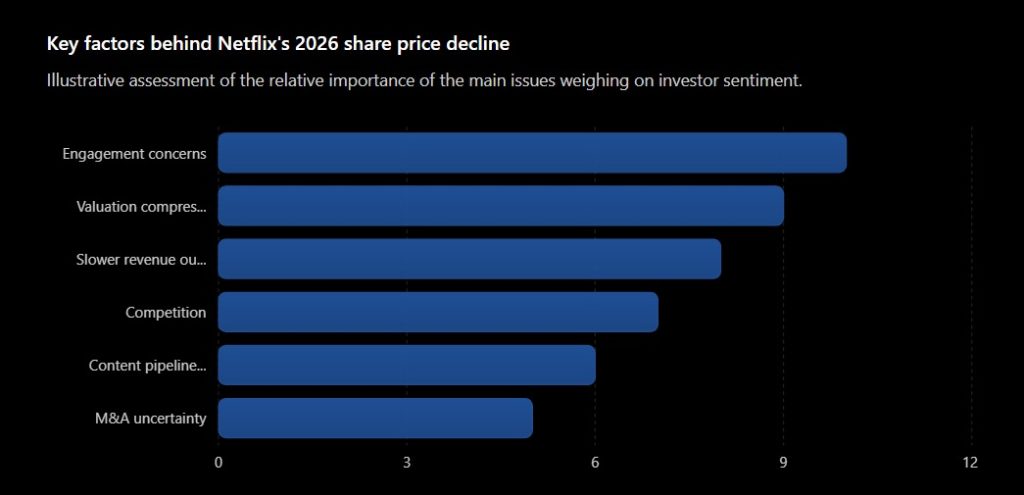
1. Engagement has become the biggest concern
Wall Street increasingly believes subscriber growth alone is no longer enough.
Instead, investors want evidence that existing subscribers are spending more time watching Netflix content, using its advertising tier and becoming less likely to cancel.
Recent analyst commentary suggests engagement metrics have softened compared with last year, raising questions over pricing power and long-term advertising opportunities.
Guidance, Hastings and margins… why Netflix stock took a pounding
2. Revenue growth is slowing
Consensus still expects healthy double-digit revenue growth.
However, it would represent one of Netflix’s slowest quarterly growth rates for some time.
For a company trading on a premium multiple, even modest deceleration can produce a significant valuation reset.
3. Valuation was expensive
Even after the correction, Netflix still trades above many traditional media companies on earnings and cash-flow multiples.
Earlier this year investors were willing to pay that premium because Netflix appeared almost immune from economic weakness.
Now markets are demanding stronger proof that growth can reaccelerate.
Several brokers have reduced price targets—not because they dislike the business—but because they believe the valuation had become stretched.
4. Questions over the content pipeline
Netflix remains heavily dependent on producing regular global hits.
Markets are questioning whether recent releases have matched the impact of previous blockbuster series.
Without major cultural events driving viewing hours, engagement naturally slows.
5. Strategic uncertainty
The company’s flirtation with large-scale media acquisitions earlier this year surprised investors who historically valued Netflix’s organic growth model.
Although Netflix ultimately stepped away, the episode raised questions over future capital allocation.
What does Wall Street expect?
| Metric | Q2 2026 Consensus |
| Revenue | ~$12.58bn |
| EPS | ~$0.79 |
| Revenue growth | ~13%-14% YoY |
| Operating margin | Expected to remain above 30% |
Source: Koyfin consensus
Consensus forecasts remain for another profitable quarter despite softer investor sentiment.
Five things markets will watch most closely
1. Advertising business
This could be the single biggest share-price driver.
Investors want evidence that:
- advertising revenue is accelerating
- advertiser demand remains strong
- monetisation per user continues improving
If management upgrades advertising expectations, sentiment could improve quickly.
2. Viewer engagement
Markets want reassurance that:
- viewing hours remain healthy
- churn remains low after price increases
- users continue adopting the advertising tier
Weak engagement commentary would likely outweigh an earnings beat.
3. Guidance
Forward guidance may matter more than Q2 results.
Investors want confirmation that management still expects:
- double-digit revenue growth
- expanding margins
- rising free cash flow
Any reduction would probably disappoint.
4. Content pipeline
Upcoming major releases could influence expectations for the second half.
Investors will listen carefully for commentary on:
- blockbuster franchises
- live programming
- international content
- gaming initiatives
5. Capital allocation
Markets will look for clarity around:
- share buybacks
- investment spending
- acquisition strategy
Investors generally prefer Netflix returning excess cash to shareholders rather than pursuing transformational acquisitions.
What could move the shares?
Bullish catalysts
✔ Better-than-expected advertising growth
✔ Strong engagement metrics
✔ Margin expansion
✔ Raised full-year guidance
✔ Positive commentary on second-half content
Bearish catalysts
✖ Weak engagement
✖ Slower advertising adoption
✖ Higher content spending
✖ Conservative outlook
✖ Signs price increases are hurting customer retention
What can Netflix do to reverse the share price decline?
1. Accelerate advertising
Advertising remains Netflix’s largest untapped profit opportunity.
If management demonstrates the business can become a multi-billion-dollar revenue stream, investors could begin valuing Netflix more like a digital advertising platform than a traditional media company.
2. Produce more global hit content
Nothing moves Netflix faster than blockbuster programming.
Repeated global successes improve:
- engagement
- retention
- pricing power
- advertising inventory
3. Expand live programming carefully
Netflix has already experimented with live sport and entertainment.
Adding selective premium events could increase viewing time without dramatically increasing costs.
4. Keep margins expanding
Netflix has become much more disciplined operationally.
Continued operating leverage would reassure investors that earnings can grow faster than revenue.
5. Maintain capital discipline
The market generally favours:
- buybacks
- organic investment
- measured acquisitions
rather than large transformational deals.
Analyst debate
The bullish case
Many analysts still argue Netflix possesses one of the strongest competitive positions in global media.
Positives include:
- unrivalled global scale
- strong free cash flow
- expanding operating margins
- significant advertising upside
- pricing power
- opportunities in live entertainment and gaming
Despite recent weakness, many analysts continue to rate the shares Buy, with consensus price targets implying meaningful upside from current levels.
The bearish case
More cautious analysts argue:
- engagement has peaked
- valuation remains demanding
- advertising expectations may be too optimistic
- competition for viewer attention continues increasing
- revenue growth could gradually slow into high-single digits
Recent price-target reductions largely reflect these valuation concerns rather than deteriorating fundamentals.
Is Netflix still expensive?
| Metric | Assessment |
| Revenue growth | Strong but slowing |
| Margins | Excellent |
| Free cash flow | Strong |
| Balance sheet | Healthy |
| Valuation | Still above media peers |
| Long-term growth potential | High |
Netflix arguably deserves a premium valuation given its combination of recurring revenue, global scale and improving profitability.
However, premium valuations require premium execution.
Investor verdict
Netflix entering one of its most important earnings seasons in several years but its’ 20% decline looks less like a collapse in fundamentals and more like a reset in expectations. The business continues to generate double-digit revenue growth, expanding margins and strong cash flow, but investors now want evidence that its next growth engine—advertising, deeper engagement and selective live programming—can offset a maturing subscription business.
For Thursday’s earnings, beating consensus EPS or revenue alone may not be enough. The decisive factors are likely to be advertising momentum, user engagement and management’s outlook for the second half of 2026. With options markets pricing an earnings move of roughly 7%-8%, any positive surprise on those qualitative measures could trigger a sharp relief rally, while another cautious outlook could extend what has already been a difficult year for the streaming giant.
You might also like:
