



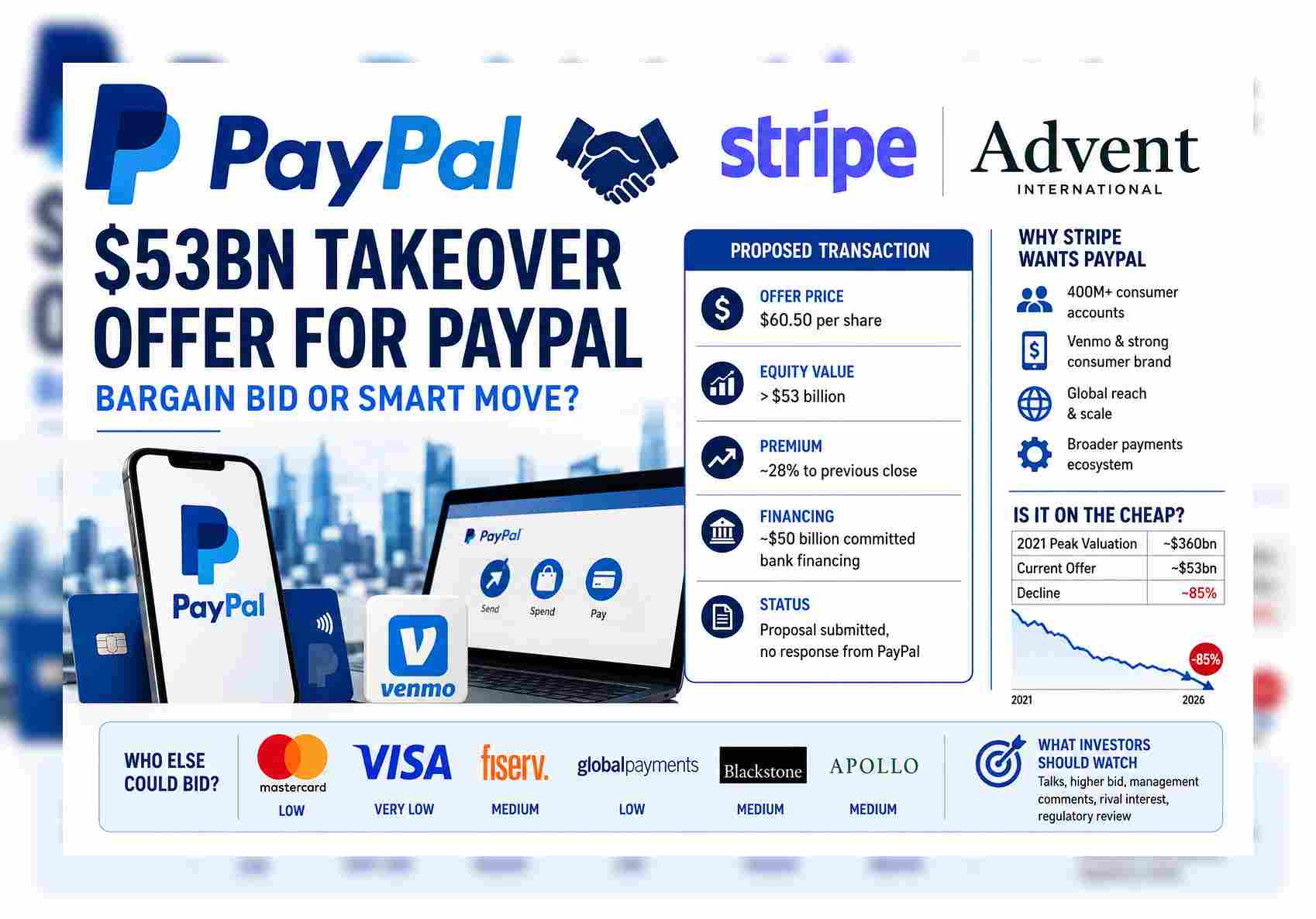
A surprise $53 billion joint takeover proposal from Stripe and Advent International has thrust PayPal (NASDAQ:PYPL) back into the spotlight. According to Reuters and the Financial Times, the consortium has offered $60.50 per share, around a 28% premium to PayPal’s previous closing price, with roughly $50 billion of committed bank financing already lined up. This appears to be a credible takeover proposal rather than unfounded market speculation, but PayPal has not responded and there is no confirmation that talks are underway, and there is no certainty a transaction will happen.
For UK retail investors, the key question is whether this is an opportunistic attempt to buy a struggling payments giant before its turnaround gains traction.
| PayPal (NASDAQ:PYPL) | Price: $47.37 (-18.5% YTD) | Market cap: $41.79bn |
Proposed transaction
| Item | Details |
| Buyers | Stripe + Advent International |
| Offer | $60.50 per share |
| Equity value | >$53bn |
| Premium | ~28% to previous close |
| Financing | ~$50bn committed bank financing |
| Status | Proposal submitted, no response from PayPal |
Is the bid real?
Unlike many market rumours, this report appears credible.
Reuters reports the offer was first discussed in April before being formally submitted earlier this month, with financing already arranged. That suggests this is more than speculative chatter. Nevertheless, it remains only an unsolicited proposal, and PayPal has not entered formal negotiations.
Is $53bn ‘on the cheap’?
Potentially yes.
PayPal was once among the world’s most valuable fintech companies.
| Period | Approximate valuation |
| 2021 peak | ~$360bn |
| Current offer | ~$53bn |
| Decline from peak | ~85% |
The enormous fall reflects:
- slower ecommerce growth after the pandemic
- stronger competition from Apple Pay, Google Pay and newer fintechs
- investor concerns over execution
- lower valuation multiples across fintech
However, today’s PayPal is still a highly profitable business with hundreds of millions of active accounts, significant free cash flow and valuable assets including Venmo, branded checkout, merchant acquiring and Braintree. Supporters of the company could argue that a successful turnaround would justify a materially higher valuation than $53bn.
PayPal plunges to 8-year low as CEO is dumped on feeble performance
Why Stripe wants PayPal
Strategically, the combination makes considerable sense.
Stripe dominates online merchant payments, particularly among developers and internet businesses.
PayPal would add:
- one of the world’s largest consumer payment networks
- Venmo
- over 400 million consumer accounts
- stronger international consumer reach
- larger merchant relationships
- additional AI and data opportunities
Instead of competing for merchants, the combined company could potentially offer a much broader payments ecosystem.
Why Advent is involved
Private equity brings three advantages:
- financial firepower
- operational restructuring expertise
- experience investing in payments businesses
Reuters reports the intention is not to break up PayPal but for Stripe and Advent to jointly own the company equally.
Reasons PayPal shareholders may reject the offer
Despite the attractive premium, there are several reasons to hold out.
1. New management
New CEO Enrique Lores only took charge earlier this year and has already launched a significant restructuring programme focused on AI, organisational simplification and renewed growth.
Selling before investors see whether the turnaround succeeds could crystallise value too early.
2. Premium may be too small
Although 28% looks generous against the latest share price, many long-term investors remember PayPal trading well above current levels.
If management believes earnings can recover over the next two to three years, $60.50 could prove insufficient.
3. Regulatory risk
A combination between two major global payments platforms would attract extensive antitrust scrutiny in both the US and Europe.
Long regulatory reviews increase execution risk.
Reasons shareholders might support a sale
Equally, there are compelling arguments in favour.
- Immediate cash premium.
- Increased competition has made future growth less certain.
- Fintech valuations remain well below pandemic highs.
- The payments industry is consolidating rapidly.
Investors accepting the bid eliminate execution risk associated with PayPal’s turnaround.
Could another bidder emerge?
Several names could theoretically have strategic interest, although each faces obstacles.
| Potential buyer | Likelihood | Main issue |
| Mastercard | Low | Competition concerns |
| Visa | Very low | Significant antitrust barriers |
| Fiserv | Medium | Financing size |
| Global Payments | Low | Integration following recent acquisitions |
| Blackstone/KKR consortium | Medium | Private equity interest possible |
| Apollo | Medium | Financial buyer with payments experience |
Large technology companies such as Apple or Google would almost certainly encounter overwhelming competition concerns.
What happens next?
Three broad scenarios appear most likely.
| Scenario | Probability (subjective) |
| PayPal rejects offer | High |
| Negotiations lead to higher bid | Medium |
| Current offer accepted | Low-Medium |
Given the recent management changes and ongoing turnaround, many analysts would expect PayPal’s board to seek a higher valuation before engaging seriously.
What UK retail investors should watch
The biggest indicators over coming weeks will be:
- whether PayPal confirms discussions
- any increase above $60.50 per share
- comments from management regarding standalone value
- interest from rival bidders
- regulatory commentary
Investor verdict
This appears to be a credible takeover proposal rather than unfounded market speculation, backed by financing and reported by multiple reputable outlets. However, it is far from a done deal, and PayPal has yet to indicate any willingness to engage.
For long-term investors, the debate comes down to one question: is PayPal a structurally challenged payments company worth around $53bn, or a temporarily out-of-favour fintech capable of delivering a successful turnaround?
The answer will determine whether this bid is remembered as a fair premium—or an opportunistic attempt to acquire one of fintech’s best-known franchises at a significant discount to its long-term potential.
You might also like:
