




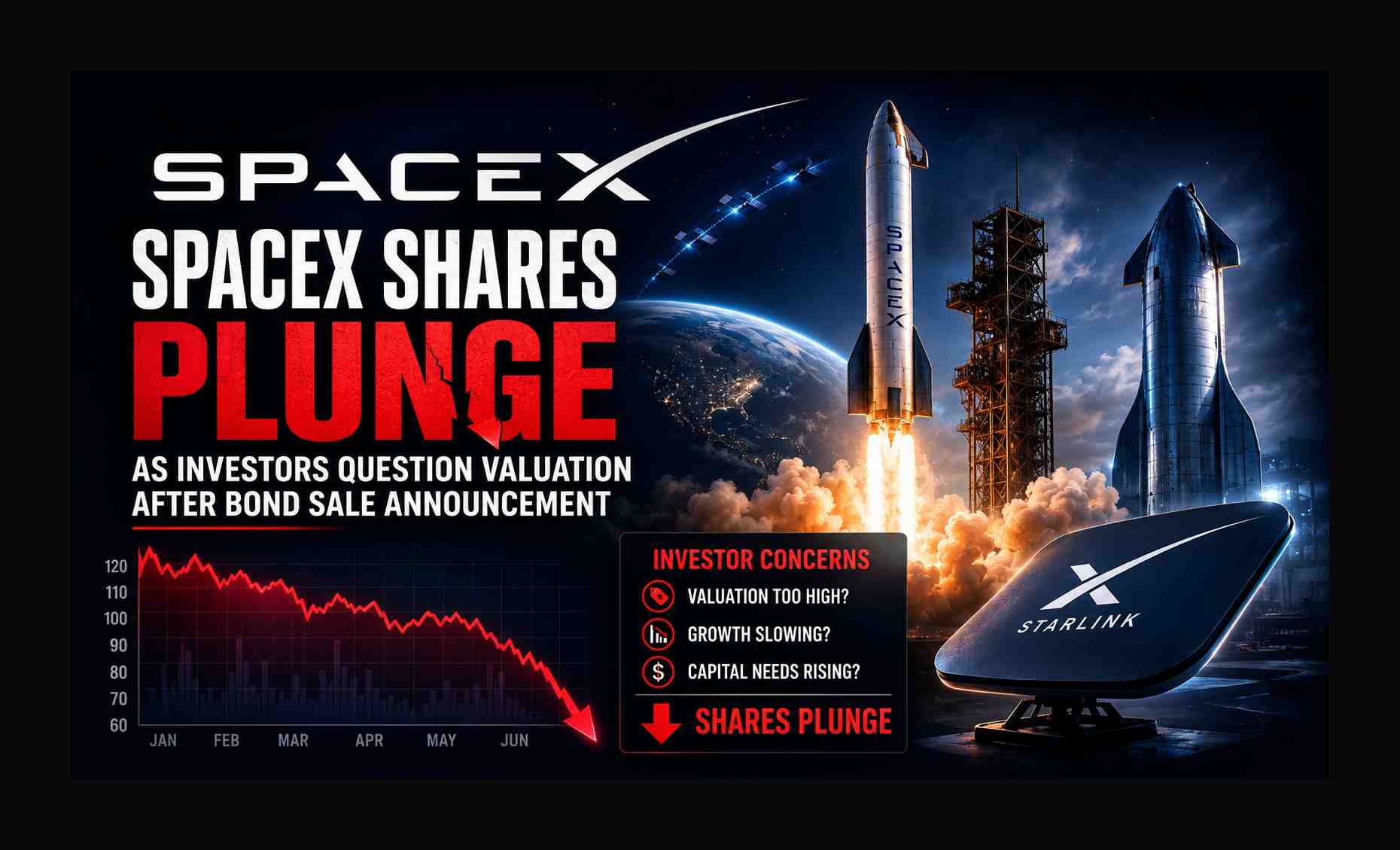
While the stock remains above its $135 IPO price, enthusiasm that briefly pushed SpaceX’s valuation close to $3 trillion has started to cool. This is because investors reassess the company’s fundamentals.
SpaceX: Does a $2.1 trillion valuation make sense?
Why did the shares fall?
The immediate catalyst was SpaceX’s announcement that it intends to issue investment-grade bonds. Reports suggest the offering could raise at least $20 billion. The proceeds will primarily refinance bridge loans used in the company’s merger with Elon Musk’s AI business xAI. They will also support broader corporate spending plans.
The move surprised some investors because SpaceX disclosed it already held approximately $100.8 billion of cash and equivalents following its IPO. That raised a natural question: if cash reserves are so substantial, why is additional borrowing required?
Valuation concerns move centre stage
The deeper issue is valuation.
| Metric | SpaceX |
| IPO price | $135 |
| IPO valuation target | ~$1.75 trillion |
| Peak market value after listing | Nearly $3 trillion |
| Current market value (22 June) | ~$2.0 trillion |
| 2025 revenue | $18.7 billion |
| 2025 net income | Loss-making |
| Cash balance | $100.8 billion |
Sources: Company filings, Reuters, market data.
Even after the recent decline, SpaceX trades at well over 100x trailing sales. This is a valuation that implies enormous future growth from Starlink, launch services, AI infrastructure and potentially Mars-related ventures. Analysts have noted that much of the investment case relies on future opportunities rather than current profitability.
Some private-market analysts valued the company between $780 billion and $1.6 trillion before the IPO. This highlights how aggressive public market pricing became during the first week of trading.
What analysts are saying
The bond sale itself is not necessarily a negative signal.
Adam Sarhan of 50 Park Investments argued that debt financing avoids shareholder dilution. It also allows Elon Musk to maintain control without issuing additional shares.
However, analysts at KeyBanc initiated coverage with a neutral stance, arguing that much of SpaceX’s long-term growth potential is already reflected in the share price. They want further evidence that programmes such as Starship can achieve commercial scale before becoming more constructive.
Meanwhile, market commentators have warned investors to expect ‘Tesla-like volatility’ because only a small percentage of shares are publicly traded. This makes the stock highly sensitive to news flow and investor sentiment.
Investor verdict
For UK retail investors, the latest decline looks less like a deterioration in the business. Instead, it looks more like a valuation reset.
SpaceX remains one of the world’s most exciting growth stories, combining dominant positions in launch services, satellite communications and AI infrastructure. However, at a market value above $2 trillion, investors are paying today for growth that may take many years to materialise.
The bond sale has reminded the market that SpaceX’s ambitions require extraordinary amounts of capital. While the company’s investment-grade credit ratings suggest lenders remain comfortable with the balance sheet, equity investors are beginning to demand stronger evidence. They want proof that future earnings can justify one of the richest valuations ever awarded to a newly listed company.
Shares in SpaceX suffered their sharpest decline since listing and the sell-off highlights that even exceptional businesses can be vulnerable when expectations become stretched. Long-term prospects remain compelling. However, near-term volatility is likely to remain very high as investors balance SpaceX’s transformational opportunities against an already enormous valuation.
You might also like: