




Advanced chip tech designer Advanced Micro Devices (NASDAQ:AMD) delivered another record quarter, comfortably beating Wall Street expectations and raising guidance. This underlines the view that AMD remains one of the world’s highest-quality advanced semiconductor companies.
However, after a huge rally in 2026, investors were looking for evidence that AMD is rapidly closing the gap with Nvidia (NASDAQ:NVDA) in AI accelerators.
| Advanced Micro Devices (AMD) | Price: $475.00 (-8.4% after-hours) | Market cap: $774.6bn |
The results reinforced AMD’s long-term growth story, but they were not enough to justify increasingly ambitious expectations, sending the shares sharply lower in after-hours trading on 4 August.
Q2 2026: Reported vs expected
| Metric | Reported | Consensus | Beat/Miss |
| Revenue | $11.54bn | ~$11.3bn | ✅ Beat |
| Adjusted EPS | $1.66 | ~$1.62 | ✅ Beat |
| Data Centre revenue | $6.72bn | ~$6.5bn | ✅ Beat |
| Gross margin (non-GAAP) | 56% | In line | ✔ |
| Q3 revenue guidance | ~$13.0bn | ~$12.5-12.6bn | ✅ Ahead |
Source: AMD, LSEG consensus.
Market reaction
Despite beating expectations and raising guidance, AMD shares plunged around 9% in after-hours trading as operational progress slammed the brakes on heady expectations.
The market’s reaction reflected valuation rather than fundamentals. AMD shares had already gained around 140% during 2026, meaning investors needed another major upward revision to AI revenue forecasts to fuel further optimism. Instead, management largely reaffirmed its existing AI growth narrative.
What management said
CEO Lisa Su did strike an optimistic tone.
She said:
‘We delivered an excellent quarter, with record revenue and profitability as Data Center revenue more than doubled year-over-year.’
She also added:
‘AI is driving a significant expansion in demand for compute across all of our markets.’
AMD also expects:
- Data Centre revenue to accelerate further during H2
- EPYC server processor demand to continue strengthening
- Instinct AI accelerator deployments to scale
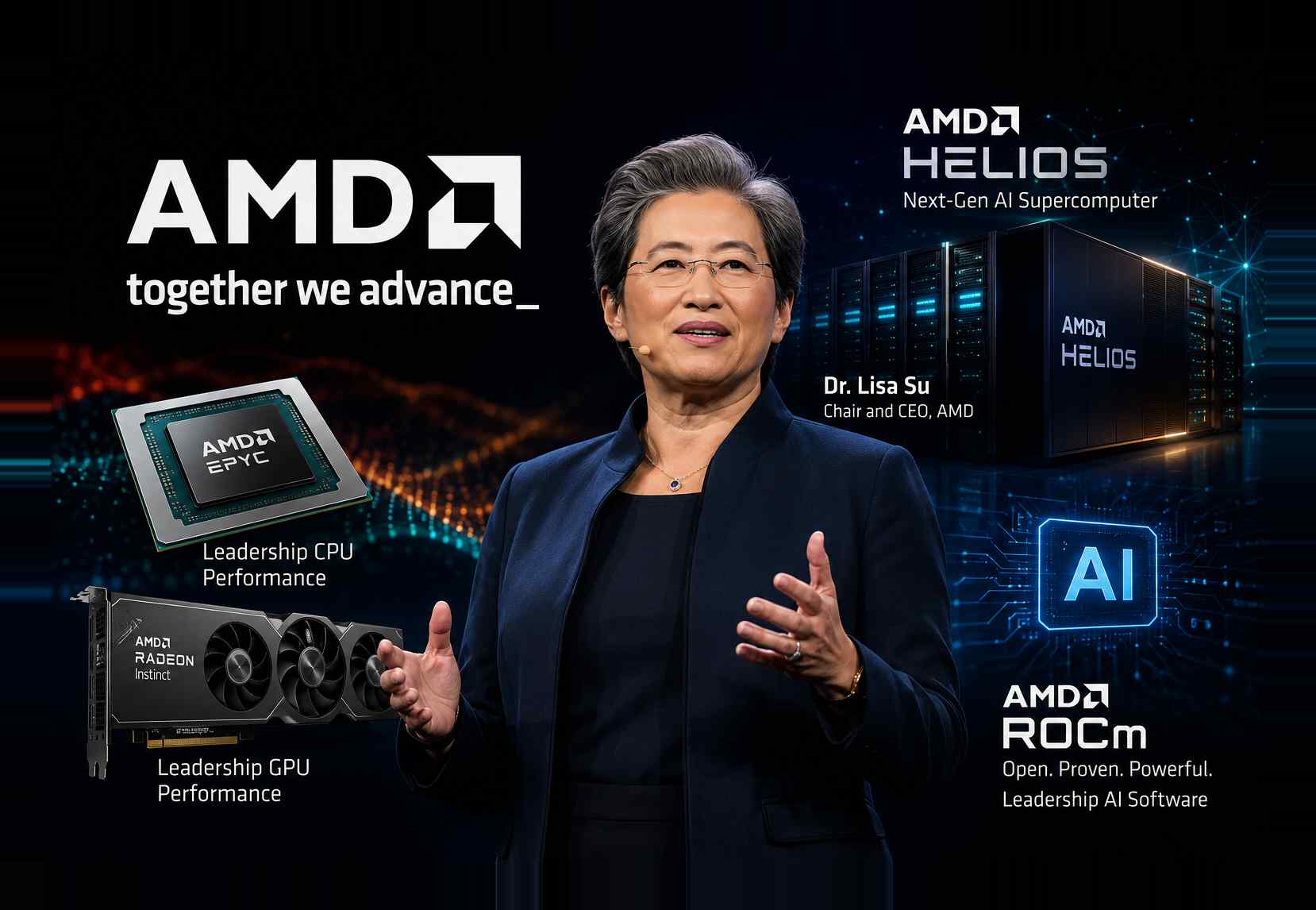
- Helios AI systems beginning volume production
Chief Financial Officer Jean Hu said Data Centre now represents 58% of company revenue, highlighting how quickly AMD has transformed from a PC chip company into a major AI infrastructure supplier.
CPUs remain AMD’s biggest competitive advantage
Although investors increasingly focus on GPUs, AMD’s greatest strength remains its server CPU business.
EPYC CPUs
AMD’s EPYC processors continue taking market share from Intel in enterprise servers.
Advantages include:
- lower power consumption
- higher core counts
- better cloud economics
- strong relationships with Microsoft Azure, AWS and Google Cloud
Server CPUs remain an enormous profit engine that generates cash to fund AMD’s AI ambitions.
GPUs
The AI accelerator market remains dominated by Nvidia.
AMD’s Instinct MI350 and forthcoming MI450 products continue improving, while Helios rack-scale systems represent the company’s most serious attempt yet to compete directly against Nvidia’s integrated AI infrastructure.
However, software remains the key challenge.
Although AMD’s open-source software stack ROCm has improved dramatically, CUDA (Nvidia’s own software stack) remains the industry’s preferred AI development ecosystem.
Opportunities
AI infrastructure spending
Hyperscalers continue investing hundreds of billions of dollars into AI infrastructure.
AMD is increasingly winning:
- Microsoft
- Meta
- Oracle
- OpenAI partners
- Anthropic
- Core Scientific
These wins demonstrate AMD is becoming a credible second supplier rather than merely an alternative.
CPU leadership
AMD continues gaining share from Intel (NASDAQ:INTC).
That business is highly profitable and provides steady cash generation regardless of GPU market volatility.
Intel Q2 earnings smash forecasts: is the AI turnaround already priced in?
Enterprise AI
Many companies prefer dual sourcing rather than relying entirely upon Nvidia.
That should continue benefiting AMD over the next several years.
Risks
Nvidia still dominates AI
Nvidia remains well ahead in:
- software ecosystem
- networking
- integrated systems
- developer adoption
AMD must continue closing that gap.
Expectations remain extremely high
Reuters described the quarter as ‘objectively good’, but noted investors had raised the performance bar dramatically following AMD’s huge share price rally.
Gaming weakness
Gaming revenue fell sharply as the console cycle matures.
While this matters less than previously, it still offsets some AI growth.
Cash flow versus investment
| Metric | Q2 2026 |
| Operating cash flow | ~$2.4bn |
| Free cash flow | ~$1.6bn |
| Cash & investments | ~$13.1bn |
AMD continues generating substantial free cash flow while increasing investment in AI products.
Unlike several competitors, AMD remains comfortably free cash flow positive despite rapidly expanding R&D spending. Capital intensity is also significantly lower than foundries such as TSMC (NYSE:TSM) because AMD operates as a fabless semiconductor designer.
Valuation versus global peers
| Company | Primary strength | Relative valuation* |
| NVIDIA | AI GPUs | ~26x Premium |
| AMD | CPUs + growing AI GPUs | ~46x High premium |
| Broadcom | Networking & AI ASICs | ~24x Premium |
| Intel | CPUs & foundry | ~54x Recovery premium |
| TSMC | Semiconductor manufacturing | ~23x Premium |
AMD now trades much closer to Intel’s recovery growth multiple than Nvidia’s dominant premium multiple.
That leaves relatively little room for disappointment.
Analyst reaction
Several analysts viewed the numbers positively but argued expectations had become excessive.
Reuters reported analysts described the results as:
‘Objectively good.’
However, many noted the stock had already priced in exceptionally strong AI momentum.
Yahoo Finance strategist Jared Blikre commented:
‘This was not an exceptional result.’
The implication was not that AMD disappointed fundamentally, but rather that investors had expected another major acceleration in AI revenue.
Before earnings, Stifel analyst Christopher Rolland highlighted AMD’s ‘two big engines’ of server CPUs and AI GPUs, while Jefferies analyst Blayne Curtis pointed to Helios systems as an important longer-term growth driver rather than an immediate earnings catalyst.
Bull case vs bear case
| 🐂 Bull case | 🐻 Bear case |
| Record revenue growth of 50% | Valuation already reflects exceptional AI growth |
| Data Centre revenue more than doubled | Nvidia still dominates AI software and GPUs |
| Strong EPYC CPU market share gains | Gaming business continues to decline |
| AI partnerships continue expanding | Helios revenue ramp takes time |
| Positive free cash flow funds growth | Investors expect larger quarterly AI upside |
Investor verdict
AMD remains one of the world’s highest-quality advanced semiconductor companies.
Its CPU franchise continues producing dependable cash flow while funding an increasingly competitive AI accelerator business. Long term, AMD looks well positioned to benefit from continued AI infrastructure spending.
However, following a spectacular share price rally, investors are demanding perfection. Q2 results showed AMD is executing well—but they did not materially change the long-term earnings outlook sufficiently to justify another immediate leg higher in the share price.
For UK retail investors, AMD still offers one of the best diversified ways to gain exposure to AI computing through both CPUs and GPUs. The key risk is no longer operational execution but valuation: with expectations already elevated, future upside will likely depend on AMD proving it can capture a meaningfully larger share of the AI accelerator market rather than simply continuing to deliver strong, predictable growth.
Disclaimer: The author Steven Frazer has a personal interest in Nvidia and Broadcom.
You might also like: