




AI cloud platform CoreWeave (NASDAQ:CRWV) delivered the kind of quarter bulls wanted to see — but it remains a high-risk, capital-intensive AI infrastructure stock. The Q2 evidence favours the bulls for now.
Revenue reached $2.575bn, up 112% year on year, narrowly beating the roughly $2.56bn consensus. Adjusted EBITDA was a much stronger $1.51bn, while adjusted operating income jumped to $128m from just $21m in Q1.
| CoreWeave (NASDAQ:CRWV) | Price: $107 (~+18.5% after-hours) | Market cap: ~$58.4bn |
More importantly, the revenue backlog reached approximately $104bn, while CoreWeave said it had secured another $25bn+ of net new customer commitments early in Q3.
The catch is the funding required to deliver that growth. Q2 capital expenditure was about $9.4bn, while full-year capex guidance has been increased to $35bn-$39bn. Operating cash flow of $679m was nowhere near enough to fund investment organically.
For UK investors, this is therefore less a conventional earnings story and more a bet on whether AI demand, pricing power and utilisation can grow faster than depreciation, debt and infrastructure spending.
Q2: beat, but not by a huge margin
| CoreWeave Q2 2026 | Actual | Expected | Verdict |
| Revenue | $2.575bn | ~$2.56bn | 🟢 Beat |
| YoY revenue growth | 112% | — | 🟢 Exceptional |
| Adjusted net loss | $567m | ~$677m | 🟢 Beat |
| GAAP net loss | $626m | — | 🔴 Still large |
| Adjusted EBITDA | $1.51bn | ~$1.43bn | 🟢 Beat |
| Adjusted EBITDA margin | 59% | ~55% | 🟢 Better |
| Adjusted operating income | $128m | ~$67m | 🟢 Strong beat |
| Operating margin | 5% | — | 🟢 Improving |
| Capex | ~$9.4bn | ~$8.2bn | 🔴 Higher |
| Revenue backlog | ~$104bn | — | 🟢 +246% YoY |
The revenue beat was modest, but the quality of the beat was better than the headline suggests. Adjusted operating income of $128m was substantially ahead of expectations and represented a major improvement from the $21m recorded in Q1.
That is important because investors have increasingly worried that CoreWeave could grow revenue while depreciation and financing costs consume the economics.
Management now appears to be showing evidence that operating leverage is beginning to emerge.
Share-price reaction
CoreWeave closed Tuesday at $90.32, up 2.4% during regular trading, but surged ~18.5% in after-hours trading following the results release.
That reaction tells us something important: investors were apparently more impressed by guidance, backlog and improving operating leverage than they were worried by the enormous increase in capex.
For UK investors, remember that US after-hours prices can be much less liquid and more volatile than the following regular session.
What management is saying
CEO Michael Intrator described Q2 as an ‘important inflection point’, arguing that CoreWeave’s scale is beginning to translate into operating leverage.
After the results, he was even more bullish, saying:
‘We outperformed our plan across the board.’
He also said that, with near-term capacity effectively sold out, CoreWeave was securing compute agreements on ‘increasingly favorable terms.’
That is potentially the most important statement in the results.
CoreWeave’s investment case depends on being able to pass some of the enormous cost of GPUs, power and datacentres through to customers. If demand exceeds available capacity, it has greater pricing power.
And that appears to be happening.
Capacity is the bottleneck
Active power increased by almost 500MW during Q2 to 1.5GW, while contracted power reached approximately 3.7GW.
CoreWeave also says more than half of its $104bn backlog relates to contracts where customer delivery has already begun.
That matters because the headline backlog is not simply $104bn of guaranteed near-term revenue. It is subject to delivery and availability requirements. Nevertheless, the proportion already entering delivery gives investors more confidence that it can eventually translate into reported sales.
Guidance: the biggest positive surprise
CoreWeave raised its outlook.
Q3 2026
| Metric | Q3 guidance | Analyst expectation |
| Revenue | $3.45bn-$3.60bn | ~$3.4bn |
| Adjusted operating income | $200m-$260m | ~$264m |
| Capex | $11.5bn-$13.5bn | — |
FY2026
| Metric | Previous | New |
| Revenue | $12bn-$13bn | $12.4bn-$13.2bn |
| Adjusted operating income | $900m-$1.1bn | $960m-$1.15bn |
| Capex | $31bn-$35bn | $35bn-$39bn |
The revenue upgrade is relatively small.
The more interesting change is profitability: adjusted operating income guidance increased despite the enormous investment programme.
Management expects operating margins to continue expanding and reach the low teens by Q4.
That is exactly what bulls needed to see.
Extraordinary backlog
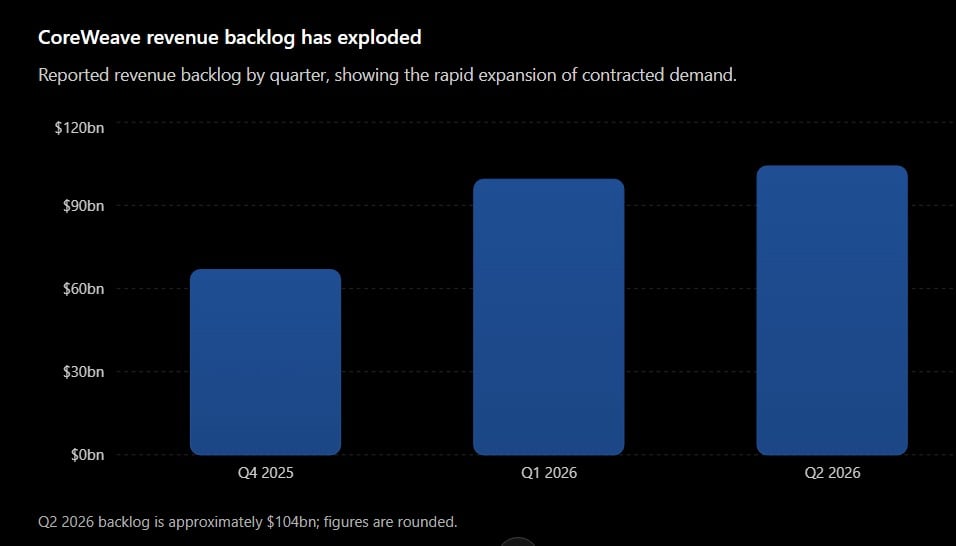
CoreWeave ended Q2 with approximately $104bn of revenue backlog, up from $99.4bn in Q1 and roughly 246% higher year on year.
Even more strikingly, that figure doesn’t include more than $25bn of new customer commitments secured in early Q3.
This creates an unusual situation.
Demand is not currently the obvious problem.
The problem is converting that demand into revenue quickly and profitably enough to justify the capital required.
CoreWeave’s role in the AI ecosystem
CoreWeave is essentially an AI-focused cloud infrastructure provider.
Instead of selling AI models like OpenAI or Anthropic, or GPUs like Nvidia, CoreWeave buys/finances the infrastructure required to run those workloads and rents computing capacity to customers.
Think of the ecosystem as:
Nvidia → GPUs → CoreWeave → AI compute → AI labs / enterprises
Its customers include major AI companies and enterprises, while Nvidia is strategically important both as a supplier and shareholder. CoreWeave also works with customers including Microsoft, Meta, Anthropic and a growing range of enterprises.
The opportunity is that AI companies need enormous amounts of GPU capacity before they can generate revenue from their own AI products.
CoreWeave effectively monetises that infrastructure bottleneck.
Next opportunity: inference
One of the most interesting developments is that CoreWeave is moving beyond simply renting GPU capacity for AI training.
Its managed inference business reportedly went from approximately $1m to more than $100m annualised revenue run-rate in a single quarter.
Inference is potentially a major long-term market because once AI models are trained, they must continually be run to answer queries, power agents and perform business tasks.
If CoreWeave captures a larger share of that workload, its addressable market becomes considerably bigger.
The company is also adding storage, networking, CPUs and software — potentially making its revenue mix more valuable than simply selling raw GPU hours.
But here’s the catch: cash flow
This is where the CoreWeave story becomes much more speculative.
Q2 operating cash flow was $679m.
Against that, the company reported approximately $6.42bn of purchases of property and equipment in the cash-flow statement.
That implies quarterly free cash flow of roughly:
$679m − $6.42bn = approximately -$5.74bn
For the first half:
$3.66bn operating cash flow − $14.12bn capex = approximately -$10.45bn FCF.
So while the adjusted EBITDA number looks spectacular, CoreWeave is not yet generating the cash needed to finance its own expansion.
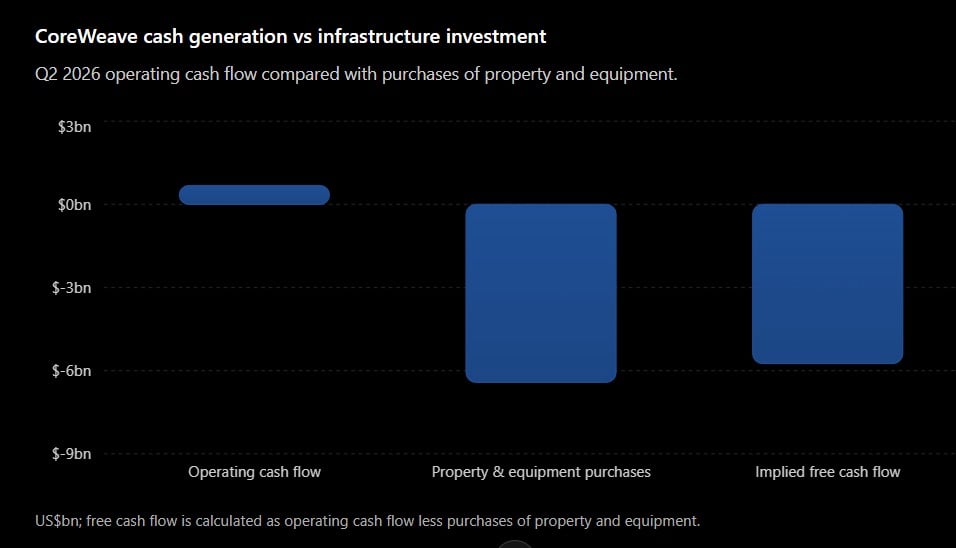
There is an important accounting distinction here: CoreWeave’s management uses a broader capital-expenditure figure of about $9.4bn for Q2, while the cash-flow statement shows $6.42bn of purchases of property and equipment. Investors should therefore avoid mixing the two measures without checking the company’s definition. Reuters reports the $9.4bn management capex figure.
Either way, the conclusion is unchanged:
cash generation is currently dwarfed by investment requirements.
Debt is the other side of the equation
At the end of June, CoreWeave had approximately:
- $5.5bn cash
- $6.9bn cash, cash equivalents and restricted cash
- $25.2bn non-current recourse debt
- $6.2bn current recourse debt
- $2.4bn non-current non-recourse debt
- plus substantial lease liabilities.
During H1, financing provided almost $14bn of net cash, including debt issuance.
That illustrates the model:
raise capital → buy GPUs/build datacentres → activate capacity → recognise revenue → generate operating cash → repeat.
The bull case says this is a temporary funding requirement during an extraordinary infrastructure build-out.
The bear case says CoreWeave is building a highly leveraged business where the next generation of GPUs could make today’s equipment economically obsolete before it has generated sufficient returns.
How does CoreWeave compare with peers?
Direct comparisons are difficult because the businesses are at very different stages.
| Company | Business | Key valuation issue |
| CoreWeave | AI cloud / GPU infrastructure | Huge growth but high debt + capex |
| Nebius | AI cloud infrastructure | Faster expected scaling, much cleaner balance sheet |
| IREN | AI cloud + datacentres | Strong contracted AI growth; smaller scale |
| Applied Digital | AI data-centre infrastructure | Infrastructure opportunity but execution/customer concentration risk |
| Oracle | Hyperscale cloud + enterprise software | Much broader, more diversified cash flows |
CoreWeave’s valuation needs to be judged primarily against future revenue and operating cash flow, rather than today’s earnings.
For perspective, IREN’s (NASDAQ:IREN) enterprise value was about $12.2bn in late July versus CoreWeave’s roughly $69bn at that time, while IREN’s AI Cloud ARR target had recently been raised to more than $4bn.
Nebius (NASDAQ:NBIS) is an especially interesting comparator. Its enterprise value was around $57bn in July, and Morningstar has estimated $11bn of revenue in 2027 and $15bn in 2028.
But CoreWeave is considerably further along in actual revenue generation and contracted customer commitments.
The market is therefore paying a substantial premium for CoreWeave’s scale, backlog and execution — but also accepting substantially greater leverage and capital intensity.
Analyst reaction
The analyst response following the results was broadly constructive, but not universally bullish.
Zacks
Zacks strategist Andrew Rocco described the quarter as:
‘a pivotal one for CoreWeave’
while highlighting the ‘massive contracted backlog’ and its rare multi-year revenue visibility.
JPMorgan
JPMorgan remained more cautious, maintaining a Neutral rating while raising its price target from $105 to $110.
The argument is essentially that the improved results are encouraging but much of the future growth is already reflected in the valuation, while operating margins remain below what some bulls expect.
Deutsche Bank
Deutsche Bank remained bullish and raised its target from $135 to $150, maintaining a Buy rating.
Piper Sandler
Piper Sandler initiated coverage shortly before the results with an Overweight rating and a $151 target, reflecting the bullish view of CoreWeave’s role in the AI infrastructure build-out.
The divergence is revealing: bulls are valuing future AI infrastructure scarcity; bears are valuing the enormous financing required to build it.
Bull vs bear case
| 🐂 Bull case | 🐻 Bear case |
| $104bn backlog provides exceptional visibility | Backlog takes years to convert |
| Another $25bn+ commitments already secured | Customers could renegotiate/cancel |
| AI compute demand remains supply constrained | AI infrastructure spending could eventually slow |
| Pricing power improving | GPU prices/performance can change rapidly |
| Operating leverage is emerging | Depreciation and interest remain enormous |
| Q2 adjusted operating income beat expectations | GAAP operating loss remains |
| Inference could dramatically expand TAM | Competition from AWS, Azure, Google and other neoclouds |
| Nvidia relationship provides strategic advantages | Dependence on Nvidia ecosystem |
| 1.5GW active power, 3.7GW contracted | Enormous power/data-centre requirements |
| Revenue guidance raised | Capex guidance also raised to $35bn-$39bn |
| Potential path to low-teens operating margins | Free cash flow remains deeply negative |
What UK retail investors should watch next
I would focus on five numbers, rather than simply revenue growth.
1. Adjusted operating margin
Q2 reached 5%, versus 1% in Q1.
If CoreWeave reaches the promised low-teens range by Q4, the investment case becomes materially stronger.
2. Free cash flow
This is arguably the most important metric.
The question is not whether CoreWeave can produce $1.5bn of quarterly EBITDA.
It is whether that EBITDA eventually becomes cash available after GPUs, datacentres, interest and other capital requirements.
3. Capex per dollar of incremental revenue
The company is currently spending extraordinary sums to expand capacity.
Investors need to see revenue growth eventually catch up with the infrastructure investment.
4. Backlog conversion
The $104bn number is impressive, but investors should ask:
How quickly is backlog becoming revenue?
Management says more than half is already in delivery, with the proportion expected to exceed two-thirds by year-end.
5. Customer concentration
CoreWeave’s largest customers are enormous technology companies.
That provides financial strength — but also negotiating power for the customer.
Investor verdict
CoreWeave’s Q2 results strengthen the long-term AI infrastructure thesis, but they do not eliminate the biggest risk: capital intensity.
The most bullish aspect of the quarter was not the 112% revenue growth. It was the combination of $104bn backlog + rising pricing power + improving adjusted operating income + evidence of operating leverage.
The most worrying aspect remains the other side of the balance sheet.
CoreWeave is spending tens of billions of dollars a year to build infrastructure, while free cash flow remains deeply negative and interest expense alone reached $640m in Q2.
That makes CoreWeave fundamentally different from a high-margin software AI stock.
For a UK retail investor, it is best to categorise the company as high-growth, high-risk AI infrastructure exposure rather than a conventional cloud investment.
Best AI-focused stocks joining the Nasdaq-100 Next week
AI demand remains supply constrained, backlog converts rapidly, pricing stays strong and operating margins expand faster than depreciation and interest costs. At the same time, AI capital spending eventually normalises, GPU economics deteriorate, customers gain bargaining power and CoreWeave is left carrying tens of billions of dollars of infrastructure debt.
The Q2 evidence favours the bulls for now. But at this stage of the cycle, cash conversion matters more than headline revenue growth.
You might also like: